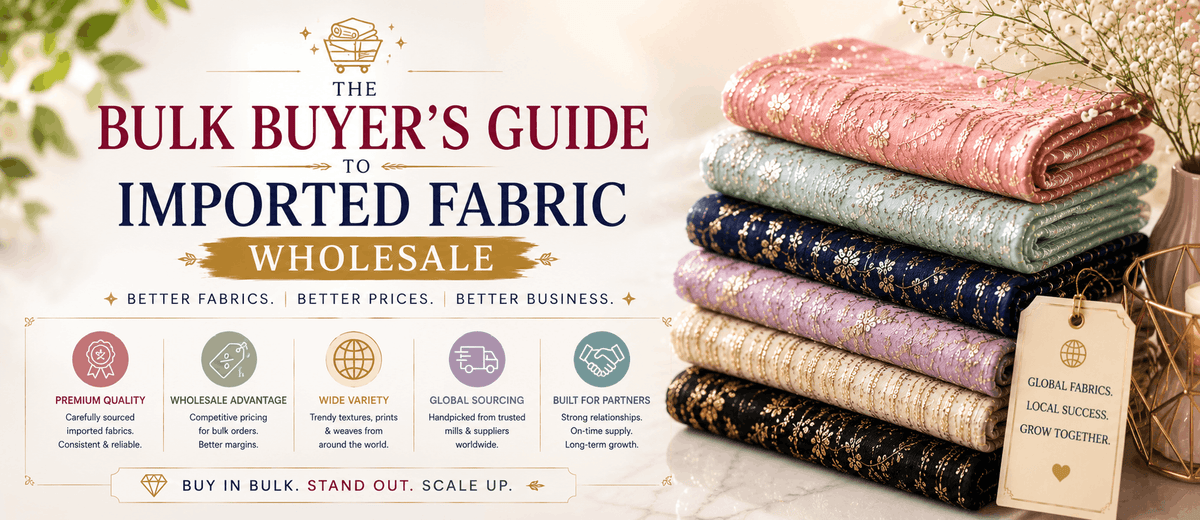
The Bulk Buyer's Guide to Imported Fabric Wholesale
A label owner in Chandni Chowk once launched a bridal capsule on an imported embroidered net. It sold out in eleven days. She came back for a repeat of forty thaans and the answer she got from three different suppliers was the same. That lot was finished. Not out of stock. Finished. There was no second lot anywhere in the market and there never would be. She had built a bestseller on a fabric she could not buy again.
That is the imported fabric trade in one story. The goods are often better constructed and wider than anything domestic at the same rate, but they arrive in closed lots. Buyers who understand that build their season around it. Buyers who do not treat every sell-out as a crisis. Here is what I explain to bulk buyers before they put money into imported stock.
Quick answer: Imported fabric wholesale means buying cloth manufactured outside India at trade rates by the thaan or by the lot. In the ethnic trade it usually means goods from China, Korea, Japan, Turkey or Dubai. The main advantage is width, since imported cloth commonly runs 58 to 60 inches against the domestic 44 inches, which cuts your cost per garment. The main risk is that a finished lot rarely repeats in the same shade.
What the word imported actually means on a Delhi bill
Imported is a sourcing description, not a quality grade and not a fabric type. It tells you the cloth was made outside India. It tells you nothing on its own about fibre, weight or finish. A poor Chinese poly net and a fine Japanese organza both sit under the same word on the same bill.
In practice the trade uses the term in three loose ways. The first is genuine direct import, where the seller or a known importer brought the container in and can show you the lot details. The second is second-hand import, where the goods came through two or three hands in the market before reaching the counter, so origin information is already thin. The third is the loosest usage, where imported simply signals better finishing than the standard domestic line, sometimes on cloth that was actually woven in Surat or Erode.
None of the three is dishonest by itself. What matters is that you know which one you are buying, because they carry completely different reorder profiles. Ask one question at the counter and it separates them cleanly. Ask whether the seller can repeat the lot, then ask within what time. A direct importer gives you a straight answer with a timeline. A third-hand seller does not.
Origin tiers and what each one is actually good at
Origin is worth understanding because it predicts what you are getting far better than the word imported does. This is the working map I use.
| Origin | Typically strong in | Usual width | Reorder behaviour | Delhi trade price (per metre) |
|---|---|---|---|---|
| China | Net, sequins, embroidered bases, volume goods | 58 to 60 inches | Repeatable on plain bases, rarely on worked ones | Rs 120 to Rs 700 |
| Korea | Crepes, satins, soft-finish poly | 58 inches | Usually repeatable with lead time | Rs 180 to Rs 450 |
| Japan | Fine organza, technical finishes | 44 to 58 inches | Small lots, long lead time | Rs 400 to Rs 1200 |
| Turkey | Velvet, jacquard, heavier occasion cloth | 58 to 60 inches | Seasonal, lot-limited | Rs 350 to Rs 900 |
| Dubai re-export | Mixed lots, abaya-weight goods | 58 inches | Almost never repeatable | Rs 200 to Rs 800 |
These bands cover finished goods landed in Delhi this week. Freight and duty move them more than the mill price does, so an identical article can shift ten percent between two consignments. You can see the range of constructions currently running in our imported fabric collection before you commit to a lot.
Why width is the number that decides your real cost
Buyers compare imported and domestic goods on rate per metre and get the answer wrong almost every time. The comparison that matters is cost per garment.
Take a lehenga skirt needing roughly 3.5 metres of 44 inch domestic cloth at Rs 220. That is Rs 770 of fabric. The same skirt on a 58 inch imported cloth needs about 2.6 metres because you get more usable panels across the width. At Rs 280 per metre the imported version costs Rs 728. The imported goods looked 27 percent more expensive on the rate card and came out cheaper in the garment, with less wastage at the cutting table on top.
Wide goods also change your panel layout. On a 58 inch cloth you can often cut a full ghera panel without a join, which removes a seam the customer can see. That single change is worth more at the retail counter than the rate difference. Run the per-garment maths on every imported quote before you reject it on rate.
Five checks before you commit money to an imported lot
- Measure the width yourself, edge to edge. Sellers quote nominal width. A cloth billed at 58 inches that measures 56 changes your panel plan and your costing. Measure before you agree a rate.
- Ask for the total lot quantity in the market. If the answer is vague, assume no repeat and buy your whole season requirement now. This one question prevents the most expensive mistake in imported goods.
- Check the selvedge for markings. Genuine imports usually carry printed selvedge information such as composition, width or a lot code. A blank selvedge on goods sold as direct import deserves a second question.
- Compare two thaans of the same shade in daylight. Imported consignments often mix dye lots inside one shade code. Line up the pieces you are actually taking rather than the sample on the shelf.
- Agree the defect policy before payment. There is no mill to send an imported roll back to. Settle in advance whether shortfall or fault gets replaced, credited or discounted.
Minimum order quantity and how landed cost is built
Imported pricing works differently from domestic pricing because the cost is fixed before the goods reach the counter. The importer has already paid mill price, freight, duty, clearing and warehousing. That means there is less room to move on rate than buyers expect. The room that exists sits in quantity.
| Order tier | Typical quantity | Rate movement | Who it suits |
|---|---|---|---|
| Cut piece | 1 to 6 metres | Retail rate | Designers sampling a construction |
| Small bulk | 1 thaan (about 18 to 25 m) | 5 to 10 percent off retail | Boutiques running one design |
| Trade bulk | 5 to 20 thaans | 10 to 18 percent off retail | Resellers, repeat labels |
| Full lot lift | Entire consignment of one article | Best rate, negotiated per lot | Exporters, labels wanting exclusivity |
The full lot lift is the tier most bulk buyers overlook. If a lot is small enough for your season and the article suits your line, taking the whole consignment gets you the sharpest rate and something more valuable than the discount. Nobody else in your market can stock that article. For a label competing on design rather than price, that exclusivity is often worth more than the twenty percent. Wide occasion goods work particularly well this way, which you can see reflected across our lehenga fabric collection.
Building a production plan around goods you cannot reorder
The habit that makes imported stock profitable is planning backwards from the lot instead of forwards from the design. Decide how many pieces the lot can produce before you finalise the garment, then hold back a reserve of about eight percent for cutting errors, sampling and replacement pieces. Buyers who cut to the last metre end up short by two garments on their best selling design with no way to recover.
Keep a labelled half metre from every imported lot in a file with the date, the rate and the seller. When a customer returns a piece nine months later asking for a matching dupatta, that file is the only thing that will tell you whether a match exists anywhere. It also settles shade disputes with tailors quickly. This takes five minutes per lot and saves entire arguments later.
Common mistakes bulk buyers make with imported fabric
- Comparing rate per metre instead of cost per garment. Wide imported goods often cost less in the finished piece despite a higher rate card.
- Assuming a bestseller can be repeated. Ask about lot size before you launch, not after the stock sells out.
- Treating imported as a quality guarantee. It describes where the cloth was made. Judge fibre, weight and finish exactly as you would on domestic goods.
- Skipping the width measurement. A two inch shortfall against the quoted width can break a panel layout you already costed.
- Paying in full before agreeing the defect terms. There is no mill claim on imported goods. Settle the terms while you still hold the payment.
Questions bulk buyers ask me at the counter
Is imported fabric always better than Indian fabric?
No. Imported describes origin rather than quality. Indian mills lead on cotton, silk, chanderi and most handloom goods. Imported cloth usually leads on width, on fine synthetic finishing and on constructions not woven here. Judge every lot on fibre, weight, finish and width instead of on the label.
Can imported fabric be reordered in the same shade?
Sometimes on plain bases from Korea or China with enough lead time. Rarely on embroidered or worked goods. Almost never on Dubai re-export lots. Ask the seller for the total lot quantity in the market before you launch a design, then buy your full season requirement in one purchase.
What width does imported fabric usually come in?
Most imported ethnic goods run 58 to 60 inches against the common Indian 44 inches. Some Japanese specialty cloth still comes at 44. Always measure edge to edge yourself, because nominal width and actual width differ often enough to matter in a panel layout.
What is the minimum order for imported fabric wholesale?
Trade rates generally start at one thaan of about 18 to 25 metres. The sharper 10 to 18 percent band opens at five thaans. Taking a full consignment of one article gets the best rate along with market exclusivity on that design.
Ready to order imported fabric at trade rates?
If you run a boutique, a label or a reselling line, the fastest way to lock trade pricing is to join the wholesale programme. You get thaan rates, lot quantity disclosed upfront so you can plan a season honestly and first refusal on full consignments. See the tiers and register on our wholesale fabric page to start your first bulk imported fabric order.