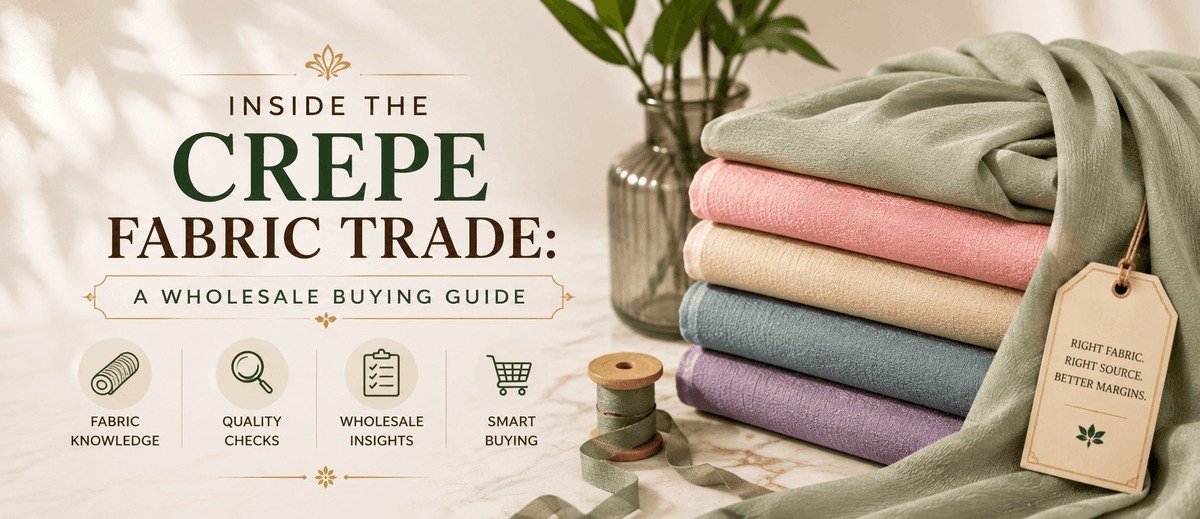
Inside the Crepe Fabric Trade: A Wholesale Buying Guide
Crepe is the fabric that hides its faults until the garment is stitched. Two thaans feel almost the same in the hand on the counter. One falls clean and straight off a hanger. The other twists at the hem the moment your karigar cuts it, because the grain was never stable to begin with.
Twelve years at a Lajpat Nagar counter teaches you to read crepe by its weight and its fall, not by the shade card. Before a first bulk order, three things decide whether a lot earns its money.
- Weight and drape. Too light and the suit needs lining. Too stiff and the gown will not fall.
- Grain stability. A crepe that twists off grain will torque at the seams after the first wash.
- Colour hold. Dark crepe on cheap dye bleeds onto linings plus the customer other clothes.
Get those three right and the styling takes care of itself. This is the working reference I hand new bulk buyers. Not a sales pitch. A guide to buying crepe fabric wholesale the way trade buyers who stay in business actually buy it.
Quick answer: Buying crepe fabric wholesale means purchasing crepe by the thaan or in bulk metres at trade rates. The common bases are bemberg or georgette crepe, moss crepe, heavy crepe and printed american crepe. Delhi trade prices run about Rs 120 to Rs 300 per metre for light poly crepe. Heavy and bemberg crepe runs Rs 300 to Rs 700 per metre. Rates drop as your minimum order quantity rises.
What crepe fabric actually is
Crepe is a fabric with a crimped, pebbled surface. That texture comes from tightly twisted yarn or from the weave itself, not from any print or coating. That is the first thing to explain to a new buyer. The matte, slightly grainy face is the whole point of crepe, so a crepe that looks flat and shiny is usually a weaker imitation.
Almost everything that decides quality lives in two places buyers skip. The weight and the twist. The weight decides the fall and whether a garment needs lining. The twist decides grain stability, which is whether the fabric holds its shape or torques at the seam after a wash.
Hold a length up by one corner and let it drop. Good crepe falls in a clean vertical line. A length that swings to one side is off grain, so hold that thought for the judging section below.
Types of crepe fabric worth stocking at wholesale
This is the table I pull out at the counter. Match the crepe type to what your karigar is actually stitching for the customer.
| Crepe type | Feel and fall | Best garment use | Delhi trade price (per metre) |
|---|---|---|---|
| Light poly crepe | Thin, soft, needs lining | Budget suits, dupattas, linings | Rs 120 to Rs 300 |
| Moss crepe | Fine grain, fluid, good stretch of fall | Gowns, palazzos, flowy kurtis | Rs 220 to Rs 450 |
| Bemberg or georgette crepe | Soft, cool, rich matte drape | Sarees, suits, dupattas | Rs 300 to Rs 700 |
| Heavy or French crepe | Weighted, structured, opaque | Structured suits, blazers, trousers | Rs 350 to Rs 650 |
| Printed american crepe | Medium weight, print holds well | Daily suits, kurtis, co-ord sets | Rs 180 to Rs 400 |
Prices above reflect Delhi wholesale rates as of this week for standard widths of 44 to 58 inches. Crepe rates move with yarn cost rather than season, so treat them as a working band rather than a fixed number. You can match a shade against live running stock in our crepe fabric collection before you lock an order.
How to judge crepe fabric before you commit a thaan
A crepe thaan is a real commitment because off grain or bleeding stock cannot be re-sold. Run these five checks first.
- Weight and drape. Hold a length off the counter edge. It should fall soft without collapsing into nothing. Too light and every suit needs a lining, which adds cost your customer will feel.
- Grain twist. Drop a length by one corner. A clean vertical fall means stable grain. A length that pulls sideways will torque at the seam and twist the side of a stitched kurti after one wash.
- Transparency. Hold the fabric over your hand. Light crepe often needs lining, so factor that into the rate before you call it cheap.
- Colour bleed. Rub a damp white cloth over dark shades. Crepe on cheap dye bleeds worst on black, maroon and navy. Catch it at the counter, never after delivery.
- Recovery. Scrunch a corner in your fist for ten seconds and release. Good crepe relaxes back clean. Cheap crepe holds the crush lines, which show on every packed and shipped garment.
Drape and stitching, why crepe rewards a careful karigar
Here is the thing that separates a trade buyer from a beginner. Crepe is a drape fabric, so its whole value is in how it falls on the body. A stable crepe cut on grain hangs clean and reads costlier than it is. An off grain crepe fights the karigar at every seam.
Two habits protect a crepe order at the table. First, tell your karigar to cut on grain and to hang finished panels overnight before final stitching so any drop settles. Second, plan a fine needle and a light hand, because a heavy needle leaves holes in soft crepe that never close. Pass those two notes with the stock and your return rate drops on its own.
Minimum order quantity, pricing bands and boutique margin
Every new bulk buyer asks the same question. Where does the rate break. Here is the honest structure most Delhi suppliers work with, ours included.
| Order tier | Typical quantity | Rate movement | Who it suits |
|---|---|---|---|
| Sample cut | 1 to 5 metres | Retail rate | First time buyers testing drape and bleed |
| Small bulk | 1 thaan (about 40 to 50 m) | 5 to 10 percent off retail | Boutiques running one suit line |
| Trade bulk | 5 to 20 thaans | 12 to 20 percent off retail | Resellers, repeat daily wear labels |
| Manufacturer lot | 50 thaans and above | Mill linked rate on request | Exporters, large labels |
One habit protects your crepe margin more than any bargaining. Pool your shades into one order. Ten buyers each taking one thaan of different colours still count as one trade lot at the counter, so everyone holds the discount.
This is the whole reason a wholesale community works. Fifteen boutiques buying together reach a rate none of them would touch alone.
Where crepe earns its keep in a boutique line
Crepe is a year round earner, which is exactly what makes it valuable. It is not tied to one season the way velvet or heavy brocade is, so it keeps your shelf turning between wedding rushes.
If you build occasion wear, keep bemberg and moss crepe as your hero stock for sarees, gowns and fluid suits. Our saree fabric range shows the crepe drapes boutiques order most for daily and party sarees. For everyday labels, printed american crepe is the quiet earner because it stitches into suits, kurtis and co-ord sets that repeat all year.
Light poly crepe has its place too, but treat it as a volume base for budget suits and linings rather than a hero fabric. It sells on price, so keep it separate from your bemberg stock in both storage and billing.
Common mistakes bulk buyers make with crepe fabric
- Ignoring grain twist. An off grain crepe torques at the seam and twists a finished kurti. Drop test every roll before you buy.
- Skipping the bleed test. Dark crepe on weak dye ruins linings and the customer other clothes. Test every deep shade before you scale.
- Buying the thinnest crepe to save money. A see through crepe looks cheap per metre then needs lining on every garment, which erases the saving.
- Confusing poly crepe with bemberg. They look similar on the roll but fall and price very differently. Feel the weight and the drape, never the shade card alone.
- Over ordering seasonal prints. Printed crepe dates fast. Buy prints to real orders and keep plain crepe as your safer running base.
Storing crepe stock without crease lines
Crepe holds fold marks and picks up damp, so a few storage habits keep your stock sale ready.
- Store crepe rolled, never folded tight, so no permanent crease line sets across a length.
- Keep rolls off a damp floor because crepe picks up moisture and a musty roll loses a sale on smell alone.
- Do not stack heavy thaans on soft crepe, since the weight sets a flat line into the drape.
- Keep dark shades away from direct sun, because strong light fades deep crepe colours over weeks on an open shelf.
Questions bulk buyers ask me at the counter
What is the minimum order for crepe fabric wholesale?
Trade rates usually begin at one full thaan, which for crepe often runs 40 to 50 metres. Below that you pay close to retail. To reach the sharper 12 to 20 percent trade discount you generally need five thaans or more, which is where pooling shades across buyers helps.
Which crepe is best for sarees and gowns?
Bemberg or moss crepe for both because they fall soft and fluid without needing heavy lining. Keep heavy or French crepe for structured suits and trousers where you want the fabric to hold its shape rather than flow.
How do I stop crepe from twisting after stitching?
Buy on grain stock in the first place by drop testing each roll. Then tell your karigar to cut on grain and hang the panels overnight before final stitching so any drop settles before the seams are closed.
Is light poly crepe worth stocking?
Yes as a volume base, not as a hero fabric. Light poly crepe suits budget suits, dupattas and linings where price leads the sale. Just remember most of it needs lining, so price that in before you compare it with a heavier crepe.
Ready to order crepe fabric at trade rates?
If you run a boutique, a daily wear label or a reselling line, the fastest way to lock trade pricing is to join the wholesale programme. You get thaan rates, shade booking and colour pooling with other buyers. See the tiers and register on our wholesale fabric page to start your first bulk crepe order.