Dyeable Jacquard Fabric Wholesale: The Motif Will Not Match The Ground
A boutique owner from Karol Bagh brought back nine metres last October and asked me what had gone wrong at the dyer. Her jacquard had come out of the bath in the rose shade she asked for, but the woven booti was sitting a clear step lighter than the cloth around it. She thought the dyer had rushed the bath.
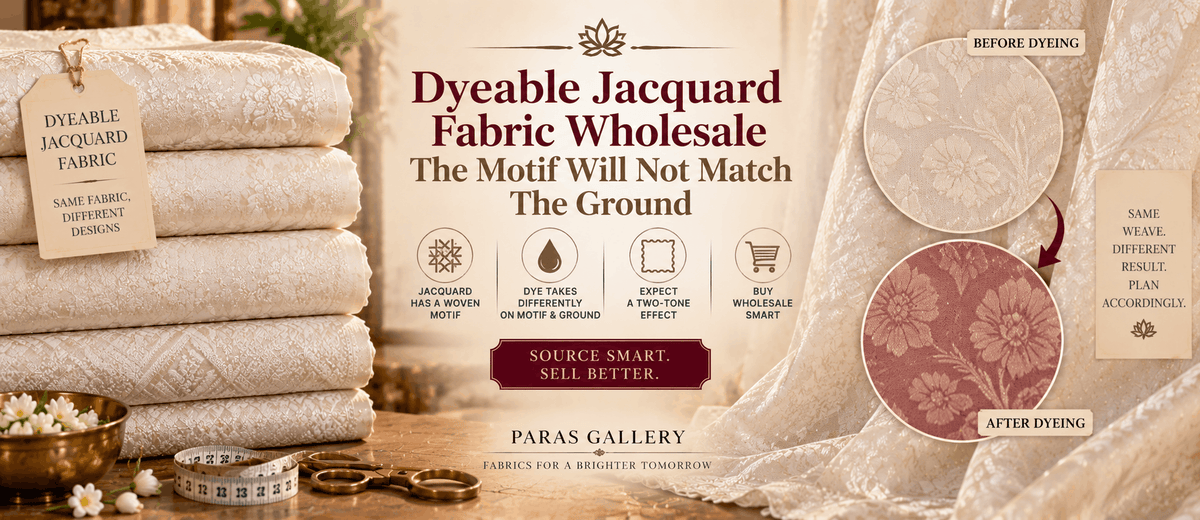
He had not. That gap between the motif and the ground is what a dyeable jacquard does, every single time, plus it is the reason anybody buys one instead of a plain dyeable. Nobody had told her, so she had sold it as a fault.
Quick answer: A jacquard holds a tight ground plus a loose float, so one bath gives you two depths of the same colour. Treat tone on tone as the specification, not a defect. Confirm the fibre of both yarns before you book, because a mixed cloth will split into a hard two tone. Dye a full width trial through the production route rather than a lab dip. Do not promise a customer an exact reorder shade. Delhi trade rates run roughly Rs 180 to Rs 900 per metre.
One cloth, two surfaces, one bath
Everything that follows comes from a single fact about how the cloth is built. The loom does not print or lay the design on. It lifts individual warp ends to let weft float across the surface, so the motif is made of yarn that spends more of its length lying loose on top of the cloth instead of being locked into the weave.
That loose yarn has more of itself exposed to the liquor when the piece goes into the bath. It is also under less tension, so it swells more freely and holds dye longer before it releases. The ground weave, packed tight, does the opposite. Same yarn, same dyestuff, same forty minutes, two different results.
Which way the difference runs is worth knowing at the counter. On most viscose and cotton jacquards, the raised float comes out deeper than the ground because it takes up more liquor. On a polyester filament float over a spun ground, it usually comes out lighter, since the filament has less surface to grab with. Ask a supplier which way their quality behaves. If they cannot tell you, they have not dyed it themselves, plus you are the one carrying the risk. The running qualities in our undyed jacquard yardage are listed with the ground and float fibres stated separately for exactly this reason.
Contrast is a ratio, plus it moves with the shade you choose
Here is the part that catches out even experienced buyers. The difference between motif and ground is not a fixed thing you can measure once and file away. It is a ratio, plus it behaves differently at different depths.
Dye the same greige lot a pale blush and the motif reads clearly, because a small absolute difference is a large proportion of a light shade. Dye it a deep maroon and the same cloth looks nearly flat, since the extra dye the float held is a tiny fraction of what is already there. Two boutiques dyeing from one thaan can end up with what looks like two entirely different fabrics.
Use this rather than fight it. If you want the weave to be the design, keep to pastels, ivories, powder shades plus the mid tones. If you want a rich flat colour where the motif only shows when light catches it, go deep. Decide that before you commit the bath, because you cannot correct it afterwards without stripping the cloth. Stripping a jacquard flattens the float permanently.
The blend that turns tone on tone into two tone
A soft tonal difference is what you are buying. A hard split, where the motif stays cream while the ground goes emerald, is a different thing entirely and it is almost always a fibre problem.
Plenty of trade jacquard is not one fibre. A viscose or cotton ground carrying a polyester float is common, because polyester holds a crisp raised motif more cheaply. Viscose takes a reactive or direct dye. Polyester needs a disperse dye at high temperature. Send a mixed cloth through one bath and only one of the two yarns colours. The other stays close to its greige tone.
Some designers want precisely that. It is a legitimate look and it sells. What is not acceptable is discovering it after you have dyed forty metres. So ask two questions at the counter and get both answers written on the quotation: what is the ground yarn, plus what is the float yarn. If the reply is a vague "mixed" or "fancy", pull half a metre and burn a few threads from each part separately. Cellulose burns to a soft grey ash and smells of paper. Polyester melts to a hard bead and smells chemical. It takes two minutes plus it settles the argument before money moves.
Why the finished cloth can come back rippled
The second consequence of two structures in one cloth is mechanical rather than colour related. Wet yarn swells then shrinks as it dries, plus the tightly bound ground has almost nowhere to go while the float has slack to lose.
On a well built jacquard the difference is small enough that the finishing range pulls it out. On a loosely woven one it is not, plus the cloth comes back with a fine seersucker ripple running across the motif areas. It looks like a finishing fault. It is actually a weave fault that the bath revealed.
You cannot see this in the greige. That is the whole difficulty. Undyed jacquard on the counter looks calm and flat, since nothing has been through water yet. The only reliable way to find it is to dye a trial, which brings us to the rule that saves the most money in this category.
Dyeable jacquard qualities plus Delhi trade rates
| Quality | Ground and float | Typical tone on tone result | Best garment use | Delhi trade price (per metre) |
|---|---|---|---|---|
| Polyester dyeable jacquard | Poly ground, poly float | Slight, motif reads lighter | Volume kurtis, uniform lines, budget dupattas | Rs 180 to Rs 260 |
| Viscose dyeable jacquard | Viscose ground, viscose float | Clear, motif reads deeper | Suit tops, festive kurtas, jacket sets | Rs 290 to Rs 430 |
| Cotton dyeable jacquard | Cotton ground, cotton float | Moderate, softens after wash | Daywear suits, summer kurtas, jackets | Rs 320 to Rs 480 |
| Union jacquard (mixed fibre) | Viscose ground, poly float | Hard two tone by design | Statement panels, contrast yokes, borders | Rs 340 to Rs 560 |
| Viscose silk blend jacquard | Blended ground, blended float | Deep, with surface sheen shift | Bridal blouses, occasion lehenga panels | Rs 620 to Rs 900 |
The row that costs boutiques money is the fourth. Union jacquard is often quoted alongside viscose quality at a similar rate, because from a metre away in the greige they look the same cloth. They are not, plus the buyer who does not ask finds out in the dyehouse. If you want to compare a dyeable quality against what a mill has already finished, our full jacquard range across fibres shows the same weave structures in ready shades.
A full width trial, not a lab dip
Every dyer will offer you a lab dip. On a plain cloth that is fine. On a jacquard it is close to useless, for two reasons.
First, a lab dip is a small swatch dyed in a beaker with a bath ratio nothing like a production machine. The whole tone on tone effect depends on liquor movement around a raised surface, so a beaker exaggerates it and a jet machine will not repeat what you saw. Second, a swatch is not full width. Jacquard shows selvedge to centre drift more than plain cloth does, because the loom tension varies across the reed plus the float density is rarely identical at the edges. A metre of full width tells you things a ten centimetre square never will.
So make the trial a real one. Take one full width metre off the actual thaan you are booking, send it through the same machine, same recipe, same finishing route as the bulk will take. Then look at it dry, in daylight, folded so the motif at the selvedge sits next to the motif at the centre. Check three things: is the contrast where you want it, is the ripple absent, is the edge to centre shade steady. Sign off on that piece, keep it, plus staple a corner of it to the order copy. When a dispute comes six weeks later, that stapled corner is the whole argument.
Order tiers plus who carries the bath minimum
| Tier | Typical quantity | Rate movement | Who it suits |
|---|---|---|---|
| Trial length | 1 m full width, off the booking thaan | Greige rate plus dye charge | Settling contrast, ripple plus edge drift |
| Single thaan | About 25 to 30 m | 5 to 9 percent off retail | Boutiques dyeing one shade for one line |
| Bath sized lot | 4 to 6 thaans in one colour | 11 to 16 percent off retail | Resellers who want no shade break mid line |
| Greige booking | 20 thaans and above, dyed in stages | Greige rate held across the season | Labels running colour to order through a season |
The third row exists because of one number most buyers never ask about, which is the dyehouse minimum. A machine has a working load, so anything under it gets charged as if it were full. Dyeing one thaan and dyeing four often costs almost the same in bath charges, which quietly changes your per metre cost by more than any discount you negotiated on the greige. Ask your dyer for their minimum load in kilos, convert it to metres for the quality you are buying, plus size your colour lots to it.
The fourth row is the one that suits a growing label. You book the greige, which is the part that runs out, then draw it down and dye in batches as orders land. It fixes your cloth cost early plus keeps your colour decisions late, which is the right way round.
What to settle before a dyeable jacquard booking
- Get the ground fibre plus the float fibre written separately. One word like mixed is not an answer, it is a future dispute.
- Ask which way the motif goes. Deeper or lighter than the ground changes how you shade the whole line.
- Choose the depth for the effect you want. Pale shows the weave, deep hides it, plus you only get one attempt.
- Dye one full width metre off the booking thaan. A lab dip cannot show ripple or edge to centre drift.
- Size the colour lot to the dyehouse minimum load. Bath charges move your metre cost more than the greige discount does.
- Tell the customer a reorder is a near match. Contrast shifts with depth, so exact repetition is not on offer.
Dyeable jacquard questions that come up at the counter
Can I get a dyeable jacquard to come out one flat colour?
Not properly, no, plus chasing it usually makes the cloth worse. The tonal difference comes from structure rather than from the dye recipe, so no amount of levelling agent removes it. A dyer can compress it by going deeper, which is the honest route, or by over-running the bath, which flattens the float and costs you the raised hand you paid for in the first place. If your design needs a genuinely flat surface, you are buying the wrong cloth and a plain dyeable or a piece dyed satin will serve you better. The better commercial move is to sell the tone on tone as the point of difference, since it is what a printed motif cannot imitate plus it is visible in a shop window from several feet away.
My reorder came back looking different from the first lot. Is that a supplier fault?
Usually not, plus it is worth understanding why before you raise it. Three things stack up on a jacquard reorder. The greige may be from a different loom beam with slightly different float tension. The bath will be a fresh recipe hitting a fresh substrate, so the ground can land within tolerance while the float lands outside it. And the contrast ratio between the two shifts with depth, so a shade half a step deeper compresses the motif noticeably. On a plain dyeable, only the first two apply and the eye forgives them. On a jacquard all three compound. Protect yourself by booking one greige lot for the whole season and dyeing in staged batches from it, which removes the loom variable completely.
Is dyeable jacquard cheaper than buying it already dyed?
On the metre rate yes, on the landed cost it depends entirely on your volume. Greige runs lower because the mill has skipped dyeing plus finishing, but you then carry the bath charge, the dyehouse minimum load, transport both ways plus your own trial length. Below about three or four thaans in a single shade that arithmetic goes against you and a ready dyed thaan is simply cheaper. Above it, the position flips and keeps improving, because bath charges are largely fixed per load rather than per metre. The real gain is not price anyway, it is control. You get exactly the shade your line needs instead of the nearest thing a mill happened to make, plus you can hold stock uncommitted until an order tells you what colour it should be.
Should dyeable jacquard be pre-shrunk before the design goes on?
If anything is going to be applied to it, yes, without exception. Embroidery, sequin work, lace or a printed border laid on greige jacquard will pucker after the bath, because the ground and the float shrink by different amounts while the applied work shrinks by none. Send the cloth through dyeing plus finishing first, let it settle for a day, then send it to the karigar. It costs you a step in sequence and nothing in money. The same logic applies to cutting: do not cut panels from greige jacquard on the assumption you will dye the cut pieces, since the cut edges distort in the bath plus your panels come back the wrong size. Dye the yardage, then cut.
Booking dyeable jacquard at trade rates
If you run a boutique, a label or a reselling line, the working route to trade pricing on dyeable jacquard is the wholesale programme. You get thaan rates on greige, ground and float fibres stated on the quotation rather than left to a sample, a full width trial metre released off your actual booking thaan, colour lots sized to a real dyehouse load so you are not paying for empty machine, greige held across a season so a staged reorder comes off one loom beam, plus a signed trial corner kept on file against every order. See the tiers and register on our trade fabric buying page to open your first bulk dyeable jacquard order.