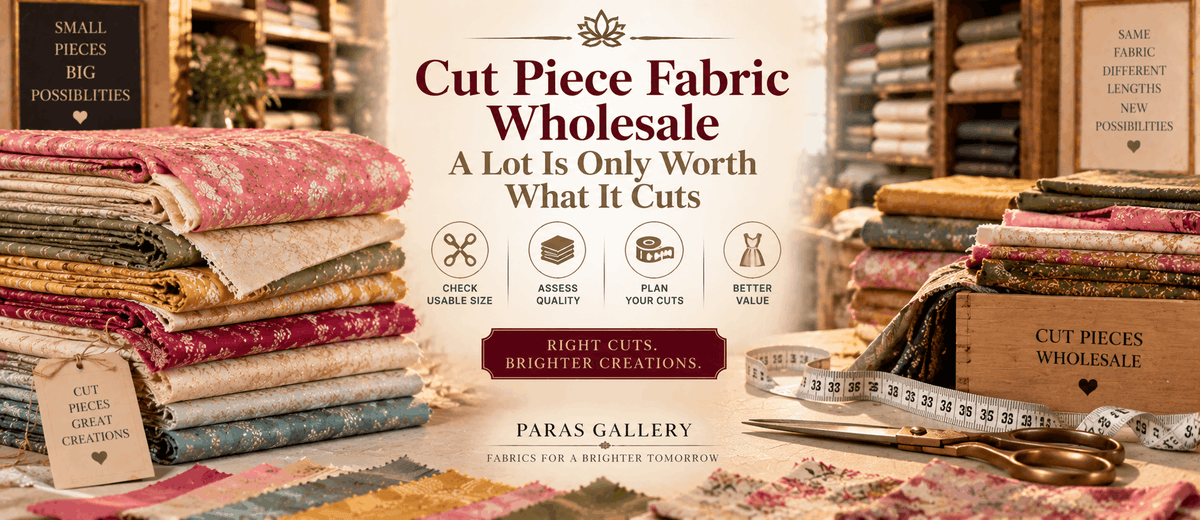
Cut Piece Fabric Wholesale: A Lot Is Only Worth What It Cuts
A reseller from Gandhi Nagar bought a hundred and forty metres of mixed cut piece last winter at a rate he was very pleased with. He rang me three weeks later because he had cut fifty one garments out of it and could not work out where the rest had gone.
Nothing had gone anywhere. It was sitting in his godown in lengths of one point eight and two point three metres, all of it perfectly good cloth, none of it long enough for the kurta he wanted plus too long to be worth cutting as a blouse. He had bought metres. He needed garments. Those are not the same purchase.
Quick answer: Sort any cut piece lot into length bands before you talk rate, because your real cost is per usable garment rather than per metre. Anything falling between two bands is dead length you paid for. Ask which of the four sources the lot came from. Check shade across pieces under one lamp, since they come from different thaans. Accept that no lot can be reordered. Delhi trade rates run roughly Rs 90 to Rs 520 per metre.
Four different things arrive under one name
Ask a supplier what the lot is and you will often get one word back. Cut piece. That word is covering four separate products with four different risk profiles, so make the distinction yourself.
The thaan tail is the commonest. A roll runs down until the remainder is too short to sell as yardage, so it comes off and joins a pile. This is sound cloth from the middle of a good run, plus it is the best value in the category. The sample or approval length is the next. A buyer asked for two metres to show a client, the order did not happen, plus the cloth came back. Also sound, usually pressed and handled but rarely damaged.
The fault cut is where care is needed. A weaver or printer finds a defect, the mill removes a length around it, plus what remains either has the fault trimmed away or still has it sitting somewhere in the piece. Both get sold. Only one is worth your money. The fourth is deliberate short cutting for retail counters, where a mill or a wholesaler cuts a thaan down into blouse and dupatta lengths on purpose. That one carries the highest rate, because it is planned stock rather than a byproduct, plus the lengths are consistent.
Get the source stated. It changes what you should pay by a wide margin plus it tells you where to look during inspection. The sorted lots in our short length fabric stock are listed with the length carried on each piece rather than as a bulk weight, which is the format that lets you do the arithmetic below.
Metreage is the number on the bill, yield is the number that pays you
On thaan goods, metres and garments are close to interchangeable. You buy thirty metres, you cut ten kurtas, the leftover is a small tail. On cut piece it breaks down completely, because each piece is a hard boundary. You cannot join two pieces to make a longer one.
So the only honest way to value a lot is to work out what it will actually cut. Take the pieces, sort them into length bands, count the bands, then multiply each by what that band yields on the width you have. A 1.4 metre piece at 44 inch width is a blouse. The same 1.4 metres at 58 inch is a blouse plus a matching sleeve set, or a blouse plus a yoke. Width changes yield as much as length does, which is why a lot quoted purely in metres tells you almost nothing.
Do this before the rate conversation rather than after. It takes twenty minutes on a hundred piece lot with a tape and a pencil. What it gives you is a per garment cost you can compare against yardage, which is the only comparison that means anything to your margin.
Length bands, what each one cuts plus where the dead length hides
| Length band | What it cuts at 44 inch | What it cuts at 58 inch | Dead length risk |
|---|---|---|---|
| Under 0.7 m | Yokes, patches, pockets, borders | Yokes, sleeve pairs, contrast panels | Low, if you run a trims line |
| 0.9 to 1.2 m | Blouse piece | Blouse plus sleeves | Low, the strongest band commercially |
| 1.6 to 2.0 m | Blouse only, remainder wasted | Short kurti | High at narrow width, this is the trap band |
| 2.4 to 2.8 m | Kurta | Kurta plus a yoke or pocket set | Low |
| 3.2 to 4.0 m | Suit top plus dupatta panel | Full suit set, or a saree fall run | Low, but rare in tail lots |
The middle row is where money quietly disappears. On a 44 inch cloth, one point nine metres cuts a blouse plus leaves you three quarters of a metre of nothing. You paid for one point nine. You used one point one. Unsorted lots are usually heavy in that band precisely because it is the length nobody else wanted either. Count that band separately plus price it as though it were a blouse piece, since that is all it is.
Cut piece lot types plus Delhi trade rates
| Lot type | Typical source | Length consistency | Best commercial use | Delhi trade price (per metre) |
|---|---|---|---|---|
| Mixed unsorted lot | Godown clearance, assorted tails | None, sold by weight | Trims, patchwork lines, tailoring school stock | Rs 90 to Rs 150 |
| Sorted plain cut piece | Thaan tails, banded by length | Good within a band | Blouse counters, linings, sampling | Rs 160 to Rs 240 |
| Sorted printed cut piece | Print run tails, approval lengths | Good, but design repeats vary | One-off kurti lines, kids wear, dupatta pairs | Rs 190 to Rs 320 |
| Deliberate retail cut | Thaan cut down on purpose | Uniform by design | Counter stock a boutique resells as is | Rs 240 to Rs 380 |
| Sorted embroidered cut piece | Work run tails, panel offcuts | Variable, placement dependent | Blouses, yokes, contrast panels on plain kurtas | Rs 300 to Rs 520 |
The first row looks like the bargain plus almost never is, unless you genuinely run a trims or patchwork line. Weight priced lots hide their length distribution completely, so you are buying blind on the only variable that matters. If a supplier will not let you band a sample of fifty pieces before you commit, that is the answer to the question you were about to ask.
Shade drifts inside a lot in a way it never does on a thaan
A thaan is one dye batch, so any shade variation inside it is a fault. A cut piece lot is the opposite. Its pieces came off different thaans, dyed on different days, possibly in different months. A step in shade between two pieces is normal and it is not a complaint.
What it does mean is that you cannot plan a garment across two pieces. Sleeves from one, body from another, plus the customer sees it in daylight even when you did not see it under a shop tube. This bites hardest on pale shades plus on anything with a sheen, since both show a half step that a dark matte cloth would swallow.
Handle it at inspection rather than at cutting. Take the lot outside or under a single north facing window, stack the pieces of each colour together, then pull anything that reads off. Group what remains into shade families and label them on the piece itself with tailor's chalk. It is ten minutes of work plus it turns an unusable pile into a sortable one. Blouse work is the natural home for this cloth because a blouse is cut from one piece, which is why our blouse length fabric range and the cut piece stock feed each other.
What a fault cut promises plus what it does not
When a mill removes a defect it takes out a length around it, so what is sold on is usually clean. Usually. The word doing the work in that sentence is worth a direct question at the counter: has the fault been trimmed out of these pieces, or are these the pieces containing it.
Both answers are legitimate trade. A piece with a known slub or a print misregistration in the middle is still useful for a yoke or a blouse cut around it, plus it should carry a rate that reflects that. What is not acceptable is a lot sold as clean cloth that turns out to be the defect pile. Check by unrolling a sample of pieces fully on a table rather than eyeballing the outside of a folded stack, since a folded piece hides its middle by design.
Then write the answer on your purchase copy. Not because a supplier will renege, but because six weeks later neither of you will remember, plus a written line settles it in a sentence instead of an afternoon.
Order tiers plus what sorting is worth paying for
| Tier | Typical quantity | Rate movement | Who it suits |
|---|---|---|---|
| Banding sample | 40 to 50 pieces off the lot | Retail rate | Measuring the length distribution before you commit |
| Single sorted lot | About 80 to 120 m across bands | 7 to 11 percent off retail | Boutiques running a blouse or yoke counter |
| Band specific lot | One band only, 150 m and up | 10 to 15 percent off retail | Resellers cutting one garment type repeatedly |
| Standing tail offtake | Monthly, whatever the season produces | Best available, first refusal | Labels with a permanent one-off line |
Band specific buying is the tier most boutiques should be on plus almost none are. If your counter sells blouses, buy the blouse band and nothing else. You will pay more per metre than a mixed lot and considerably less per garment, which is the number your margin is actually made of.
The last tier is a relationship rather than an order. Tails arrive when they arrive, so a buyer who takes them consistently gets shown them first plus gets the sound ones rather than the picked-over remainder. That is worth more over a year than any discount you could negotiate on a single lot.
What to settle before a cut piece lot booking
- Band fifty pieces with a tape before you discuss rate. The length distribution is the entire value of the lot.
- Ask which of the four sources it is. Thaan tail, approval length, fault cut plus deliberate retail cut are four different purchases.
- Convert to cost per garment, not cost per metre. Compare that figure against yardage before deciding anything.
- Get fault status in writing. Trimmed out or still present changes the rate plus changes how you cut.
- Sort by shade under one light source on arrival. Pieces come from different thaans, so a step is normal rather than a defect.
- Never promise a customer a repeat. A cut piece lot is by definition unrepeatable, so sell it as a one-off.
Cut piece questions that come up at the counter
Is cut piece fabric second quality?
Mostly no, though the category does contain some. The bulk of what moves as cut piece is the tail of a good thaan, cloth identical to what was sold as yardage the previous week, off the roll simply because the remainder was too short to sell as a roll. Approval lengths are the same story. The portion that genuinely is second quality is the fault cut, plus even then the cloth around the defect is sound. What makes the category feel like seconds is that unsorted lots mix all of it together, so a buyer gets one bad piece and revises their opinion of the whole pile. Buy sorted, ask about fault status plus inspect a sample properly and you are buying first quality cloth at a discount that exists purely because of its length.
Should I buy cut piece by weight or by metre?
By metre if you have any choice, because weight tells you nothing about the one variable that decides your yield. Two lots of the same weight can contain wildly different length distributions, plus the lighter cloth will always look like the better deal per kilo while cutting fewer garments. Weight pricing also punishes you on heavier fabrics, where a kilo of velvet or brocade is very few metres. Where weight buying does work is for genuine trims stock, patchwork lines or tailoring school supply, since none of those care about piece length. If a supplier will only sell by weight, insist on banding a sample first plus convert their kilo rate into your own metre rate before you agree to anything.
Can I reorder a cut piece design that sold well?
Not as cut piece, plus this is the constraint that shapes how the category should be used. Each lot is a one time accumulation of whatever tails existed, so it cannot be produced again. Sometimes the underlying design is still running as yardage and you can buy a thaan of it, which is worth asking about the moment something sells fast. More often the design has been discontinued, which is precisely why its tails were released. Plan around it instead of fighting it. Cut piece belongs in the part of your line where uniqueness is the selling point, so a customer hears one of a kind rather than out of stock. The lines that get hurt are the ones where a shop promised a repeat it was never in a position to make.
How much cut piece stock should a boutique carry?
Enough to fill a defined counter plus not one piece more, because cut piece is the easiest stock in a shop to accumulate and the hardest to clear. Work backwards from what it feeds. If you sell roughly twenty blouses a month, a blouse band lot of around sixty pieces is a three month position, which is sensible. What goes wrong is buying attractive lots with no home in the line, since each one is unrepeatable and therefore cannot be built into anything. A practical discipline is to allow cut piece a fixed share of your fabric spend, review the pile every quarter plus move anything older than two seasons into a bundled offer while it still looks current. Stock that ages in this category does not simply sit, it dates.
Booking cut piece lots at trade rates
If you run a boutique, a label or a reselling line, the working route to trade pricing on cut piece is the wholesale programme. You get lots banded by length before dispatch rather than sold as an undifferentiated pile, the source of each lot stated on the quotation, fault status confirmed in writing, a banding sample released before you commit to the full lot, band specific buying so a blouse counter is not paying for kurta lengths it will never cut, plus first refusal on tails as they come off the rolls through a season. See the tiers and register on our bulk buying and registration page to open your first sorted cut piece order.