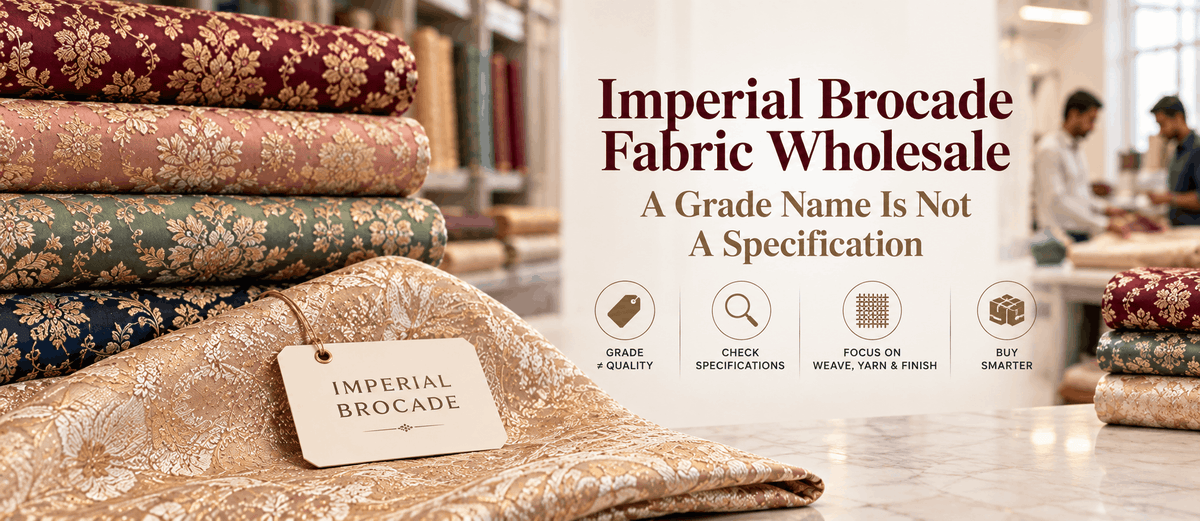
Imperial Brocade Fabric Wholesale: A Grade Name Is Not A Specification
A boutique owner from Karol Bagh brought back four metres last February and put it on my counter next to the piece she had bought from us in November. Same design. Same supplier code on her copy. Same word on both bills. Imperial brocade.
One was three inches narrower across the woven field. The other carried an extra colour in the motif that she had not asked to lose. Nobody had cheated her. She had ordered a word. A word is not a thing you can hold anyone to.
Quick answer: Imperial is a trade grade, not a fibre or a weave, so nothing about the word is standardised. Write the specification yourself in four lines on the order copy: usable width inside the selvedge, weft colour count, repeat length in inches plus ground weight band. Match the repeat before you cost the metres, since panel matching on a large repeat eats cloth nobody quoted for. Delhi trade rates run roughly Rs 340 to Rs 1,450 per metre.
Imperial is a grade name, not a fibre or a place
Brocade tells you how the cloth was made. A supplementary weft rides above the ground and forms the motif. That much is a fact about construction and it is checkable. Imperial tells you nothing of the kind. It is a marketing tier that grew up inside the trade to mean the heavier, wider, more richly woven end of the range. It stuck because it sells.
There is no council issuing it, no minimum specification behind it plus no penalty for using it loosely. A mill running a modest two colour design on a light poly ground can call it imperial with a clear conscience, because the word only ever meant better than our other one. Which it may well be.
So stop treating the term as information. Treat it as a shelf, then ask what is actually on the shelf. Everything below is how you do that in about six minutes at a counter.
The four lines that turn a grade name into a specification
These four go on the purchase copy in writing. Not because anyone is dishonest, but because six months later the person who took your order has moved on plus the loom has been reset. A written line survives both.
| Spec line | How to take it | Why it decides your cost |
|---|---|---|
| Usable width | Tape across the woven field only, inside both selvedges, not the number on the bill | Decides how many panels nest side by side. Two inches lost is often a whole kali |
| Weft colour count | Pick one motif, count separate colours inside it with a pin tip, ignore shading | Colours are loom time. This is the honest driver of rate, not the design name |
| Repeat length | Mark one motif point, run the tape down until the same point returns, note it in inches | Sets your matching wastage. The single most underquoted number in the category |
| Ground weight band | Ask for the band in writing, then sanity check by hand against a sample you already own | Same motif on a light ground and a heavy one give two different garments |
Take those four once, on the first thaan you like, then keep them. They become your house definition of imperial and every future quotation gets measured against them rather than against a memory. The wide woven brocade range is listed with width stated separately from design, which is the format that lets you do this without opening a roll.
Why the repeat decides your cost per garment more than the rate does
Imperial designs are drawn for big surfaces. Lehenga skirts, sherwani fronts, panelled jackets. That means large repeats, often two to three times what you would see on an ordinary mill brocade, plus a large repeat has a consequence that never appears on a rate card.
If two panels sit next to each other in a finished garment and the motif does not line up across the seam, the eye finds it immediately. So the cutter has to position each panel at the same point in the repeat, which means skipping cloth between panels. That skipped cloth is paid for plus never worn.
The arithmetic is simple enough to do standing at a counter. Take the repeat length, take the number of panels that must match, then allow up to one repeat of skip between each matched pair. On a twelve panel lehenga skirt with a 24 inch repeat you can be adding around a metre and a half over what an unmatched layout would have needed. On a blouse with a centre front match plus two sleeves you are adding far less, which is precisely why blouse cutting is where a big repeat imperial quality is most economical.
Do this before you compare two suppliers on rate. A cloth at a higher rate with a small repeat can finish cheaper per garment than a keener rate on a large repeat, plus the rate card will never tell you so.
Counter checks that separate a real imperial quality from a dressed up mill brocade
Four checks, none needing equipment, all doable while the thaan is still on the counter.
The selvedge walk. Open a metre flat plus run the tape across the woven field between the two selvedge edges, ignoring the plain woven border strips. Compare that figure to the billed width. On genuine wide imperial goods the loss is small. Where a 60 inch bill turns into a 55 inch usable field, your panel maths changes and nobody told you.
The pin colour count. Choose the busiest motif on the cloth. Slide a pin tip under each visibly separate coloured weft in turn plus count. Two is common. Four or five means a meena quality with real loom time in it. This one number explains most of the rate gap between two pieces that look similar from a metre away.
The fold and match. Fold the length back on itself so two faces meet, then slide until the motifs line up. Note how far you had to slide. That is your repeat, measured in the same motion, plus you learn immediately whether the design is symmetrical or one way. A one way imperial design is a different purchase from a symmetrical one because half your nesting options disappear.
The cut edge fray. Snip a small triangle from a spare corner plus rub it between finger and thumb for a few seconds. A well constructed ground holds together and sheds a little. A thin ground carrying a heavy motif starts letting the supplementary weft slide out at the cut edge, which is exactly what your tailor will fight at every seam allowance.
Imperial brocade qualities plus Delhi trade rates
| Quality | Typical usable width | Weft colours | Best fit in a line | Delhi trade price (per metre) |
|---|---|---|---|---|
| Two colour poly ground | 44 to 46 in | 2 | Blouse counters, contrast yokes, kids festive | Rs 340 to Rs 480 |
| Wide two colour | 56 to 58 in | 2 | Jackets, straight kurtas, mens festive | Rs 470 to Rs 690 |
| Meena, three colour | 56 to 58 in | 3 | Lehenga kalis, panelled skirts, sherwani | Rs 640 to Rs 920 |
| Multi meena on viscose blend | 58 to 60 in | 4 to 6 | Bridal skirts, statement pieces, exhibition stock | Rs 890 to Rs 1,450 |
| Dyeable imperial ground | 54 to 58 in | 1, tonal | Shade matched orders, made to measure work | Rs 410 to Rs 620 before dyeing |
Read the width column against the price column rather than each on its own. A wide two colour piece at Rs 620 can beat a 44 inch three colour piece at Rs 700 on cost per lehenga, because the wide cloth nests an extra panel across. Cost per garment is the only comparison that survives contact with a cutting table. For blouse work the width advantage largely disappears, so a narrower quality from our blouse length brocade stock often costs less per finished piece than the imperial width does.
Order tiers plus what a grade name cannot promise on a reorder
| Tier | Typical quantity | Rate movement | Who it suits |
|---|---|---|---|
| Spec sample | 1 m, taken to record the four lines | Retail rate | Anyone about to place a first order on a new quality |
| Single thaan | Roughly 28 to 35 m | 6 to 9 percent off retail | Boutiques cutting one bridal or festive line |
| Design lot | 3 thaans of one design, one dye lot | 10 to 14 percent off retail | Labels running a matched set across garments |
| Loom booking | Booked ahead against the four line spec | Best available, spec held | Buyers who need the same cloth twice in a season |
The last tier is the one that solves the Karol Bagh problem. A reorder placed against the word imperial is not a reorder. A reorder placed against a recorded width, colour count, repeat plus ground band is something a supplier can either meet or decline, which is all a buyer ever needs. Take the decline when it comes. It is far cheaper than the argument in February.
One more thing belongs on the copy at design lot level and above. A dye lot on a coloured ground drifts between runs, so anything that has to look like one outfit should come off one lot. Ask for it. Nobody volunteers it.
What to settle before an imperial brocade booking
- Measure usable width yourself. The billed figure includes selvedge you cannot cut into.
- Count the weft colours with a pin. That count, not the design name, explains the rate.
- Record the repeat in inches on the copy. Then cost matching separately from metreage.
- Ask whether the design is one way. A one way motif removes half your nesting options.
- Get the ground weight band written down. Same motif, different ground, different garment.
- Book a matched set on one dye lot. Ground colour drifts run to run and the eye catches it.
Imperial brocade questions that come up at the counter
What actually makes a brocade imperial rather than ordinary?
Commercially, nothing fixed. It is a grade name a mill or a wholesaler applies to its better line, so the honest answer is that it means whatever that particular seller has decided it means. In practice the goods sold under it do share tendencies. They tend to run wider, often 56 to 60 inches against the 44 inch standard. They tend to carry more weft colours, so the motif reads as several shades rather than gold on a ground. They tend to sit on a heavier ground plus carry larger repeats drawn for big surfaces. Those tendencies are useful as a starting expectation, though none of them is guaranteed by the word. The workable approach is to accept the term as a shelf label, then measure the four things that vary underneath it and write them on your order copy so a future delivery can be checked against something real.
How many metres of imperial brocade does a lehenga take?
It depends far more on repeat and width than on the design, which is why a single figure quoted over the phone is usually wrong. Start from the panel count plus the finished length, work out how the panels nest across your measured usable width, then add matching allowance of up to one repeat between each pair of panels that must line up. A wide cloth with a short repeat can come in near the unmatched figure. A 44 inch cloth with a 24 inch repeat on the same skirt can want roughly a metre and a half more. The habit worth building is to ask for the repeat before you ask for the rate, since the repeat is what turns a quotation into a real number. If the seller cannot state it, fold and match a length yourself at the counter and take it in thirty seconds.
Is imperial brocade worth the difference over normal brocade for a boutique?
For lehenga, sherwani plus panelled outerwear, usually yes, because the width does real work. An extra twelve inches across can mean one more kali nests per row, which pulls cost per garment down even as cost per metre goes up. For blouse counters, contrast yokes plus anything cut small, usually no. Small panels do not benefit from width, they simply pay for it, plus a large repeat that helps a skirt look considered will fight you on a blouse front. The sensible pattern in most shops is a split. Carry an imperial quality for the pieces that are photographed and sold on impact, then hold an ordinary width brocade for the volume cutting behind it. Buying one grade for everything is how boutiques end up with margin sitting in the offcut bin.
Can I get the same imperial brocade again next season?
Only if you recorded it as a specification rather than as a name, plus even then treat the ground colour as a separate question from the cloth. The construction can usually be repeated because the loom card exists, so width, colour count, repeat plus ground band are all things a supplier can match if you can state them. The colour is harder, since a fresh dye run on a coloured ground will sit a shade off the last one and the difference shows most on large flat panels. Where a garment must look like one piece, buy the whole requirement in one lot at the outset. Where a repeat order is genuinely seasonal, ask for a cutting from your original delivery to be kept at the supplier's end and matched against, which costs nothing plus settles arguments before they start.
Booking imperial brocade against a written specification
If you run a boutique, a label or a reselling line, the working route to trade pricing on imperial brocade is the wholesale programme. You get usable width stated separately from billed width on the quotation, weft colour count declared per design, repeat length recorded on the order copy so matching can be costed before you commit, a one metre spec sample released ahead of the thaan, single dye lot allocation on design lots so a matched set stays matched, plus loom booking against your recorded four line spec when you need the same cloth twice in a season. See the tiers and register on our bulk buying and registration page to open your first specified imperial brocade order.