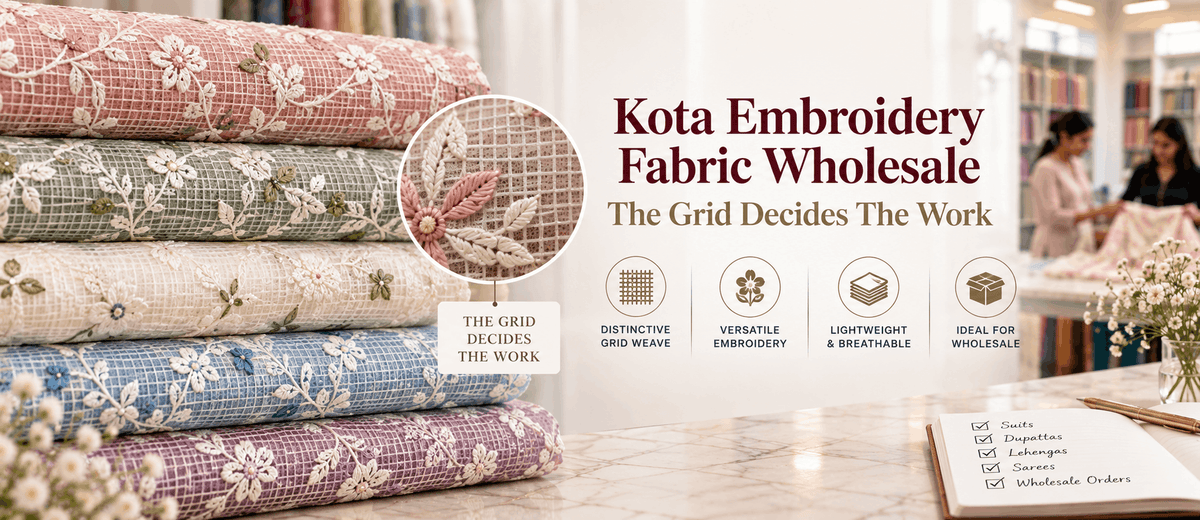
Kota Embroidery Fabric Wholesale: The Grid Decides The Work
A designer from Shahpur Jat rang me in April about forty dupattas that had come back from her karigar looking, in her words, slightly drunk. The motifs were fine. The colours were fine. Something about the cloth around the motifs was wrong plus she could not name it.
I asked her to hold one up to a window. The little woven squares that make kota what it is were sitting square across the open field plus leaning into diamonds for about an inch around every flower. Once you see it you cannot unsee it, plus no amount of pressing brings it back.
Quick answer: Kota is a woven grid, so the work has almost nothing to hold onto. Hold the cloth to daylight plus read the squares next to a motif. Square is sound. Diamond means the grid was dragged and it will not recover. The ground is transparent, so the reverse is part of the face. Keep work weight light against ground weight. Ask whether the lot was pre shrunk, since shrinkage closes the squares. Delhi trade rates run roughly Rs 260 to Rs 1,900 per metre.
Kota is a grid before it is a cloth
Most embroidery bases are a surface. You lay something on them plus the surface takes it. Kota doria is not built that way. Fine yarns plus thicker yarns alternate in both directions, so what you actually hold is a lattice of small open squares with a bit of yarn holding them apart. The trade calls those squares khat plus they are the whole product.
Which means the buyer is purchasing openness. Not colour, not weight, not surface. Openness. Everything that happens to this cloth afterwards, in the embroidery frame, in the wash, at the iron, either preserves that openness or quietly destroys it. That is the lens to hold every decision up against.
It also means that a needle going in does not pierce a surface. It pushes yarns aside. On solid cloth the yarns close back. On a grid they have nowhere to go, so they stay where the needle left them. Everything below follows from that one physical fact.
Hold it to a window: the square read that grades a lot in ten seconds
This is the test worth learning above all others on this category, because it needs nothing, takes seconds plus tells you about the karigar rather than about the cloth.
Take a piece to a window or a doorway with daylight behind it. Ignore the motif. Look instead at the four or five rows of squares immediately around it. On sound work those squares stay square right up to the edge of the embroidery, then carry on unchanged across the open field.
On work that was tensioned too hard on the frame, or laid too densely for the ground, the squares nearest the motif are stretched into diamonds or into flattened rectangles. Sometimes you get a visible halo of distortion around every flower. That distortion is not a finishing issue plus it will not press out, because the yarns have been physically moved and there is no surrounding cloth to pull them back.
Do this on five pieces from different points in a lot rather than one, since frame tension varies between hands on the same order. If four read clean plus one does not, you have a karigar problem to raise before dispatch instead of a return to argue about afterwards. Everything in our embroidered kota doria stock is inspected this way against light rather than under a counter lamp, which is the only way the distortion is visible at all.
On a transparent ground the reverse is part of the face
Turn any solid embroidered cloth over plus you can find a mess back there without it mattering. Carried threads running from one motif to the next, knot clusters, remains of backing paper. The customer never sees any of it.
Kota gives you no such cover. Light passes through, so everything on the back reads from the front as a grey shadow lying between the motifs. A long carried float across four inches of open grid shows as a line. A cluster of knots shows as a smudge. Backing fragments left in the squares show as cloudiness that people mistake for a stain plus try to wash out.
So inspect from the face, against light, then confirm from the back. Ask two direct questions at the counter. Have the floats been cut between motifs rather than carried, plus has all backing been removed rather than trimmed. On dupatta lengths this matters most across the open central field, which is exactly where the eye rests, so it is worth checking there first. The finished lengths in our dupatta range are checked for carried floats down the middle before they go out.
Genuine kota doria against the kota look imitation
Plenty of what moves as kota is a polyester cloth woven or heat set to imitate the grid. It is not a scandal, it has a place plus it is cheaper. It is only a problem when it is priced as the real thing. Three checks separate them.
The pin slide. Push a pin tip gently into one open square without touching the yarns. On a genuine woven grid it drops through cleanly plus the square is unchanged when you withdraw. On a fused or heat set imitation the square is not really open, so the pin snags, tears or leaves a mark.
The crush and count. Squeeze a corner hard in your fist for a slow count of ten, then open your hand. Genuine cotton silk kota creases sharply plus holds the creases. Poly springs back looking almost untouched. This is the single quickest read of the two.
The wet square. Wet a fingertip plus press it on a spare corner for a moment. Cotton silk takes the water into the yarns plus goes visibly darker at once. Poly beads it plus stays the same shade. Do this on a corner you can spare, near a selvedge, never in the middle of a saleable field.
Work weight against ground weight, the ratio that decides whether it hangs
Kota is among the lightest grounds anyone embroiders on. That is its appeal plus it is also its limit. A motif noticeably heavier than the cloth carrying it will drag, because on a grid there is no dense surface to spread the load into. It pulls a small pucker at first, then a permanent sag in wearing.
The practical guidance is unfashionable but correct. Kota wants scattered light work, fine thread, small motifs plus generous spacing. It does not want dense allover embroidery, heavy metal work or anything with real mass in it. When a design calls for that, the honest answer is that kota is the wrong base, not that the karigar should try harder.
Where a heavier effect is genuinely needed, keep it at the borders plus the pallu where a hem turning and a finished edge can carry the extra weight, then leave the body of the field light. Almost every kota piece that hangs well is built that way. Almost every one that sags was designed as though it were a solid cloth.
Kota embroidery qualities plus Delhi trade rates
| Quality | Ground | Work type | Best fit in a line | Delhi trade price (per metre) |
|---|---|---|---|---|
| Light machine buti | Poly kota | Scattered machine motifs | Volume dupattas, summer counters, gifting | Rs 260 to Rs 390 |
| Machine buti on real kota | Cotton silk kota doria | Scattered machine motifs, cut floats | Day function sarees, temple wear, office festive | Rs 480 to Rs 740 |
| Border plus pallu work | Cotton silk kota doria | Weight at edges, light field | Sarees, dupattas sold as a single statement piece | Rs 690 to Rs 1,050 |
| Hand thread work | Cotton silk kota doria | Frame worked by hand, fine thread | Limited lines, boutique exclusives | Rs 980 to Rs 1,450 |
| Dense hand work | Fine cotton silk kota doria | Close hand motifs, high karigar hours | Made to order pieces, wedding day function | Rs 1,300 to Rs 1,900 |
The two hand rows carry a warning that belongs with them. Density plus hand work together are the combination most likely to produce the distortion described earlier, because a hand worker on a frame applies more tension than a machine head does. The dearest quality on this list is not automatically the soundest one. Run the window read hardest on exactly the rows you paid most for.
Order tiers plus why kota is a season rather than a stock item
| Tier | Typical quantity | Lead time | Who it suits |
|---|---|---|---|
| Inspection cutting | Half a metre, for the window read | Same day | Any first order on a new karigar or quality |
| Ready lot | 20 to 40 finished pieces | From stock | Boutiques filling a summer plus early festive counter |
| Machine work to order | One design across 60 m and up | Roughly 3 to 5 weeks | Labels running a repeatable summer line |
| Hand work booking | Piece counted, not metre counted | Roughly 6 to 12 weeks | Designers with a dated function to hit |
Kota sells hardest from late winter through the hot months plus into the early festive weeks, because it is a cloth for daylight and for standing about in heat. That makes booking a calendar problem rather than a stock problem. Hand work in particular competes for the same karigar hours as everything else in the season, so a piece counted order placed in January behaves very differently from the same order placed in April.
The practical rule most boutiques arrive at eventually is to take ready lots for the counter plus book only the hand work ahead. Trying to book everything ties up money in a cloth that will not hold its moment, plus trying to book nothing means the good hands are gone by the time you want them.
What to settle before a kota embroidery booking
- Run the window read on five pieces. Squares beside a motif must still be square.
- Ask whether floats were cut or carried. On a transparent ground a carried float is a visible line.
- Confirm all backing was removed, not trimmed. Fragments in the squares read as cloudiness.
- Get the ground stated as cotton silk or poly in writing. Then verify it with the crush and the wet square.
- Ask whether the ground was pre shrunk before working. If it was not, the squares will close later.
- Keep heavy work at borders only. A dense field on a light grid sags and cannot be rescued.
Kota embroidery questions that come up at the counter
Does kota doria shrink after it has been embroidered?
The ground does, plus the thread mostly does not, which is the part that causes trouble. Genuine kota doria carries cotton in it, so it moves when it meets water. The embroidery thread sitting on top moves very little. The result is not simply a smaller piece, it is a closing of the open squares around every worked area, so the cloth loses exactly the transparency it was bought for plus the motifs start to look tight against a denser ground. The way to avoid it is upstream rather than downstream. Ask whether the ground was pre shrunk before the work went on, since a pre shrunk ground has already done most of its moving. If the answer is no, or nobody knows, treat the lot as one to sell rather than to hold plus tell your customer plainly how it should be handled. Do not attempt to correct it after the fact.
Can dense embroidery be done on kota at all?
It can be executed, plus it usually should not be. The grid gives a needle very little to hold, so density fights the base rather than sitting on it. What you get is distortion around the motifs, a hand that feels stiff in patches plus a piece that sags in wearing because the mass has nowhere to distribute. Buyers see photographs of heavily worked kota and ask for it, so the request comes up often. The better conversation is to move the weight to where the cloth can carry it. Put the density into the border plus the pallu, where a hem turning, a finished edge or a lining strip is available to support it, then keep the open field light and scattered. That reads as a considered design rather than a compromise. It is also the reason the pieces that photograph well in this category almost all share the same layout.
How do I tell real kota doria from the polyester version quickly?
Crush a corner in your fist for a slow ten count plus open your hand. Real cotton silk kota creases sharply and keeps the creases. The imitation springs back looking almost as it did. That one test settles most cases in under a minute. If you want a second opinion, press a wet fingertip on a spare corner near the selvedge: the genuine cloth darkens immediately as the yarns take the water, while poly beads it and holds its shade. A third check is the pin slide, where a pin tip should drop cleanly through an open square on a woven grid but snags or marks on a fused imitation. None of this makes the polyester version a bad purchase. It launders easily, holds colour plus suits a volume counter. It only becomes a problem when it is bought as the real thing plus priced as the real thing.
Is kota embroidery only a summer line for a boutique?
Mostly, though the season is wider than people expect and it is worth stretching deliberately. The natural home is late winter through the hot months, because the cloth is built for daylight, heat plus standing about at long functions. That covers a great many day weddings, temple occasions, office festive wear plus the whole run of pre monsoon events. Where it also earns its place is the early festive weeks, where a light worked kota dupatta sits comfortably against a heavier suit and gives a customer something to buy when everything else on the counter feels warm. What does not work is trying to run it through deep winter or against the bridal counter, since it will always read as a lighter proposition than what sits beside it. Treat it as a defined seasonal line with a start plus a finish, order to that shape and the category behaves well.
Booking kota embroidery lots at trade rates
If you run a boutique, a label or a reselling line, the working route to trade pricing on kota embroidery is the wholesale programme. You get a half metre inspection cutting released before the lot so you can run the window read yourself, ground stated as cotton silk or poly on the quotation rather than left to the design name, pre shrink status confirmed in writing, floats cut between motifs plus backing fully removed as a dispatch standard, piece counted booking on hand work with the karigar lead time given honestly at the time of order, plus season aligned scheduling so a summer counter is filled before the hands are committed elsewhere. See the tiers and register on our bulk buying and registration page to open your first kota embroidery order.