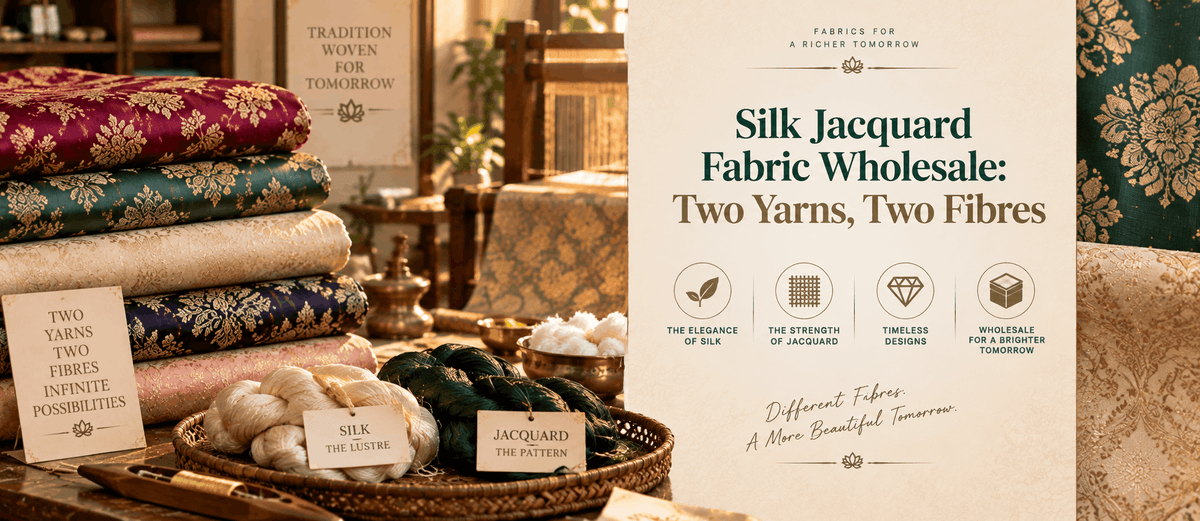
Silk Jacquard Fabric Wholesale: Two Yarns, Two Fibres
A boutique owner in Lajpat Nagar brought me a bill last month and asked why the same design had cost her three different prices from three different counters in one week. All three lengths were sold to her as silk jacquard. All three looked close enough across a shop counter.
We pulled a thread from each selvedge and burned them on the pavement outside. One shrivelled and smelled of singed hair. One melted into a bead you could not crush between your nails. The third did one thing in the warp and the other thing in the weft. Nobody had lied to her. She had simply been buying a structure while thinking she was buying a fibre.
Quick answer: Jacquard is a machine, not a fibre. Every length has a ground yarn plus a separate figure yarn. The two are often different fibres. Pull one of each from the same selvedge and burn them separately. Then turn the cloth over and measure the longest unbound float, because that is what snags on a stitching floor. Delhi trade rates run roughly Rs 340 to Rs 2,400 per metre.
Why the name on the bill tells you almost nothing
On a plain woven cloth there is one warp and one weft, so naming the fibre is straightforward. A jacquard is not built that way. The harness lifts warp ends individually, which is what lets a mill weave a curved motif instead of a stripe. To make that motif visible it needs a second yarn system carrying the figure.
Those two systems come off different cones. A mill buying silk for the ground has no obligation to buy silk for the figure, plus figure yarn is consumed in large quantity because it runs across the whole width whether the motif needs it or not. Substituting there is where the margin lives. It is the most ordinary decision in the mill and the least visible one at the counter.
So when a counter says silk jacquard, that phrase is doing two jobs at once and only one of them is honest work. It is telling you the cloth was woven on a jacquard harness, which is true. It is implying the fibre content, which it cannot do on its own. Ask for the split, ground and figure stated separately, then put it on the quotation.
The selvedge pull, plus what each yarn does in a flame
This takes two minutes and settles the argument before money moves. Find the selvedge, which is the finished edge running down the length. Fray about half an inch of it with a pin. You want two separate yarns out of that fray: one running down the length, which is your ground warp, plus one running across, which will include the figure weft.
Burn each one on its own with a lighter, holding it with tweezers over a hard floor. Mulberry silk pulls away from the flame rather than running towards it, goes out on its own once you withdraw the lighter, smells unmistakably of burning hair and leaves a black ash that crumbles when you press it. Polyester behaves in the opposite way on every count. It runs to the flame, melts before it burns, drips, smells sharp and chemical, then cools into a hard bead you cannot crush at all. Viscose sits between them, burning fast and cleanly like paper with a soft grey ash plus a smell of burnt leaves.
Read the two results as a pair rather than as one answer. Silk in both is a genuine silk jacquard and will be priced accordingly. Silk ground with a poly figure is the common mid tier, plus it is a perfectly reasonable buy at the right rate, since the ground gives the hand while the figure gives the shine and the durability. Poly in both is a synthetic jacquard, useful for volume work, only a problem when it carries a silk price. Every length in our silk jacquard range is bought with that split stated by the mill rather than inferred from the design name.
Turn it over: float length is the fault that reaches your customer
Everything above is about what you paid for. This next part is about whether the cloth survives being made into a garment, plus it is the complaint I field most often on this category.
Where the figure weft is not wanted on the face, it has to go somewhere, so it runs along the back until it is needed again. A careful mill binds those runs down at intervals with a stitching point. A mill in a hurry does not. What you get then is a long unbound float lying loose across the reverse. Long floats catch. They catch on a machine needle, on a hook, on a finger ring, on the corner of a cutting table. The loop pulls through to the face and the piece is finished.
So before booking, lay a metre face down and find the widest gap between motifs. Run a fingernail flat across the back of that gap. If the yarn lifts away from the cloth in a visible loop over more than roughly a centimetre and a half, you are looking at a snag risk that will land on your stitching floor rather than in the mill. Two metres out of a fifty metre lot is enough to know. It is also worth doing on any design with large plain areas between figures, since that layout is exactly where floats get longest. The broader woven jacquard stock is checked this way before a lot is opened for booking.
Silk jacquard qualities plus Delhi trade rates
| Quality | Ground yarn | Figure yarn | Best fit in a line | Delhi trade price (per metre) |
|---|---|---|---|---|
| Synthetic jacquard | Polyester filament | Polyester or metallic | Volume blouse pieces, lehenga linings, gifting | Rs 340 to Rs 520 |
| Art silk jacquard | Viscose filament | Viscose or polyester | Festive suits, kurta lengths, mid counter sarees | Rs 560 to Rs 880 |
| Silk ground, poly figure | Blended or spun silk | Polyester filament | Boutique blouses, jackets, structured cholis | Rs 940 to Rs 1,350 |
| Silk ground, silk figure | Mulberry silk | Mulberry silk | Wedding sarees, bridal blouse, made to order | Rs 1,450 to Rs 1,980 |
| Silk with zari figure | Mulberry silk | Tested zari | Statement lines, bridal counter, exclusives | Rs 1,900 to Rs 2,400 |
One note that belongs with the third row rather than the last. Silk ground with a poly figure is the row most boutiques should be buying and the row most often mispriced upward, because it photographs almost identically to the full silk quality and holds a press better. Know which row you are on, pay that row's rate and the category stops being confusing.
Booking tiers plus why the repeat governs your wastage
| Tier | Typical quantity | Lead time | Who it suits |
|---|---|---|---|
| Burn cutting | Quarter metre, for the selvedge pull | Same day | Any first order on a new mill or quality |
| Stock length | 20 to 50 metres from an open lot | From stock | Boutiques cutting blouse plus jacket pieces |
| Shade lot booking | One colour across 100 m and up | Roughly 2 to 4 weeks | Labels running a repeatable festive line |
| Loom booking | New card, minimum run applies | Roughly 8 to 14 weeks | Designers wanting an owned motif |
The number that quietly decides your cost per garment is the repeat, meaning the distance down the length before the motif starts again. A large repeat looks impressive on a hanger and eats cloth in cutting, because every panel has to be placed so the motif lands where you want it. On a blouse that can push consumption up by a third against a small scattered repeat on the same rate.
So ask for the repeat measurement before you calculate your order quantity rather than after. It is a routine question at any counter that weaves rather than resells, plus the answer changes your metre requirement more than the per metre rate does. Buyers who skip it tend to order to last season's number and come up short in the middle of a run.
What to settle before a silk jacquard booking
- Get ground and figure stated separately on the quotation. One fibre name for a two yarn cloth is not a specification.
- Run the selvedge pull on both yarns. Burn them apart, never together.
- Measure the longest unbound float on the reverse. Past roughly a centimetre and a half you are buying snags.
- Ask for the repeat length in inches. Then recalculate consumption before you fix the quantity.
- Book one shade lot for a whole line. Jacquard grounds shift between lots more than plains do.
- Check the reverse for loom marks along the selvedge. A wandering edge means tension trouble across the width.
Silk jacquard questions that come up at the counter
Is silk jacquard the same thing as brocade?
They overlap without being the same, plus the distinction is worth holding because it changes what you should pay. Both are figured cloths woven with an extra yarn carrying the pattern. Brocade in Indian trade usage almost always implies that the figure yarn is zari or a metallic, which is why brocade reads as heavier plus more formal. Silk jacquard is the wider category and covers any figured silk regardless of what the figure yarn is made of, so a great deal of silk jacquard is figured in plain silk or in polyester with no metal at all. In practice a counter will call the same length by whichever name sells it, which is why the fibre split matters more than the label. Ask what the figure yarn is. If the answer is zari you are in brocade territory and should expect brocade rates. If the answer is silk or poly, you are buying jacquard and should not be paying for metal you did not get.
Why does my silk jacquard snag when the plain silk beside it does not?
Because a plain silk has no loose yarn anywhere on it, while a jacquard has figure yarn lying across the back wherever the motif is absent. On a plain weave every yarn is locked at every crossing, so there is nothing for a needle to lift. On a jacquard the figure weft runs unbound between motifs, so the longer that run the easier it is to hook. This is not a fault in the fibre and it will not improve with a better quality of silk. It is a fault in how the mill chose to bind the back, so the fix is at booking rather than in handling. Turn the cloth over, find the widest plain area in the design, then look at how far the yarn travels there before it is tacked down. Also warn your stitching floor. Rings off, needles fresh, plus cut with the reverse facing up so the floats sit against the table rather than dragging over a hook.
Can silk jacquard be dyed or shade matched after weaving?
Only in the narrow case where both yarn systems are the same fibre, plus even then with care. The moment the ground and the figure are different fibres, a single dye bath treats them differently: silk takes an acid dye that viscose largely ignores, polyester takes neither without heat and pressure, so what comes out is a two tone cloth rather than a single colour. Mills exploit that on purpose to produce a tonal effect, which is fine when it is intended and a disaster when you were expecting a solid. If you need a specific colour across a line, the workable route is to book a woven shade lot in that colour rather than to buy greige and dye it. Where a piece dyed jacquard genuinely is required, ask the counter to confirm both systems are the same fibre in writing, then run a sample length through the bath before committing the order. Do not assume the design name tells you.
How much extra cloth should I allow for a large repeat?
Start from the repeat length itself rather than from a percentage, since the percentage moves with the garment. Measure how far it is down the length before the motif begins again, then think about where that motif has to land on the piece you are cutting. On a blouse where a single central motif is wanted on the front, you effectively cannot use any length between one motif and the next, so a fourteen inch repeat can cost you close to a third more cloth than a scattered four inch repeat at the same rate. On a saree body or a flowing kurta where the motif can fall anywhere, the waste is small. The habit worth building is to ask the repeat, cut one garment from a sample length, then multiply the real consumption rather than the theoretical one. Everyone learns this eventually. Learning it before a hundred metre booking is cheaper than learning it after.
Booking silk jacquard lots at trade rates
If you run a boutique, a label or a reselling line, the working route to trade pricing on silk jacquard is the wholesale programme. You get a quarter metre burn cutting released before the lot so you can run the selvedge pull yourself, ground and figure fibre stated separately on the quotation rather than collapsed into one name, a maximum unbound float span agreed as a dispatch standard, repeat length given in inches at the time of quoting so you can fix consumption before quantity, single shade lot allocation held across a whole line, plus loom booking with the minimum run and the honest lead time stated at order. See the tiers and register on our bulk buying and registration page to open your first silk jacquard order.