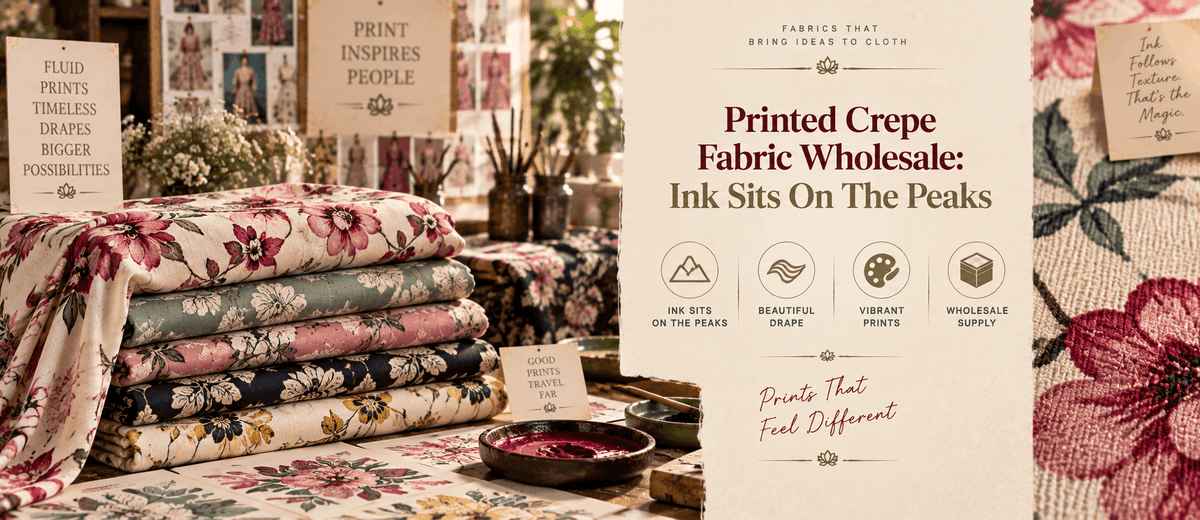
Printed Crepe Fabric Wholesale: Ink Sits On The Peaks
A kurti label in Gandhi Nagar sent back nine hundred metres in July. Their complaint was that the cloth had faded in transit. It had not faded. The thaan they approved on our counter was folded flat and the sample they cut was flat too, so all anybody ever looked at was the top of the surface.
The first time that cloth went over a shoulder it opened. Tiny white specks came up through the colour wherever the fabric was pulled, thick enough across a sleeve to look like a wash mark. Nothing had faded. The ink had simply never reached the bottom of the crimp.
Quick answer: Crepe has a pebbled surface, so ink lands on the peaks and may never reach the valleys. Stretch a printed area on the true bias and watch for white pinpricks opening in the colour. Then turn it over and check whether any colour carried through. Grin through is permanent. Delhi trade rates run roughly Rs 190 to Rs 720 per metre.
The crimp is in the yarn, which is why the print behaves oddly
Most textures you print on are pressed into the cloth after weaving, so they flatten out under a printing blanket and take colour evenly. Crepe is not one of those. The texture comes from yarn that was given an extreme twist before it ever reached the loom, plus once the cloth is woven that yarn keeps trying to untwist. The result is a surface that pebbles from the inside out.
A pressed texture yields under pressure. A twist texture does not, because the crimp is a property of the yarn rather than a shape imposed on the cloth. Push a printing blanket against it and the peaks compress a little, then spring straight back as soon as the pressure lifts. The valleys never really open.
Which is why penetration on this ground depends on the print recipe rather than on machine pressure. Thinner paste, slower running, more passes, the right choice of process for the fibre. Every one of those costs the printer money, plus every one of them is the first thing dropped when a rate is squeezed. That is the whole economics of the category in three sentences.
The bias stretch, the one minute check that finds grin through
Take a piece with a good area of solid colour in the design, since scattered small motifs on white will hide the fault completely. Find the true bias, which is the diagonal at forty five degrees to both the selvedge and the weft.
Hold it between two thumbs about three inches apart and pull gently along that diagonal. Not hard, just enough to open the cloth. Watch the colour rather than the cloth. On sound printing the colour stretches with the fabric and stays continuous, maybe going slightly paler in tone across the whole area. Where penetration failed you get something quite different: distinct white pinpricks appearing between the printed peaks, which then close again when you release. It looks like the colour is grinning at you, hence the name.
Do it along the bias and not along the straight grain, because straight grain barely opens the crimp and will pass cloth that fails. Do it on three or four points down a lot rather than one, since print penetration varies with squeegee pressure and paste viscosity across a run. Then turn the piece over. Colour that has carried part way through to the reverse is a decent proxy for ink having reached the valleys on the face. Colour stopping dead at the surface with a bright white back is the warning sign. The lots in our printed crepe range are checked on the bias rather than flat on a counter, because flat is exactly where this fault hides.
Screen against digital on a crimped ground
This choice matters more on crepe than on a flat cloth, so it deserves its own decision rather than being left to whatever the counter has in stock.
Rotary screen pushes paste through a perforated cylinder under pressure. On crepe that pressure is an advantage, because it drives colour down into the valleys, so screen printed crepe often has better penetration than people expect. The cost is flexibility. Each colour needs its own screen, so short runs are uneconomic plus small design changes are expensive. Fine gradients are hard to hold.
Digital sprays ink from a head with no contact and no pressure at all. It gives you photographic detail, unlimited colours plus a viable run of thirty metres, which is why most new design development goes this way. On crepe the lack of pressure is exactly the problem. The ink has to wick into the valleys on its own, so penetration depends entirely on how the cloth was pre treated and how much ink the printer laid down. A digital printer running fast on an under prepared base is the single most common source of grin through in this category.
Neither process is better in the abstract. Ask which one a lot was printed by, then match the check to it. On digital, run the bias stretch harder. On screen, look instead at registration where two colours meet plus at the join marks down the length. The wider printed fabric stock is separated by process at intake for that reason.
Printed crepe qualities plus Delhi trade rates
| Quality | Base fibre | Print process | Best fit in a line | Delhi trade price (per metre) |
|---|---|---|---|---|
| Poly crepe, screen | Polyester | Rotary screen, disperse | Volume kurtis, uniform lines, everyday counters | Rs 190 to Rs 265 |
| Poly crepe, digital | Polyester | Digital sublimation | Short run designs, co-ord sets, online sellers | Rs 285 to Rs 380 |
| Viscose crepe, screen | Viscose | Rotary screen, reactive | Boutique dress material, summer suit sets | Rs 330 to Rs 470 |
| Viscose crepe, digital | Viscose | Digital reactive, steamed | Designer placements, engineered panels, sarees | Rs 480 to Rs 640 |
| Heavy viscose crepe, digital | Viscose, higher gsm | Digital reactive, extra ink pass | Gowns, jackets, statement dress material | Rs 600 to Rs 720 |
The last row exists because of the fault this whole guide is about. An extra ink pass on a digital run is the printer solving penetration deliberately, plus it is the reason that quality carries a rate a good hundred rupees above what the base cloth alone would suggest. If a counter offers you heavy digital viscose crepe at mid tier money, that pass is what has been removed.
Order tiers plus why the strike off protects the whole run
| Tier | Typical quantity | Lead time | Who it suits |
|---|---|---|---|
| Stretch cutting | Half a metre, for the bias read | Same day | Any first order on a new printer or design |
| Ready design | 30 to 60 metres from an open lot | From stock | Boutiques cutting dress material sets |
| Digital exclusive | One artwork across 40 m and up | Roughly 2 to 3 weeks | Labels wanting an owned print |
| Screen booking | Screens cut, minimum run applies | Roughly 5 to 8 weeks | Volume lines repeating a design each season |
On any tier below stock, ask for a strike off before the run. A strike off is a short trial length printed on the actual base cloth with the actual recipe. It is the only document that lets you argue about penetration and shade afterwards. Approving artwork on a screen or on paper proves nothing, because paper has no valleys in it.
Sign the strike off, keep your half of it, then write the date on the back. When a bulk lot lands lighter or grins where the strike off did not, you are holding physical evidence rather than a memory of a colour. Every printer in the trade accepts that as the basis of a claim. Very few buyers actually keep the piece.
What to settle before a printed crepe booking
- Run the bias stretch on a solid colour area. Small motifs on white will hide the fault entirely.
- Check the reverse for carried colour. A bright white back under a dark face means the ink stayed on top.
- Ask whether the lot is screen or digital. The check you run changes with the answer.
- Get a strike off on the real base cloth. Sign it, date it and keep your half.
- Book one shade lot per design across a line. Crepe grounds take colour differently between batches.
- Rub a damp white cloth across the print. Colour lifting onto it means fastness was never fixed properly.
Printed crepe questions that come up at the counter
Can grin through be fixed after the cloth has been printed?
No, plus it is worth being blunt about that because people spend money trying. The white you are seeing is unprinted greige at the bottom of the crimp, so there is nothing to bring out, restore or set. Washing does not help since there is no ink there to fix. Steaming does not help either, plus pressing makes it slightly worse by flattening peaks that were covering the gaps. What some buyers try is an overdye in a pale tone to tint the exposed valleys, which changes the whole colour of the design and rarely gives a result anybody wants to sell. The only real remedy is at the printer, meaning the lot goes back for a second pass, which is possible on digital and awkward on screen. So the entire defence is the bias stretch before the money moves. That is why the check exists and why it is worth building into your intake routine even when the counter is busy.
Does printed crepe bleed in the first wash?
It depends on the process and the fibre pairing rather than on the price. Reactive printing on viscose bonds the dye to the fibre chemically, so once it has been properly steamed and washed off at the mill it should not bleed at all. Disperse printing on polyester bonds under heat in a similar way. Trouble comes from pigment printing, where colour is essentially glued to the surface with a binder, since a thin binder or a short curing time leaves colour that lifts. The check takes ten seconds: dampen a scrap of white cotton, rub it firmly across the print about ten times and look at the white. Any colour transfer at all means poor rubbing fastness, plus what rubs off dry will certainly run wet. Do this on dark grounds and on reds especially, because those two are where the trade sees the most complaints. Ask the counter which process was used and put the answer on the bill.
Why do two lots of the same design not match?
Because a printed crepe carries two independent sources of variation stacked on each other. The base cloth itself is dyed or bleached in batches, so the ground under the print is not identical between lots. Then the print run adds its own drift, since paste viscosity, screen wear, ink batch plus drying temperature all move a little over a long run. Put those together and two lots of one design printed six weeks apart can be visibly different when laid side by side, even though each is perfectly good on its own. This is not a defect and no printer will accept it as one. The way to manage it is to book a single shade lot for everything that will be sold as a set or a coordinated line, then to accept that a repeat order later in the season is a new lot rather than a continuation. If a customer is matching a dupatta to a kurta bought in March, buy both from the same lot in March.
Is viscose crepe worth the jump from polyester crepe?
For a boutique counter, usually yes, though the reason has little to do with the print. Viscose crepe falls softly, breathes plus feels cool against skin, which is what a customer notices in a trial room and what she remembers about the garment afterwards. Polyester crepe holds colour brilliantly, resists creasing plus costs about half as much, so it earns its place on volume lines, uniforms and anything that has to survive hard laundering. Where the print does come into it is that reactive printing on viscose tends to give deeper penetration than sublimation on polyester, so viscose lots grin through less often at the same level of care. The honest way to decide is by counter rather than by preference. If your customer touches the cloth before buying, go viscose. If she is buying a design at a price, polyester is the correct commercial answer and there is nothing second rate about it.
Booking printed crepe lots at trade rates
If you run a boutique, a label or a reselling line, the working route to trade pricing on printed crepe is the wholesale programme. You get a half metre stretch cutting released before the lot so you can run the bias read yourself, print process stated as screen or digital on the quotation rather than left to the design name, a signed strike off on the actual base cloth for every booked run, single shade lot allocation held across a coordinated line, rubbing fastness confirmed before dispatch, plus artwork ownership stated in writing on digital exclusives so a design you paid to develop is not printed for the counter next door. See the tiers and register on our bulk buying and registration page to open your first printed crepe order.