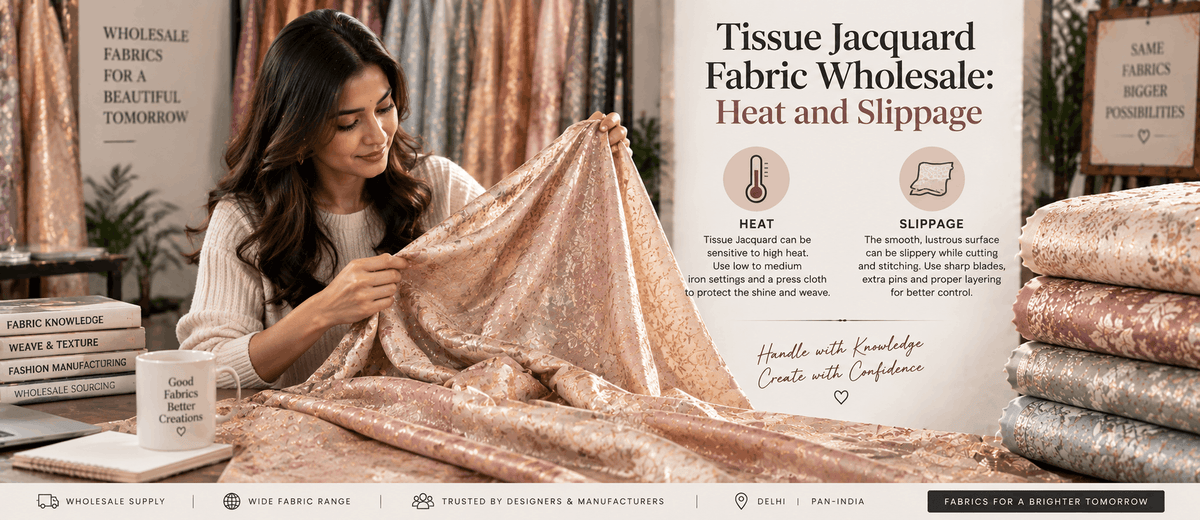
Tissue Jacquard Fabric Wholesale: Heat and Slippage
A tailor in Chandni Chowk rang me in March, furious, holding forty metres of tissue jacquard he had cut into blouse pieces the week before. Every single piece had a flat grey rectangle on the shoulder where the shine had gone. He was certain we had shipped him a second quality lot.
We had not. His new presser had come from a cotton unit and had been ironing everything at the same dial setting for eleven years. The cloth was fine when it left. It died on his table in about three seconds per piece.
Quick answer: Tissue jacquard has a metal or metallised ground. It does not scorch, it glazes, which is permanent. Run an offcut through three rising iron settings before booking so you know the ceiling. Then spread a motif edge with both thumbs to check seam slippage. Roll the lot, never fold it. Delhi trade rates run roughly Rs 220 to Rs 1,400 per metre.
Why this one behaves nothing like the rest of the jacquard family
Every other figured cloth on a wholesale floor is fibre through and through. Silk, viscose, polyester, cotton. They all respond to heat in ways a stitching floor already understands, because a fibre browns before it dies, which gives the presser a warning.
Tissue does not work that way. Its ground carries a flat metallic strip or a metallised filament, plus that material has no browning stage. It goes from bright to flat in one step, with no colour change to warn anybody, so the first sign of trouble is a finished piece with a dull patch on it. That is why this cloth generates more after-sale argument than anything else of its weight class.
The jacquard figure then adds a second problem the plain tissue does not have. A plain tissue is uniform, so it presses evenly. A tissue jacquard is thick where the motif sits, thin where the ground shows, so the iron bears down harder on the raised motif and the ground beneath it takes the punishment first. Two faults from one cloth, both arriving after your money has moved.
The offcut iron ladder, plus how to read the step that failed
This is the test that should govern the booking. Ask the counter for a four inch offcut, which any honest counter will give you, then do this before you discuss rate. It takes four minutes.
Lay the offcut face up with a piece of dry cotton cloth over it. Set the iron at wool, press three seconds with normal hand weight, lift, then look at the pressed area against an unpressed area at an angle to the light. Move the dial to silk, press a fresh part of the same offcut for three seconds, look again. Then cotton. What you are hunting is the first step where the shine goes flat and stays flat after the cloth cools. Metallic ground does not recover as it cools the way a crease does.
Whatever step failed, your floor works one full step below it, then you write that setting on the lot docket rather than trusting anybody to remember. Also test with steam off. Steam on a metallic tissue drives water into the ground and leaves spotting that looks exactly like a water stain from a customer, which is an argument you cannot win at a counter. Every lot in our tissue jacquard range is opened with its press ceiling already read this way rather than left to the buyer to discover.
Seam slippage at the motif edge, the fault that shows up in week three
The heat problem at least announces itself the same day. This one waits.
A tissue ground is deliberately open. Low yarn count is what makes it sheer, which is the whole point of the cloth. The jacquard figure sitting on that ground is the opposite: dense, heavy, tightly packed. Where they meet, at the outer boundary of any woven motif, you have a hard structure butting against a loose one. Put a seam through that boundary, let the garment be worn a few times, then the ground yarns slide away from the stitch line. A gap opens. The customer sees it, blames the stitching, then the tailor blames you.
Test it in five seconds. Find a motif on the offcut, place both thumbs on the ground fabric just outside the motif edge about an inch apart, then push them apart with steady pressure. Watch the ground yarns. On a sound quality they shift slightly and spring back. On a slippage-prone quality they separate visibly and leave a gap you can see light through, plus they stay separated. If that happens, the cloth is not unusable, but it needs a fusible or a lining stitched as one with the face, plus seam placement kept off motif edges wherever the pattern allows. The wider woven jacquard stock is checked for this at the motif boundary before a lot goes on the floor.
Tissue jacquard qualities plus Delhi trade rates
| Quality | Ground | Figure yarn | Typical press ceiling | Delhi trade price (per metre) |
|---|---|---|---|---|
| Poly tissue jacquard | Polyester with metallised film | Polyester filament | Below wool, press through cloth only | Rs 220 to Rs 340 |
| Crushed tissue jacquard | Polyester, permanently creased finish | Polyester or light metallic | Do not press at all, steam hang only | Rs 290 to Rs 430 |
| Viscose tissue jacquard | Viscose with metallic slub | Viscose or polyester | Wool setting, three seconds | Rs 460 to Rs 690 |
| Silk tissue jacquard | Silk with fine metallic | Silk or viscose | Silk setting, cloth mandatory | Rs 780 to Rs 1,100 |
| Silk tissue with zari figure | Silk with fine metallic | Tested zari | Silk setting, reverse side only | Rs 1,050 to Rs 1,400 |
The row that catches people out is the second one. Crushed tissue jacquard is bought for the texture, then somebody presses it to make it look neat before display, which removes the exact thing that was paid for. Write no press on that docket in large letters. It is the single most common self-inflicted loss in this category.
Rolling, lining plus the handling rules that travel with the lot
Tissue has crush memory. A fold made in a bale on a Tuesday is still visible on a garment in November, because the metallic ground takes a mechanical set rather than a temporary crease. Steam will not lift it and pressing it flat simply glazes the fold line, which is worse than the fold. So tissue jacquard travels rolled on a tube. If a counter offers it to you folded in a bale, that counter does not handle enough of it, so you should assume there are folds through the middle of the lot you have not seen yet.
Lining is the other thing to settle before quantity. Because the ground is sheer, the figure yarn floating along the back reads through to the face as a shadow, which reduces the crispness of the motif and makes a pale ground look muddy. Almost every tissue jacquard garment therefore needs a lining, so your costing has to carry a lining metre against every face metre. Buyers who quote a customer on face cloth alone lose that difference out of their own margin every time.
What to settle before a tissue jacquard booking
- Run the offcut iron ladder before you discuss rate. Then write the safe setting on the lot docket, one step below the step that failed.
- Press dry. Steam spots a metallic ground and the spot looks like customer damage.
- Spread a motif edge with both thumbs. Ground yarns that separate and stay separated mean slippage at every seam.
- Take delivery rolled on a tube. A folded bale of tissue is a folded bale of permanent creases.
- Cost the lining into the quotation. Sheer ground plus floating figure yarn means a lining is not optional here.
- Book one shade lot per line. Metallic grounds shift between lots more visibly than dyed cloth does, because the shift is in reflectance rather than colour.
Tissue jacquard questions that come up at the counter
Can a glazed patch on tissue jacquard be repaired?
No, plus it is worth being blunt about that with a stitching floor before the first piece is cut rather than after. A scorch on cotton is a fibre that has burned, so it is brown, which means that while it cannot be undone it is at least visible as damage. Glaze on a metallic ground is different in kind. The flat metallic strip in the ground has been physically flattened and its surface has lost the micro texture that scatters light, so the area stops reflecting and reads grey. Nothing restores that. Washing does not, steaming does not, brushing does not, plus pressing the surrounding area to match simply spreads the problem across the whole piece. People will tell you a damp cloth and a cool iron lifts it. What that actually does is raise a little pile from the fibre content sitting around the metallic, which looks slightly better under shop light and worse in daylight. The only real answer is prevention, which is why the offcut ladder is worth four minutes at the counter.
Is tissue jacquard strong enough for a lehenga panel or only for blouses?
It works for panels provided the construction carries the weight instead of the tissue carrying it. On its own a tissue jacquard is a light open cloth with poor tear strength at the ground, so a full flared panel hanging from a waist seam will distort along the grain and drop unevenly within a season. The way the trade actually builds it is as a face cloth mounted on a structured base, usually a santoon or a butter crepe lining cut to the same pattern and treated as one layer at every seam, which puts the load on the lining while the tissue only has to look right. Do that and a tissue jacquard lehenga holds fine. Skip it, then the customer returns with a hem that has gone wavy on one side. For blouses the calculation is easier because the panels are small and fusing is normal anyway. The honest rule is that tissue jacquard is a surface, not a structure, so budget for what sits behind it.
How do I tell tissue jacquard from plain tissue with a print on it?
Turn it over, which settles it immediately. A woven jacquard figure exists on both sides of the cloth because the yarn forming it has to travel somewhere, so the reverse shows the motif in negative with the figure yarn floating between shapes. A printed tissue has a face and a blank back, since pigment sits on the surface. Beyond the reverse check, run a thumbnail across a motif edge on the face. A woven motif has a raised edge you can feel, because it is built from extra yarn sitting proud of the ground. A print is level with the cloth and feels slightly stiff rather than raised. Both checks matter commercially, because printed tissue costs materially less to make and is regularly offered at jacquard rates on the assumption the buyer will not turn the piece over. It is also worth knowing that a printed tissue cannot slip at a motif edge, since there is no density change, so if you are buying print you can drop the thumb spread test entirely.
Why does my tissue jacquard look a different shade from the last lot when the colour code matches?
Because on a metallic ground you are matching reflectance rather than colour, while dye lot records only cover the colour half of that. Two lots can carry identical dye readings on the fibre portion while the metallic content differs slightly in gauge, in coating or in how tightly it was beaten in at the loom, so any of those changes how much light comes back off the surface. The result is two pieces that match perfectly under a tube light at the counter and clearly do not match when a customer holds them up at a window. This is also why a shade approval on a small swatch is unreliable for this cloth: reflectance differences only become obvious across a large area at a shallow viewing angle. The practical route is to book the whole requirement for a line in one lot, to approve against a half metre piece rather than a swatch book, then to view that piece at an angle in daylight before releasing the order.
Booking tissue jacquard lots at trade rates
If you run a boutique, a label or a reselling line, the working route to trade pricing on tissue jacquard is the wholesale programme. You get a four inch offcut released before the lot so you can run the iron ladder on your own machine, the safe press setting stated on the dispatch docket rather than left to the floor, a slippage check at the motif boundary done before the lot is opened for booking, delivery rolled on a tube instead of folded into a bale, single shade lot allocation held across a whole line so reflectance stays consistent, plus a half metre shade approval piece instead of a swatch. See the tiers and register on our bulk buying and registration page to open your first tissue jacquard order.