Floral Is a Rotation Category, Not a Stock Category: Buying Depth on a Motif That Dates
A buyer from a Karol Bagh boutique came back to the counter in March with eleven pieces of floral she had taken the previous August. The cloth was perfect. Not a mark on it, not a shade off, nothing anyone could fault. Her customers had simply stopped asking for that flower.
That conversation happens more often on floral than on any other motif family in this trade. Nobody in it made a mistake about quality. The mistake was treating floral the way you would treat a plain or a texture, as something that sits until it sells.
Floral does not sit. It rotates. A buyer who accepts that up front buys it very well.
Quick answer: Floral is the fastest-dating motif family in ethnic fabric because the flower itself carries the season, while the base cloth underneath it does not. So depth on floral should be set by how fast a design moves through your own counter rather than by how much of it you can afford. The three things that decide whether a floral piece sells or stalls are motif scale against the customer's body, whether the design runs one way, plus how many colours sit inside the repeat.
Why floral behaves differently from every other motif family
A geometric repeat reads as structure. A traditional butti reads as heritage. Both of those hold their meaning across years because neither one is pretending to be a real object. A flower is pretending to be a real object, which is why the eye judges it against a memory rather than against a pattern.
That judgement moves. The rose that read as fresh two seasons ago reads as dated now, not because the printing changed but because the customer has seen it on enough garments to place it. She cannot articulate why she has gone off it. She will simply pick up the piece next to it.
Which means the shelf life of a floral design is set outside your shop. It is set by how widely that flower has circulated in your area. A boutique in a market where four other shops buy from the same street has a much shorter window than a boutique that is the only ethnic counter for two kilometres.
Reading motif scale against the body, not against the table
Almost every scale mistake in this category starts the same way. The piece is opened flat on a counter, judged from standing height, then bought. On a counter a large bouquet looks generous. On a short kurti the same bouquet gets cut through twice and reads as a smear.
The counter check is to hold the piece against the buyer's own body at the length the garment will actually be, then step back. What matters is how many complete flowers survive inside the panel, not how the design looks lying down.
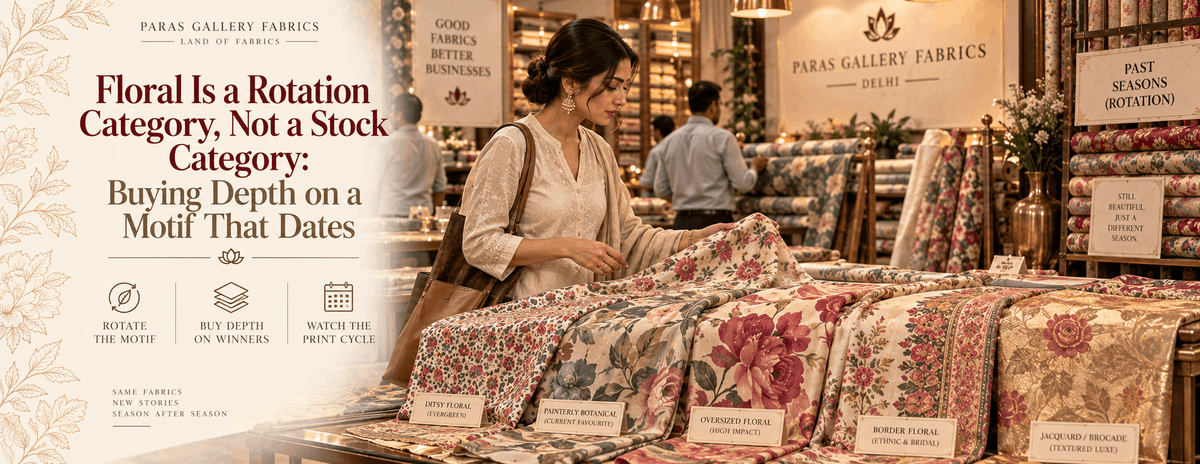
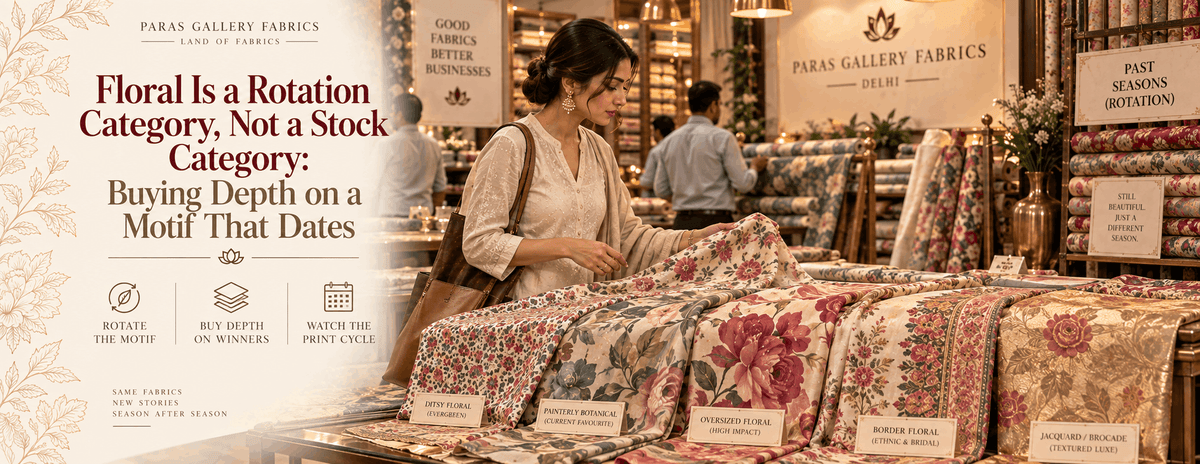
| Motif scale | Where it works | Where it fails | What to check before buying |
| Ditsy, flower smaller than a thumbnail | Everyday kurti, daily-wear suit, kids wear | Occasion garments where it reads as a plain from across a room | Step back six feet. If the flower disappears, price it as a plain |
| Mid-scale, flower about palm width | The widest selling band across suit lengths and short kurtis | Rarely fails outright, which is why it is also the most copied | Count complete flowers across the chest width of your cut |
| Large bouquet or spray | Long anarkali panels, saree pallu, dupatta grounds | Short kurtis, sleeves, any panel narrower than the repeat | Measure the repeat, then hold it against your shortest garment |
| Border floral, flower concentrated along one selvedge | Saree, dupatta, anything with a designed hem | Anything cut across the width, because the border lands sideways | Confirm the cut direction before you set the quantity |
The up-flower problem, the one direction trap buyers keep paying for
A stylised floral can usually be turned. A naturalistic one cannot, because a rose growing downwards is obviously wrong to anyone looking at it. That makes a great many floral designs directional even when nobody labels them that way.
Directional cloth costs more to cut. Every panel has to face the same way, so the tailor loses the freedom to nest pieces head to tail. On a plain or a scattered ditsy that freedom is worth very little. On a big one-way spray it is worth a noticeable share of the piece.
The check takes ten seconds. Open a length, turn it upside down, then look at it again. If your eye immediately objects, the design is one way, whatever the bill calls it. Set your metreage for a one-way cut before you agree a rate, not after the tailor calls you.
Colour count is the rate, the design is not
Buyers often assume a busier flower costs more because it looks richer. The rate is usually following the number of colours inside the repeat rather than the beauty of the drawing. More colours means more screens or a heavier ink lay, which means more handling and more that can go wrong.
This matters commercially in one very practical way. A four-colour floral and a two-colour floral can look equally good on the counter while carrying quite different rates. If the extra two colours are sitting in the background where the customer never registers them, you are paying for work that does no selling.
So count the colours yourself. Look at one full repeat, find every distinct shade including the ground, then ask which of them the customer would miss. Where the answer is none, there is usually a cleaner version of the same design at a better rate sitting in the next bundle. The wider print ranges kept in running depth through the season exist so that comparison can be made piece against piece rather than from memory.
Which florals stay sellable after the season turns
Not all of this family rotates at the same speed. The designs that hold are the ones where the flower is doing less of the work.
- Ditsy florals on cotton and cotton-blend bases hold for years, because the customer is buying the base and the comfort while the flower is only providing surface interest.
- Tonal florals, where the flower sits a shade or two off the ground, hold much better than high-contrast ones. Contrast is what dates.
- Traditional Indian flowers drawn in the older idiom hold, because they read as heritage rather than as a season. A drawn marigold or lotus is not competing with last year's magazine.
- Large photographic or trend-led sprays do not hold. They sell hard for one window, then stop. That is not a defect in them, it is the whole reason they sold hard.
Read the two groups as different purchases. One is a base line you can carry. The other is a window you have to convert.
Setting depth against rotation speed
The quantity question on floral is not how much of this can I afford. It is how many weeks of my own counter does this design have left.
Boutiques that track this well do one simple thing. They write the date of first display on the tag, then they note the date the design stops being asked for by name. After three or four designs that gives a real number for their own market, which is worth far more than any general rule.
Until that number exists, the safe pattern is a working quantity on a trend floral with an explicit balance conversation, then depth only on the tonal and ditsy lines that have already proved they carry. Our floral ranges shown scale by scale at the counter are laid out so the trend pieces and the carry pieces can be judged side by side before either quantity is set.
Questions buyers ask at the counter
How do I know if a floral is directional without asking?
Turn it upside down and look. If the flowers now appear to be growing downwards or the stems point the wrong way, it is directional and has to be cut one way. Stylised or scattered designs with no visible stem usually pass the test in both orientations, which gives your tailor room to nest panels.
Why does the same flower cost differently on two pieces?
Usually the colour count inside the repeat rather than the drawing. Each additional colour adds a screen or a pass, so a richer-looking design with fewer shades can sit below a plainer-looking one with more. Count the distinct colours in a single repeat before you compare rates on appearance.
Can I take a large floral for short kurtis if I like the design?
Only after measuring the repeat against your shortest cut. A repeat longer than the panel means every garment shows a partial flower, which the customer reads as a printing fault rather than a design choice. Where you love the design but the scale is wrong, the honest move is to use it on a longer garment instead.
My floral stock from last season has not moved. What now?
Separate it by scale before you decide anything. Ditsy and tonal pieces are usually still current and can go back on the shelf at their normal rate. Large trend sprays have passed their window, so they need a purpose rather than a price cut, which most often means turning them into a made-up line where the customer buys the garment rather than the cloth.
Bring your shortest cut length to the counter
Floral is the one category where the sample you carry decides the buying. Bring the shortest garment length you actually stitch, plus a piece of whatever is currently selling for you, so scale and contrast can both be judged against something real. Trade rates, piece holds and balance confirmations are handled at the wholesale desk that handles trade rates and lot holds.