Why a Check Punishes Cloth That a Floral Forgives: Buying Geometric Fabric for the Cutting Table
The same thaan can be perfect for one boutique buyer and unusable for the next, with nothing changed except the motif printed on it. That sounds unlikely until you have watched a master refuse a check after happily cutting a scattered floral off the identical base an hour earlier.
The difference is not the cloth. It is what the design lets the eye measure.
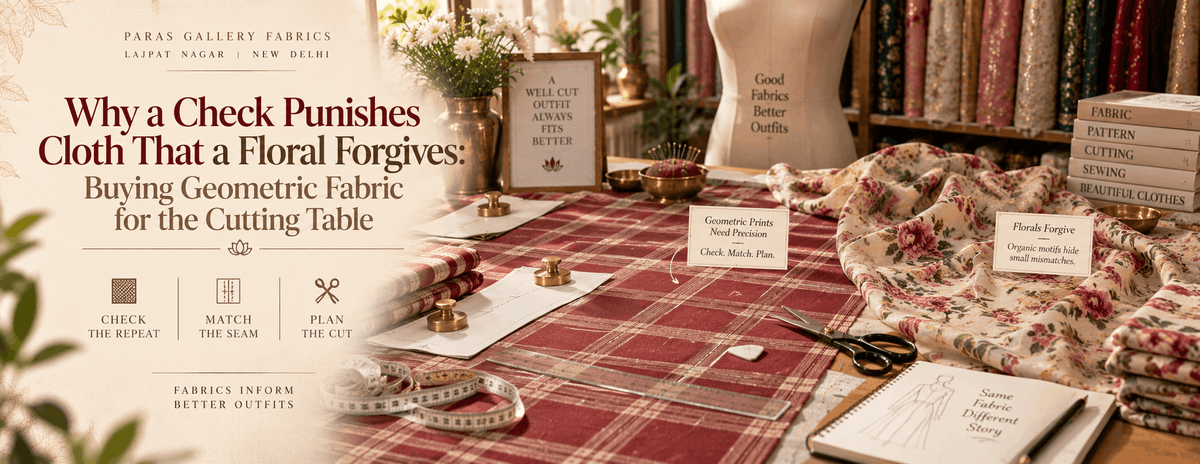
A floral, a paisley, an abstract wash: none of them contains a true horizontal or a true vertical. A viewer has nothing to compare the cloth against, so the fabric can sit slightly off square through the whole garment without a single person noticing.
Put a stripe, a grid, a chevron or a box check on that same base and every customer is now holding a ruler.
Quick answer: A geometric motif makes the cloth's grain visible, so bow and skew stop being technical faults and become defects a customer can point at. Woven geometry cannot go off grain because the line is made of yarns. Printed geometry can, because the print is laid on afterwards and nothing forces it to agree with the weave. Two checks settle it at the counter: run one line along a straight table edge down the full length, then fold selvedge to selvedge to see whether the motif lands on itself.
A straight line is a measuring instrument
Cloth comes off a finishing range under tension. If it is pulled unevenly it sets crooked, in one of two ways. Bow means the weft curves like a shallow smile across the width. Skew means the weft sits at a slant, one selvedge running ahead of the other.
On plain or scattered goods neither one is visible to anyone except a cutter, who notices only that a hem refuses to hang level. On geometric goods both become the first thing the customer sees, because the design draws the fault in ink.
That is the whole reason geometry deserves its own buying habit. You are not buying a different fibre or a different weight. You are buying a cloth that has lost the right to be approximate.
Printed geometry and woven geometry fail in opposite directions
Buyers use one word for two very different products. Splitting them changes what you inspect.
| Build | What the line is made of | How it goes wrong |
| Woven check, stripe or grid | Coloured yarns sitting in the weave itself | The line is the grain, so it can only be bowed or skewed with the cloth |
| Printed geometry | Pigment or dye laid on a finished surface | The print can disagree with the grain underneath it |
| Woven ground with a printed geometric over it | Two line systems on one cloth | They can drift apart from each other down the length |
That second row carries the trap. A cloth fed slightly askew through a printing line takes a design that runs at an angle to the weave. No amount of pressing puts it back. At the cutting table this becomes a choice with no correct answer.
Cut to the print and the garment looks straight on the hanger while hanging off grain, so it twists on the body after the first wash. Cut to the grain and the garment behaves correctly while the design reads visibly crooked. A master will ask you which one you want. That is not the moment to be hearing about it, which is why the check belongs at the counter. Across the wider printed fabric range we open for boutique buyers this single question separates the geometrics from everything else on the shelf.
The table edge read
Lay the cloth out so that one printed or woven line sits exactly along a straight edge. The edge of a cutting bench works. So does a steel scale held down, or the counter lip itself.
Now walk the length of the piece with your eye on that one line. You are watching for one of two behaviours. If the line lifts away from the edge then comes back down to it, the cloth is bowed. If it lifts away and keeps going, the cloth is skewed.
Run it once near a selvedge, once near the middle. Bow shows strongest at the centre while skew shows strongest at the edges, so one pass alone can let either fault through. Two passes take under a minute on a piece you are about to commit real money to.
Do this before anything else, because a failed table edge read makes the rate irrelevant.
The fold register check
The second check answers a question the first one cannot. Plenty of ethnic panels are cut on a fold. A kurta front, a yoke, a bodice, a straight kurti body: each is cut as one piece doubled over, which means the design must be square to the fold or the two halves will not agree.
Fold the cloth selvedge to selvedge. Smooth it without stretching. Then look at whether the motif on the top layer sits directly over the motif underneath.
On a symmetrical check or grid it should land cleanly. If the top line consistently sits ahead of the bottom one by the same small distance all the way down, the design is out of square against the fold. The garment cut from it will have a left side that does not mirror its right side, which on a centre-front placket is the most obvious fault in ethnic menswear.
Failing this check does not always mean walking away. It means the cloth must be cut open rather than on the fold, which is slower, uses more metreage, needs to be priced in before you agree a rate.
Matching at the seam is a purchase decision, not a cutting decision
Boutiques lose margin here more often than anywhere else on geometric goods. Whether a seam can be matched is fixed at the moment you buy, by the size of the repeat against the length of the panel. It has almost nothing to do with the skill of the master.
A small tight repeat matches at almost no extra cloth, because the next usable starting point is never far away. A large bold repeat forces the cutter to skip forward to find the same point again at every matched seam, which quietly adds length to every single garment.
Directional geometry removes an escape route on top of that. A one way chevron or a border grid cannot be turned end for end to save cloth the way a symmetrical check can, so the cutter loses the freedom to nest panels efficiently.
So say it at the counter, before the bill. Am I matching these seams or am I not? Asked at the counter it is a costing line. Asked at the cutting table it is a loss, because the cloth has already been bought against the wrong plan. The geometric designs we keep for boutique cutting are worth walking through with that question already settled in your head.
Scale reads differently on a body than on a roll
One last habit that costs nothing. Geometry is the one motif family where the size of the design changes meaning completely between the thaan and the garment.
A wide open roll flatters a big check, because you see many complete repeats at once and the rhythm is obvious. A blouse back or a sleeve shows two squares and part of a third, which reads as an accident rather than a design.
The fix is to stop looking at the roll. Cover the cloth with your hands so only a panel's width is visible, or hold it against a person rather than flat on the counter. Judge it at the width it will actually be worn at. Fine grids survive that test easily. Bold ones need the panel to be big enough to carry them.
Questions buyers ask at the counter
Can a crooked printed check be straightened by pressing?
No. Pressing moves the cloth, never the print. If the design was laid on at an angle to the weave, the angle is now part of the fabric. Steam can relax a temporary distortion in the weave itself, which sometimes helps a woven check, but it cannot separate ink from the yarns it sits on.
Is a woven check always safer than a printed one?
For grain honesty, yes, because the line and the grain are the same thing. Woven goods carry their own risks instead. A missed end shows as a broken line running the whole piece, a loom stop leaves a faint bar across the width, both travel the full thaan. Different inspection, not less inspection.
How much extra cloth should I allow for matching?
Think in repeats rather than in a fixed figure. Each matched seam can cost you up to one repeat of skipped cloth, so the allowance scales with the repeat you chose rather than with the garment. Measure the repeat at the counter, count the seams you intend to match, then work forward from there.
My customer says the stripes do not meet at the side seam. Whose fault is it?
Usually nobody's, which is a hard thing to explain after the sale. Side seams on a shaped garment are curved, so two straight lines meeting there diverge as the curve opens. Match them at the notch point and accept the drift below it. Promising a full length match on a curved seam is the mistake, not the stitching.
Take the table edge, not the swatch
A swatch of a check tells you the colours. It cannot tell you whether the design agrees with the cloth underneath it, which is the only question that matters on geometric goods. Ask for the piece to be run along a straight edge, ask for it to be folded selvedge to selvedge, settle the matching question before the rate. Trade rates, full piece opening for inspection, repeat measurement before booking are all handled through the wholesale counter that opens full pieces for inspection.