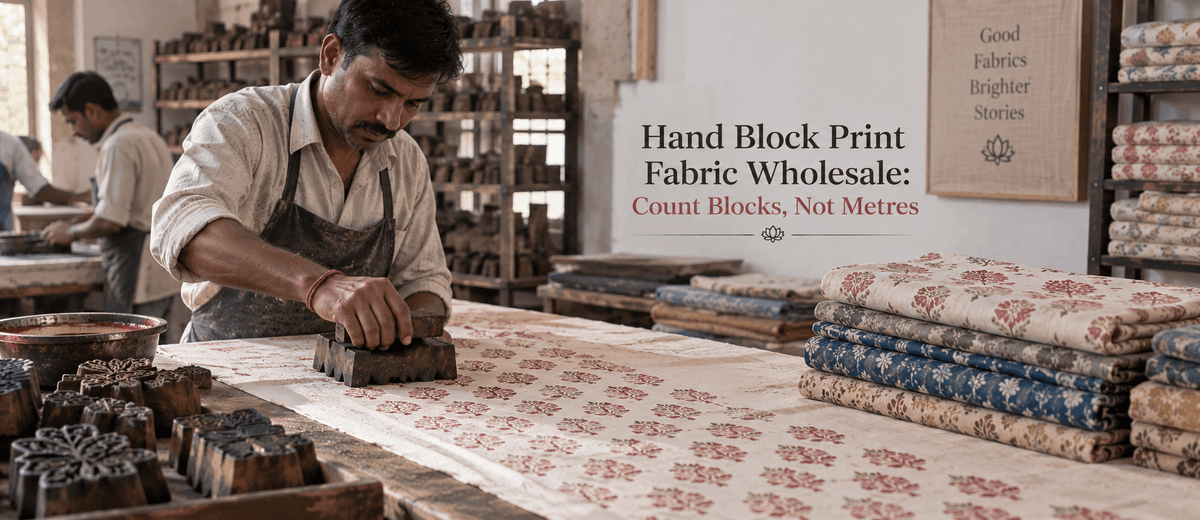
Hand Block Print Fabric Wholesale: Count Blocks, Not Metres
A buyer from Lajpat Nagar stood at our counter last spring with two block prints in front of her and one question. Both were cotton. Both were forty four inch. Both came out of the same printing cluster in Rajasthan. One was quoted at Rs 140 a metre plus the other at Rs 480. She wanted to know what she was paying three and a half times for.
The answer was sitting on the cloth in plain sight. The first design used three blocks. The second used eleven. She had been comparing fabrics when the trade was actually selling her printer hours.
Quick answer: Block count sets the rate, not metrage or design. One block per colour, one pass per block, one drying cycle between passes. Verify it is genuinely hand printed with the repeat-join walk, a thumb on the join line for one metre of selvedge. One or two stepped joins is normal. Zero over ten metres means machine. Fix the colour route in writing, because pigment crocks plus natural dye bleeds. Delhi trade rates run roughly Rs 90 to Rs 1,100 per metre.
One colour, one block, one pass down the table
A wooden block carries exactly one colour. That is the whole economics of this category in a sentence. If a design shows a black outline, a red flower, a green leaf plus an indigo ground, the printer has to walk the length of the table four separate times, plus the cloth has to dry between each walk before the next colour can be laid on top of it without smearing.
The trade has names for the three jobs those blocks do. The outline block is the rekh, which carries the drawing and sets the registration for everything after it. The filler blocks are the dattas, one for each interior colour that drops inside the outline. The background block is the gad, which covers the ground around the motif and is usually the heaviest cutting job of the set. A quoted design with four colours therefore needs a minimum of four carved blocks before a single metre gets printed, plus those blocks were cut by hand out of seasoned teak by a separate karigar who was paid before the printer ever saw them.
So when a counter quotes you two rates on visually similar cloth, ask the block count before you ask anything else. Two to three blocks is a daily commercial print. Four to six is the working Bagru or Sanganer range that most boutique lines sit in. Seven to ten is a fine design where the colour separation is doing real work. Twelve and above almost always means a resist route with wash stages in between, which is a different production model rather than just a busier print.
The repeat-join walk, plus why a perfect print is the bad sign
Every block is smaller than the cloth, so the printer lands it, lifts it, moves along, then lands it again beside the first impression. Registration is done by eye against tiny raised dots cut into the corners of the block. That is a human lining up a wooden object against a pin prick, several thousand times a day, in a hot shed.
Which means the joins drift, plus that drift is your authenticity check. Rest a thumb flat on the line where one impression meets the next, then walk it along the selvedge for a full metre while your eye follows the repeat. Count the joins that visibly step, overlap or leave a hairline gap. One or two in a metre is healthy hand registration on a commercial grade. Five or more says the printer was moving too fast, so expect that inconsistency to show up across a matched set of panels.
Now the part that catches most buyers out. If you walk ten metres and find no drift at all, you are not holding a superior hand block print. You are holding a rotary or screen print that has been sold to you as hand block, because a machine cannot miss a register and a human cannot avoid one. Perfection on this cloth is evidence against it. The second tell is the reverse face: a genuine hand block impression pushes colour through the weave unevenly, so the back reads as a softer ghost of the front rather than as a clean flat copy. Our hand block print range is walked at the selvedge before release rather than checked from the top fold.
Pigment or natural dye, the decision that outlives the sale
This is where returns come from, so settle it at booking rather than discovering it from a customer.
Pigment colour sits on top of the cloth held down by a binder. It gives bright shades on any fibre, it costs less, it needs no wash stage plus it is what the majority of commercial block print runs use. The trade off is a slightly stiffer hand over the printed area and a tendency to crock, meaning dry colour transfers by rubbing onto anything lighter that touches it. A navy pigment print against a cream lining will mark the lining.
Natural and vegetable dye penetrates the fibre instead. The hand stays soft everywhere, the shades read deeper plus quieter, the cloth ages well. The trade off is that loose surface dye releases on the first wet, so the customer sees colour in the water and believes the fabric is defective when it is behaving exactly as it should. Test both routes the same way. Fold the printed face against itself, rub plain white cloth across the fold ten firm strokes, then look at the white. Heavy transfer means a pigment print with too much loose colour or too little binder cure, so send it back. A faint trace on a natural dye is normal, so what you do about it is a line on the swing tag telling the customer to first wash separately in cold water.
Hand block print qualities plus Delhi trade rates
| Quality | Usual ground | Blocks per design | Colour route | Delhi trade price (per metre) |
|---|---|---|---|---|
| Daily two block print | Cambric, voile | 2 to 3 | Pigment | Rs 90 to Rs 150 |
| Bagru or Sanganer standard | Mul cotton, fine cotton | 4 to 6 | Pigment or part natural | Rs 160 to Rs 260 |
| Fine multi colour | Fine cotton, cotton silk | 7 to 10 | Mostly natural | Rs 320 to Rs 520 |
| Block on silk or chanderi | Chanderi, dupion, silk cotton | 4 to 8 | Pigment on silk | Rs 480 to Rs 900 |
| Resist route, ajrakh or dabu | Cotton, modal | 12 to 16, multi stage | Full natural with resist | Rs 620 to Rs 1,100 |
Read the ground column as carefully as the price column. Block printing leaves most of the cloth untouched, unlike an allover machine print that buries the base under colour, so the buyer is still buying the ground fabric on its own merits. A weak cambric under a beautiful eleven block design is still a weak cambric on the customer's back at week six. Compare it against the wider printed fabric range and the difference is obvious to the hand.
Your lot is a table, not a thaan
Hand block printing happens on a padded table, plus that table is usually twenty to thirty metres long. The printer lays a length, works it, lifts it off to dry, then lays the next length. Colour is mixed in a tray at the side of that table, by hand, to a recipe held by a person rather than by a machine.
So a reorder is not a repeat of your lot. It is a fresh table run with a freshly mixed tray, so the shade will land somewhere close rather than on top of the original. This is the single most expensive lesson in the category, because a boutique that sells through forty metres in three weeks then orders forty more is going to get cloth it cannot merchandise beside the first batch. Buy the full requirement in one table run or accept two shades in the line. There is no third option, whatever the supplier says on the phone.
Two habits follow from that. Fix the exact metrage before the run starts rather than after the first sale tells you it works, plus get the table run number written on the bill so a later dispute has something factual in it. Ask also for the offcut at the end of the run to be kept back with your name on it, since matching a future order against a physical piece is a different conversation from matching it against a memory.
What to settle before a hand block print booking
- Ask the block count before the rate. Two blocks and eleven blocks on the same cotton are different products, not different prices.
- Run the repeat-join walk for a full metre. One or two stepped joins is hand work. None over ten metres is a machine print with a hand block bill.
- Rub a fold on white cloth, ten strokes. Heavy transfer means the pigment is not cured, so reject the lot rather than negotiating it.
- Get the colour route written on the bill. Pigment or natural changes what you print on the swing tag and what the customer does on the first wash.
- Book the whole requirement in one table run. A reorder is a new tray of colour, so treat it as a new shade.
- Agree a defect allowance up front. A few smudged or doubled impressions per thaan is normal on hand work, so name the number at booking instead of claiming it later.
- Age the cloth before it goes to the cutting table. A fresh pigment run carries a binder smell plus needs a few days settled flat before it behaves predictably under a needle.
Hand block print questions that come up at the counter
How do I tell a hand block print from a machine print in ten seconds?
Look for the evidence of a human rather than for quality. Three things give it away quickly. First, the join drift described above, which a machine physically cannot produce because its registration is mechanical. Second, the edge of an individual motif: a wooden block picks up colour unevenly across its carved face, so a hand printed motif has a slightly heavier deposit where the block was pressed harder plus a lighter patch where it was not, while a screen or rotary motif is flat and even edge to edge. Third, the reverse. Hand pressure pushes colour partway through the weave, so the back shows a soft irregular ghost of the front. A pigment machine print often leaves the reverse almost clean, while a rotary print leaves a mechanically even shadow. Take any two of the three and you have your answer without needing to trust the label. The one thing that will not help you is the price, since a well made machine print on good cotton is frequently quoted above a poor hand block run on cambric.
Does hand block print fabric bleed on the first wash?
Some loose colour on the first wet is normal on natural dyed block prints plus it is not a defect, but the customer will treat it as one unless you get in front of it. The practical position is to put the instruction on the swing tag rather than in a conversation at the till, because a tag survives where a conversation does not. The wording that works is first wash separately in cold water with no detergent, dry in shade rather than in direct sun, then normal cold machine washing after that. For pigment prints the risk is different. It is crocking rather than bleeding, meaning dry rub transfer, which is why a dark pigment print should not be lined in cream or worn against a white blouse without a barrier. If you are supplying boutiques rather than end customers, put both notes on the delivery challan so the instruction travels down the chain with the cloth instead of stopping at your godown.
Why does the same design come back in a different size on reorder?
Because the block itself is a consumable. Teak blocks wear at the carved edges under thousands of impressions, they get recut when the detail goes soft plus they eventually get replaced by a fresh cutting from the same drawing. A recut block is never dimensionally identical to the one it replaced, so a motif can come back fractionally larger, smaller or with a slightly different repeat pitch. On a scattered buti the difference is invisible. On a directional border or a placement print where you have built a garment pattern around the repeat, it will cost you a recut of the pattern. The way to manage it is to ask at booking whether the design will run on the original blocks or on a recut set, then to hold a metre of the original run as a physical reference. If the design is central to a line you intend to carry for a season, buying against one block set for the whole season is cheaper than redoing the pattern midway.
Is there a minimum order on hand block printing?
Yes, plus it is driven by set up rather than by cloth. Before a single metre prints, someone has to mix the colour tray to your shade, lay and pin the cloth to the table, then run test impressions on waste until the registration is true. That work costs the same whether the run is ten metres or two hundred. Most Rajasthan clusters therefore quote a working minimum somewhere around forty to sixty metres for an existing design in a stock shade, rising steeply if you want a custom colourway because the tray has to be mixed to a new recipe plus matched across the run. If you want a new block cut to your own drawing, add the carving cost as a one time charge plus a lead time of two to four weeks before printing even starts. For a small boutique the sensible route is to buy from an existing run rather than commission one, which is exactly why a stocked hand block range exists at a lower rate than a bespoke order.
Booking hand block print lots at trade rates
If you run a boutique, a label or a reselling line, the working route to trade pricing on hand block print is the wholesale programme. You get the block count stated at quotation instead of a design name, the colour route confirmed in writing as pigment or natural before the lot is committed, a metre released for your own white cloth rub test, the table run number written onto the bill so a reorder conversation has a fact in it, the run offcut held back under your name for future shade matching, a defect allowance agreed at booking rather than argued after delivery, plus cloth aged flat before dispatch rather than sent out fresh off the drying line. See the tiers and register on our bulk buying and registration page to open your first hand block print order.