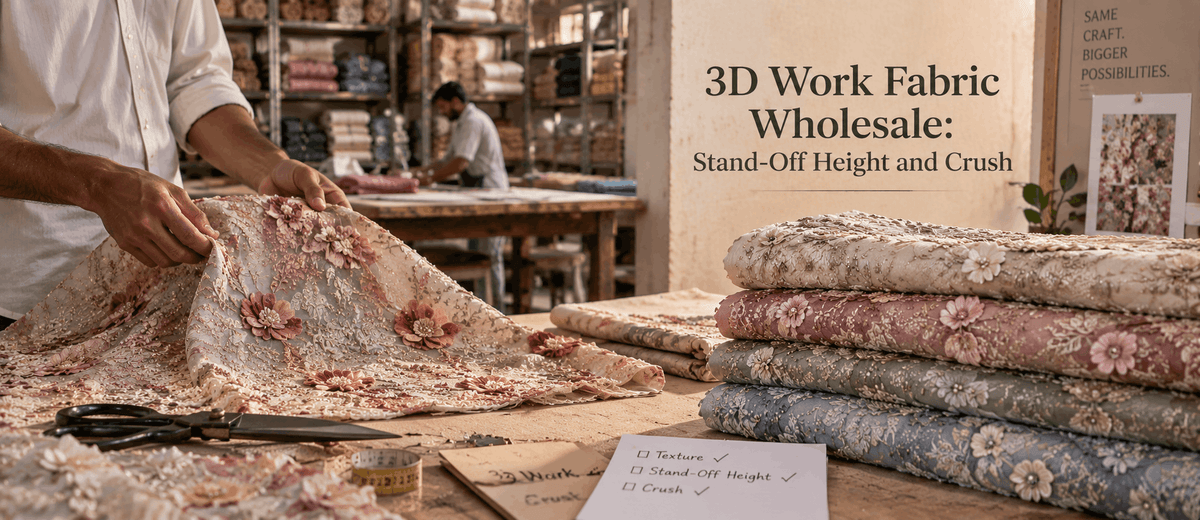
3D Work Fabric Wholesale: Stand-Off Height and Crush
A label in Chhatarpur once accepted a 3D flower lot on the counter, then called us four days later to say the fabric that arrived was not the fabric they had bought. It was. It had simply spent four days folded into a bale with two other rolls sitting on top of it, so every flower on the outside of the fold was lying down.
Nothing on the bill was wrong. Nobody had swapped anything. The lot had been bought the way flat embroidery is bought, by looking at it, plus 3D work is the one category on a wholesale floor where looking at it tells you almost nothing.
Quick answer: Buy on stand-off height plus crush recovery, not on motif design. Run the book test, a hardback laid flat on the work for sixty seconds, then time the rebound. Under thirty seconds is sound. Still flat at five minutes is a dead lot. Roll a motif 180 degrees to check it has two anchors rather than one. Take delivery rolled on a wide core, never folded. Delhi trade rates run roughly Rs 320 to Rs 1,100 per metre.
Five builds hiding under one bill heading
The trade writes 3D work on a bill the way it writes embroidery, as though it were one thing. It is at least five, each of which behaves differently once a garment is cut from it.
Gathered fabric flowers, which the floor calls rosettes, are petals of cloth stitched then drawn up into a bloom. They crush easily plus recover well, because there is nothing rigid inside them to take a set. Wired or coiled work uses a sprung metal or thread coil that holds its own geometry, so it resists crushing hard until the moment it bends, after which it stays bent permanently. Padded work, which a tailor would call trapunto, stuffs the motif from behind so the face lifts, giving the lowest projection plus by far the best recovery. Moulded petals are heat set out of a thermoplastic sheet, which buys you the highest projection in the category plus the lowest heat tolerance, because the same heat that formed the petal will unform it. Foam backed applique sandwiches a foam layer under a cloth motif, which recovers well at first then compresses permanently over months of storage.
Ask which build you are looking at before you ask the rate. Two lots at the same price with the same flower size can be a rosette that survives a year in a wardrobe plus a moulded petal that dies the first time it meets a steam iron.
The book test, sixty seconds that tells you what will arrive
Crush recovery is the single number that matters on this category, because crushing is not a risk. It is a certainty. The cloth gets rolled, carried, stacked, cut, hung, bagged, then folded into a wardrobe, so at every one of those points something presses on the work.
So measure it at the counter rather than hoping. Take any hardback book off the desk, lay it flat across a worked area of the piece so the weight spreads evenly, then leave it for a full sixty seconds. Lift it off and watch. A sound lot has the motifs standing back up inside about thirty seconds, so you will actually see them rise. A borderline lot takes a minute or two plus needs a shake to finish the job, which is workable if you tell the customer to hang the garment rather than shelve it. A lot that is still lying flat after five minutes is not going to recover in a carton either, so the cloth your customer unwraps will not be the cloth you approved.
Run it at two places on the piece rather than one, because density varies down a roll and the heavily worked sections crush differently from the scattered ones. Write the recovery time on your order copy in seconds. A supplier who has seen you time a lot once will grade the next one honestly without being asked. Every piece in our 3D work range is timed at two points before it leaves the floor rather than judged by eye.
The two-anchor roll, because a raised motif hangs off very little
A flat motif is stitched down along its whole footprint. A raised one is not, because the body of it stands clear of the cloth, so it is held at a handful of contact points and sometimes at only one. That changes the failure mode completely. Flat work fails by fraying at an edge. Raised work fails by an entire flower swinging loose from its single stitch, usually in a shop, usually on a garment a customer is already holding.
Test for it by rolling rather than pulling, since pulling only tells you the thread is strong. Pinch a motif between finger and thumb, then roll it a full 180 degrees against the ground. A motif anchored at two or more points resists the twist plus springs back when you let go. A single-point motif rotates freely and stays where you left it, which means it is a spinner and every one of its siblings on that piece is too. Do five motifs across the width rather than one, plus include one at the selvedge, where the frame tension was different and the anchoring is usually weakest.
Where a piece fails this check it is not automatically a reject. It is a costing change, because the stitching room now has to tack every motif down by hand before the panel goes into the garment, which is an operation nobody budgeted. Price that in at booking or leave the lot behind.
3D work builds plus Delhi trade rates
| Build | What projects | Stand-off height | Crush recovery | Delhi trade price (per metre) |
|---|---|---|---|---|
| Padded or trapunto raised | Motif stuffed from behind | 3 to 8 mm | Best in the category | Rs 420 to Rs 780 |
| Foam backed applique | Foam under a cloth motif | 4 to 10 mm | Good early, sets over months | Rs 380 to Rs 720 |
| Gathered flower or rosette | Stitched cloth petals | 8 to 20 mm | Crushes easily, shakes out | Rs 320 to Rs 650 |
| Wired or coiled work | Sprung metal or thread coil | 5 to 12 mm | Resists, then bends for good | Rs 480 to Rs 900 |
| Moulded thermoformed petal | Heat set poly sheet | 10 to 25 mm | Moderate, very heat sensitive | Rs 560 to Rs 1,100 |
Read the recovery column against the price column rather than the height column. The two most expensive builds in that table are also the two that fail permanently rather than temporarily, which is the opposite of how buyers instinctively read a rate card. Against the wider embroidered fabric range, 3D work carries a rate step up that is buying you projection, not durability.
Placement, seams plus the chair rule
A raised motif cannot go everywhere on a garment, so the placement map has to be settled before anything is cut rather than negotiated at the machine.
Three zones are simply out. Nothing raised belongs inside a seam allowance, because the presser foot will ride over it and throw the seam off line. Nothing raised belongs under a waistband, a belt or a closure, since the garment will not sit flat plus the motif gets permanently flattened anyway. Nothing raised belongs in a sitting zone, meaning the back of a lehenga skirt at seat level or the lower back of a jacket, which is the rule the floor calls the chair rule for obvious reasons. A bride will sit down for two hours at a reception, so whatever is on that panel is finished.
Then there is the marker. A cutting marker cannot cross a raised motif, because the layers will not lie flat and the blade will not track true, so panels have to be nested around the work instead of tessellated tightly. That is where the wastage comes from. A scattered 3D layout runs roughly ten to thirteen per cent placement wastage against a flat equivalent, plus a dense or bordered layout runs to about eighteen. Cost the metres against that figure rather than against your usual embroidery allowance, otherwise the lot comes up short two thirds of the way through the cut.
Why this category is billed by volume, not weight
Katdana and bead work make a lot heavy. 3D work makes a lot big, which costs more.
A roll of flat embroidery forty metres long might sit at a modest diameter. The same forty metres of 20 mm moulded petal work cannot be wound tight without crushing itself, so it goes onto a wide core at a loose wind and comes out as a package two or three times the diameter. Transporters charge the greater of actual weight or volumetric weight, so on this category the volume number wins almost every time. Budget freight on volume rather than on the weight of the cloth, plus do not be surprised by a bill that looks disproportionate to what is physically a light fabric.
Storage runs the same way. This cloth is never folded, never stacked, never bale packed. It goes on a wide core, stands upright or hangs on a horizontal bar, plus it sits alone rather than under anything. If your godown cannot give it that space, buy it in smaller quantities closer to the cutting date instead of holding season stock you are slowly ruining.
What to settle before a 3D work booking
- Ask which of the five builds it is. Rosette, wired, padded, moulded or foam backed are five different products at one bill heading.
- Run the book test at two points on the piece. Sixty seconds under a hardback, then time the rebound in seconds and write it down.
- Roll five motifs 180 degrees, one of them at the selvedge. A spinner means the stitching room has to hand tack every motif, so price that in.
- Get stand-off height stated in millimetres. It drives freight, storage plus what the garment can be lined with.
- Agree the placement map before cutting. No motif in a seam allowance, under a waistband or in a sitting zone.
- Cost metres at ten to eighteen per cent wastage. A marker cannot cross a raised motif, so your normal embroidery allowance will fall short.
- Specify rolled delivery on a wide core. Written on the docket, because a bale is the default and a bale kills the lot.
- Put no iron on the face on the docket plus the swing tag. Moulded petals unform at the temperature that formed them.
3D work questions that come up at the counter
Can 3D work fabric be pressed at all?
Never on the face, though the answer differs by build underneath that rule. Padded and foam backed work tolerates a warm iron on the reverse with a cloth between, since the face is standing clear of the board so nothing is bearing on the motif. Gathered rosettes also survive reverse pressing, though the petals will need shaking out afterwards to open properly. Wired work should not be pressed at all, because heat softens whatever coating is on the coil plus the board flattens the geometry you paid for. Moulded thermoformed petals are the absolute limit: they were shaped by heat, so heat is the one thing guaranteed to destroy them, plus a steam table anywhere near the lot is a hazard rather than a tool. The working instruction for a stitching floor is to press the panel before the worked section is joined wherever the construction allows it, then to steam the unworked areas only, holding the iron above the cloth rather than on it. Put that on the docket rather than assuming a karigar knows, because most of them are used to flat embroidery where none of this applies.
How do I stop 3D work getting crushed in transit?
Specify the packing in writing at booking, because every default in the supply chain works against you. Ask for the cloth rolled on a wide diameter core rather than a standard one, since a tight wind crushes the inner layers against themselves, plus ask for a loose wind so the motifs are not compressed by the tension of the roll. Ask for interleaving, meaning a layer of tissue or non woven between wraps, which stops the motifs of one layer from pressing into the gaps of the next. Ask for the roll to travel upright or suspended rather than laid down under other goods, which is the specific failure that kills most lots, since a transporter will stack anything flat that fits. On receipt, unwrap and stand the roll the same day rather than leaving it in its packing over a weekend. If a lot does arrive crushed, hang it in a humid room overnight before deciding it is a loss, because rosettes plus padded work often recover with time and moisture where a moulded petal will not.
Why is 3D work priced per metre when so little of the surface is worked?
Because you are buying the operation, not the coverage. A 3D motif is built in stages rather than stitched in a pass: the petal or shape is cut or moulded separately, formed or gathered, then attached to the ground as a second job, plus on the better qualities a third pass tacks it at a second anchor point. That is three or four touches per motif against one for a flat embroidery stitch, all of it done at a frame or by hand rather than by a machine head running continuously. A scattered layout with plenty of bare ground can therefore carry more labour than a dense flat allover on the same width. The corollary for a buyer is that motif count per square foot, not the look of the coverage, is what you should be comparing between two quotes. Count the motifs inside a flat palm width on both pieces before you decide one is better value than the other, since the eye reads the size of the flowers rather than the number of operations behind them.
Will a reorder of the same 3D design actually match?
Less closely than on flat goods, for two reasons that stack. The first is the ordinary one, a fresh dye lot on both the ground cloth plus the motif cloth, which is the same two lot problem any applique carries. The second is specific to raised work: the forming stage is not perfectly repeatable. A gathered rosette is drawn up by hand, so its height and openness vary by the hand that made it plus by the day. A moulded petal depends on press temperature and dwell time, so a later batch can come off fractionally shallower or with a different curl. Neither shows in a photograph, both show when the two batches sit in one line on a rail. The practical answer is to buy the full requirement in one lot wherever the season allows it, plus where a reorder is unavoidable, to send back a physical metre of the original rather than a design code, then to ask for a sample metre off the new run before the balance is cut. Approving a sample against the old cloth in daylight takes ten minutes and saves the whole order.
Booking 3D work lots at trade rates
If you run a boutique, a label or a reselling line, the working route to trade pricing on 3D work is the wholesale programme. You get the build named at quotation rather than the phrase 3D work, stand-off height stated in millimetres, the book test run in front of you at two points on the piece with the recovery time written on the quotation, a five motif roll check on the anchoring before the lot is committed, a placement map agreed against your garment before any metre is cut, wastage costed at the real ten to eighteen per cent instead of a flat embroidery allowance, plus rolled delivery on a wide core with interleaving written onto the dispatch docket so nothing arrives in a bale. See the tiers and register on our bulk buying and registration page to open your first 3D work order.