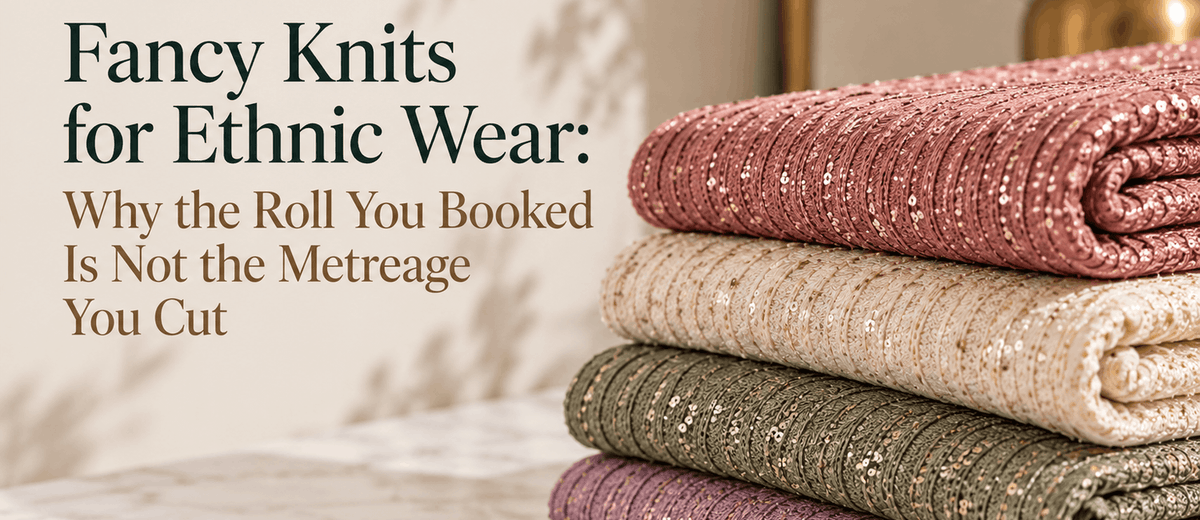
Fancy Knits for Ethnic Wear: Why the Roll You Booked Is Not the Metreage You Cut
A boutique from Shahpur Jat booked eight rolls of a textured knit in July, cut the size run in August, then came back holding two kurtis that had gone a full size smaller after one steam press. Nothing was wrong with the cloth. The roll had never been allowed to relax.
Knits reach the Delhi counter through the same lanes as woven cloth. They get billed the same way, stacked on the same shelf, quoted against the same rate card. They do not behave the same way at any stage after that.
This is the first cloth in this series that is not woven. Everything the trade knows about grain, width and marker planning was built around warp crossing weft. A knit has neither. It is one yarn looping through itself, so it moves in directions woven cloth simply cannot.
Quick answer: Knitted fabric is wound onto the roll under machine tension, so it arrives compressed along its length. Left flat for a day it relaxes back, losing length while gaining width. That is relaxation shrinkage rather than wash shrinkage. It is why a knit roll measured at the counter yields less usable cloth than the tag says. Relax the roll before you measure it, never after you cut it.
What the trade means by fancy knits
In this market the term covers anything knitted that is not plain hosiery. Textured surfaces, self patterns, ribbed and pointelle structures, loop piles, jacquard knits with a raised motif. The word fancy is doing a lot of work. It groups together structures that shrink differently, curl differently, then price differently.
The split that matters commercially is single structure against double structure. A single jersey type knit has one bed of loops. It is lighter, cheaper, faster to produce. It curls at every raw edge. A double structure knit such as interlock or a rib has two interlocking beds. It costs more, hangs heavier, lies flat when you cut it.
Your bill will almost never record which one you bought. It says fancy knit. If you are placing this cloth against your regular woven end use, our knitted ranges stocked for boutique production are the reference set to feel a single structure against a double one.
Three counter tests that take under five minutes
The edge curl test
Cut a small square off the roll end. Lay it flat. Watch the edges for thirty seconds. A single structure knit starts rolling towards itself almost immediately, tighter on the cut ends than the sides. A double structure knit sits flat and stays flat.
Curl is not a defect. It is a cost. Curling cloth slows every operation in the stitching room because the karigar has to fight the edge at the machine. On a thirty piece run that is an hour. On three hundred pieces it is a week you did not quote for.
The recovery test
Take a ten centimetre span between both hands. Stretch it to roughly half again as long, hold for ten seconds, release. Good elastane content snaps back to the original span while you watch. Poor recovery leaves the span visibly longer than it started.
Run this across the width first, then along the length. Knits stretch far more across than along. A cloth that recovers well one way while going slack the other will bag at the seat of a kurti after two wears. That is the complaint that comes back as a quality issue three weeks after delivery.
The pill rub
Rub a swatch against itself firmly, about twenty strokes, in one spot. Hold it to the light at an angle. Short loose fibre standing up means pilling is coming. Spun yarn knits pill more readily than filament yarn knits because there are more loose fibre ends to work free.
Do this before you book, not after the customer does it for you. A knit that pills is still a perfectly good cloth for a jacket or a layered piece where the abrasion points are fewer. It is the wrong cloth for a fitted daily kurti.
Relaxation shrinkage, the money question
Knitting machines deliver cloth onto a roll under tension. That tension stays in the fabric. Nobody is hiding it from you. It is simply how the cloth leaves the machine.
Spread the roll on a flat table, single layer, no tension at either end. Leave it twenty four hours. Measure the same marked span before and after. On textured knits we regularly see the length come in while the width opens out. The cloth has not lost anything. It has returned to its natural dimension.
Two things follow from that. Your usable metreage is the relaxed figure, never the roll figure, so write the relaxed number on the order copy. And your marker must be planned on relaxed width, because a marker built on the tensioned width will not fit once the cloth settles.
Skip the relaxation day and the shrinkage does not disappear. It waits and happens inside the finished garment at the first steam press instead. That is exactly the size run that came back from Shahpur Jat.
Four checks before a knit lot is booked
- Confirm whether the roll is tubular or open width. Tubular cloth has two permanent fold lines that cannot be pressed out, so panels crossing them are waste.
- Relax a sample length for a full day, then measure width at three points. Book against that figure.
- Ask whether the lot is billed by weight or by the metre. Knits are commonly sold by weight, so a heavier construction at the same rate per kilo gives you fewer metres.
- Check the knitting batch reference separately from the dye lot. A shade match across two knitting batches can still differ in loop density enough to read as two colours under shop light.
That last point catches boutiques on repeat orders. Same shade, same mill, same bill description, visibly different surface. Book the full requirement in one go wherever the design allows.
Where fancy knits earn their rate
Comfort without a fitting. A knit forgives a half inch of measurement error that a woven cloth punishes, which is why it works for stock sizes sold off the rail rather than made to measure. It also layers well under winter ethnic wear without adding bulk at the armhole.
The natural end use is the everyday kurti rather than the occasion piece, so it pairs sensibly with the kurti ranges boutiques restock through the season rather than sitting against heavy festive cloth.
Where knits do not earn their rate is anywhere the design needs a crisp held line or dense surface work. Knife pleats fall out. Heavy embroidery distorts the loops around every stitch and the distortion does not press back. Send that work to a woven base.
Questions buyers ask at the counter
Can I use my woven marker for a knit?
No. Beyond the relaxed width problem, a knit has a wale line rather than a grain line, so panels must be aligned to the wale or the garment will twist on the body after washing. Re-plan the marker rather than adapting the old one.
Why does my knit kurti twist at the side seam?
Spirality. Circular knitting imparts a slight rotation to the loops that survives into the finished cloth. It shows up after the first wash as a side seam creeping towards the front. Ask whether the lot was heat set to correct it before you book depth.
Does a knit need interlining?
At plackets, button bands and necklines, yes, with a stretch interlining. A rigid woven fusing locks those areas while the surrounding cloth still moves, so the seam ripples permanently. This is the most common finishing error on knits in house.
How much extra cloth should I budget over a woven kurti?
Plan for more than the woven equivalent, because relaxed width is narrower than roll width while tubular fold lines remove usable area. Boutiques that budget a like for like metreage against woven run short on the last sizes of the run almost every time.
Ready to book a lot?
Bring a knit garment that disappointed you last season. We will run the curl, recovery and pill tests against current lots at the counter so the difference sits in your hand rather than in a description. Trade rates, relaxed width confirmation and knitting batch references are handled through our wholesale counter for boutiques and bulk buyers.