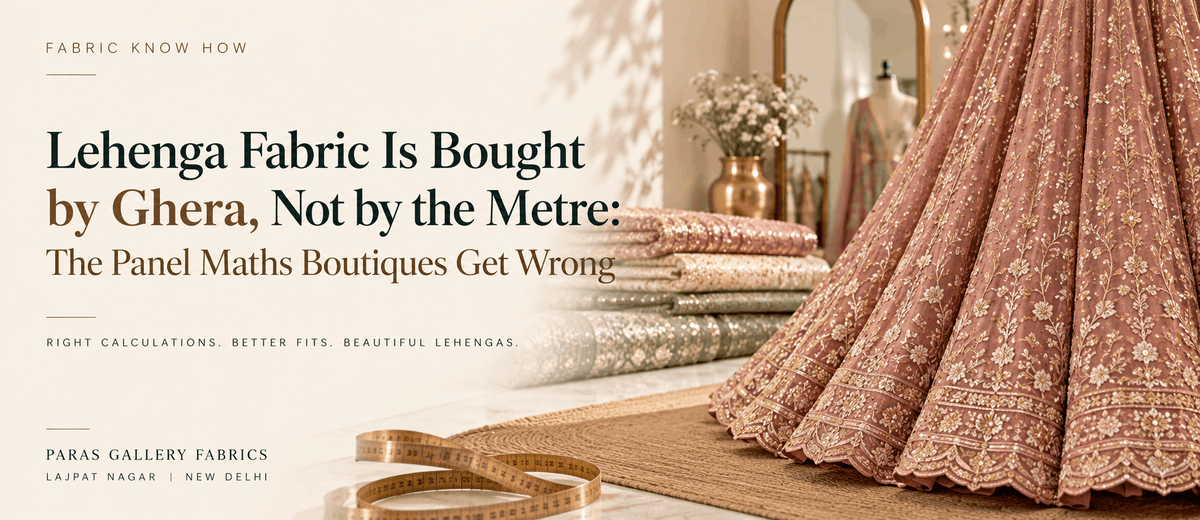
Lehenga Fabric Is Bought by Ghera, Not by the Metre: The Panel Maths Boutiques Get Wrong
A designer in Chhatarpur asked for a rate on a lehenga cloth, got a per metre figure, quoted her customer from it, then lost most of the margin when the cutting table needed eleven metres instead of the seven she had assumed. The rate was correct. The question was wrong.
Nobody wears metres. The customer is buying a hem circumference. The cloth has to be converted into that circumference through a panel count, a panel width, then a cutting direction. Every one of those three multiplies your consumption.
This guide is about the arithmetic between the rate card and the finished ghera. It is the part of lehenga buying that no rate card carries.
Quick answer: A lehenga is built from tapered panels called kalis. Ghera is the finished hem circumference, so the cloth needed is the kali count multiplied by the widest point of one kali, divided by how many kalis fit across the usable cloth width, multiplied by the lehenga length. Usable width and cutting direction decide the answer far more than the rate does. Quote per lehenga, never per metre.
Why the same ghera costs two different amounts
Take a fixed target, say a full flare lehenga in a heavier base. Two cloths at an identical rate can land a long way apart on the final bill for three reasons that have nothing to do with quality.
Usable width is the first. A wider cloth fits more kali tips across the same length, so the number of kalis you get per metre changes. The second is directionality. A cloth with a one way motif, a pile like velvet or a border along one selvedge forces every kali to face the same direction, which kills the nesting that makes a marker efficient.
The third is whether the kalis are cut straight or on the bias. Bias cut kalis fall beautifully. They also consume noticeably more cloth because a diagonal panel cannot nest against its neighbour. If your customer has asked for that fall, the cloth budget changes before you have chosen a colour.
| What changes | Effect on cloth needed | Ask before booking |
| Narrower usable width | Fewer kalis per metre, more length | Measured width, not tag width |
| One way motif or pile | No head to toe nesting, marker loses efficiency | Is the design directional |
| Border along one selvedge | Panel length locked to border position | Border pitch and repeat |
| Bias cut kalis | Diagonal panels cannot nest, waste rises sharply | Straight or bias, confirmed in writing |
| Higher kali count for the same ghera | Narrower panels, better nesting, more seams | Kali count fixed at design stage |
The shade step nobody sees until the seams are closed
This is the single most expensive mistake in lehenga sourcing. Kalis sit directly against each other around the body. Any shade difference between two panels meets along a vertical seam at eye level, under function lighting, on a garment the customer will be photographed in all evening.
On a dupatta or a kurti a slight lot variation disappears. On a lehenga it forms a visible stripe. Dye lots vary across a roll as well as between rolls, so cloth from the two ends of the same thaan can step.
The counter rule is straightforward. One lehenga comes out of one continuous length, cut in sequence, panels numbered as they leave the table so the stitching room reassembles them in the order they were cut. Never make up a shortfall from a second thaan, even a thaan of the same lot number.
Which means the booking decision happens before the cutting decision. Book the full length for the full order in one go. A reorder three weeks later for two extra lehengas is a different dye lot in practice, whatever the bill says.
Weight budget and where it sits on the body
A lehenga carries its entire weight from the waist. Two garments of the same total weight are not equally wearable, because the distribution decides comfort. Weight low at the hem swings well. Weight high near the waist is dead load the customer feels within an hour.
That is why a heavy border on a light base outperforms a uniformly heavy cloth at the same finished weight. It also explains a complaint that reaches the counter as a fabric problem when it is a construction problem. The customer says the lehenga is too heavy. What she means is that the flare is not carrying its own weight outward.
Base choice drives that. A crisp open structure holds ghera with very little mass, which is why net remains the working base under so much of this category. Our net bases stocked in depth for flare work are the reference point when you need circumference without loading the waist.
Four checks before a lehenga lot is booked
- Fix the kali count, the finished ghera and the lehenga length before asking for a rate. Without those three the rate cannot be converted into a quote.
- Measure usable width yourself with the cloth relaxed, then plan the marker on that figure rather than the tag.
- Confirm the full order length is available as one continuous piece from one lot before you commit to a customer date.
- For any embroidered or bordered base, check the repeat pitch against your kali length. A repeat that does not divide cleanly wastes cloth on every single panel.
Our buyers work backwards from the finished garment for exactly this reason, which is why the lehenga fabric range held for boutique orders is stocked in lengths that cover a full order rather than a single piece.
Season timing in the Delhi market
The lehenga pull runs ahead of the wedding cluster rather than during it. Boutiques booking after the cluster opens are competing for cloth against everyone who left it late, which is when continuous lengths become hard to secure. The lengths go first. Shades hold longer than lengths do.
Embroidered bases need the longest lead because the work is done after the base is woven, in a separate unit, on a separate queue. Plain and net bases can be pulled much closer to the date.
Questions buyers ask at the counter
More kalis or fewer for the same ghera?
More kalis means narrower panels, which nest better across the cloth width and usually cut consumption. The trade off is seam count. Every extra seam is labour plus one more place a shade step could show, so the saving is real only if the cloth came from one continuous length.
Can I add a kali later to increase the ghera?
Technically yes, visually rarely. The added panel comes from different cloth at a different time and sits between two panels that do not share its history. On a plain base you may get away with it. On anything dyed, printed or embroidered you will see the join.
Does the lining need to match the base cloth?
It needs to match the behaviour, not the fibre. A lining that hangs stiffer than the base fights the flare and collapses the ghera inward. A lining softer than the base lets the outer cloth swing while the inside lags. Match the drape first, the shade second.
How much should I add for wastage on a bias cut?
Materially more than a straight cut, because diagonal panels cannot nest and the off cuts are triangles with no second use. Confirm the cutting direction with the customer before you price the job rather than after, since the difference is large enough to move the quote.
Ready to book a lot?
Come with the kali count, the ghera and the length, not just a shade. We will work the panel maths at the counter with you, confirm the continuous length is there for the whole order, then hold it. Trade rates, lot continuity and lead times on embroidered bases are handled through our wholesale counter for boutiques and bulk buyers.