Heavy Border Fabric Wholesale: Why Repeat Length Sets Your Real Cost
Two suppliers quote you the same border design at Rs 900 a metre. One of them is thirty percent more expensive than the other and the quotation will never tell you which.
That gap has nothing to do with the work on the cloth. It comes from how the border is laid out on the roll, because on border goods you buy metres but you consume panels. Everything else on a border sample is secondary to that one arithmetic problem. A buyer who checks stitch quality, weight plus finish and then skips the tape measure has graded the cloth correctly and still costed the order wrong.
Quick answer: On heavy border fabric the repeat length decides your cost, not the rate per metre. Ask for the repeat in centimetres first. On cross border goods the repeat must clear your panel drop plus seam allowance or the thaan yields nothing. Measure border depth separately, since depth picks the garment. Check skew selvedge to border at three points across a metre. Delhi trade rates run roughly Rs 380 to Rs 2,800 per metre.
Border cloth is sold by the metre plus consumed by the panel
On allover goods a metre is a metre. Cut it anywhere, use all of it, waste is whatever your marker plan leaves behind. Border goods do not work that way, because the border has to land at a fixed place on the finished garment.
A lehenga panel needs its border at the hem. A kurta needs it at the sleeve opening or the front placket. A dupatta needs it at both ends. In every case the cloth between one border and the next either becomes a panel or becomes offcut. There is no third option. So the real unit is cost per finished panel: rate per metre multiplied by metres consumed per panel, including the dead length you cannot use. Run that number on two quotations and the cheaper rate frequently loses.
This is why border cloth deserves a different conversation at the counter from the one you have over jacquard or georgette. The question is not what the work costs. The question is how much cloth has to pass through your cutting room to produce one saleable panel.
Measure the repeat before you measure anything else
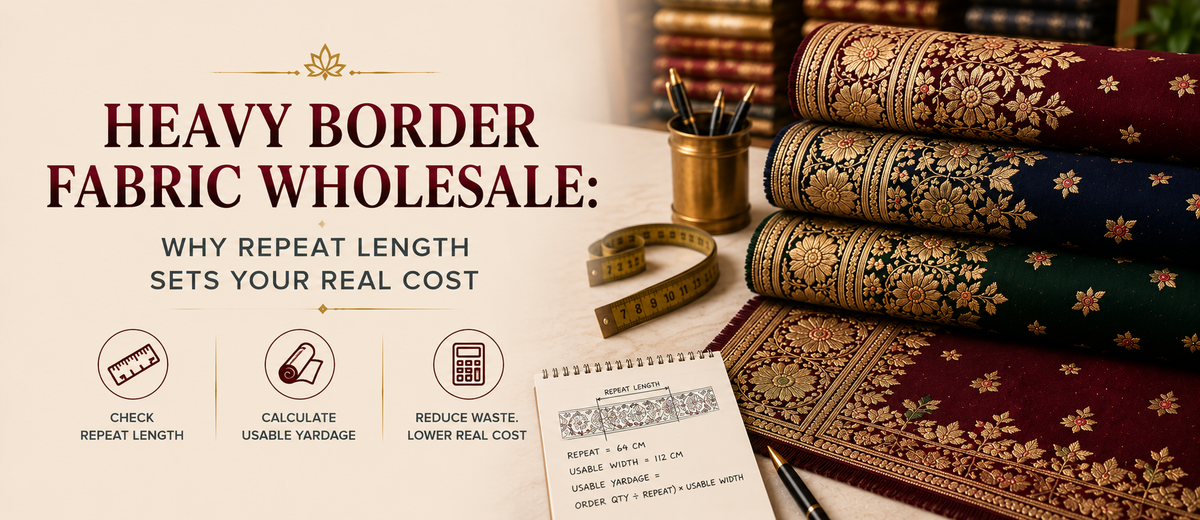
Repeat length is the distance from the start of one border motif to the start of the next. Ask for it in centimetres. If the seller answers in vague terms, put a tape on the thaan yourself and take it across three repeats, then divide, because a single repeat measured once carries too much error.
The layout tells you why the number matters. On a selvedge border the work runs down the length of the roll along one or both edges, so the repeat is a motif repeat and its job is seam matching. Get it wrong and a joined dupatta shows a broken motif at the seam. On a cross border, which the trade calls panel goods, the border runs weft-wise across the width and reappears at intervals down the roll. Here the repeat is your panel length, plus it is unforgiving. If the repeat measures 105 cm and your lehenga panel drop is 110 cm before seam allowance, that thaan cannot produce a single panel. No discount fixes it.
So carry your own panel drops to the market. A boutique running a fixed lehenga block already knows it needs, say, 112 cm plus 4 cm of allowance, which means nothing under a 118 cm repeat is worth discussing. That one figure will end half your border conversations in twenty seconds and save the rest of the day.
Border depth against garment drop: what suits what
Depth is the height of the band, measured from the outer edge inward. It is a different number from the repeat plus buyers routinely conflate the two on a quotation.
Roughly, 3 to 5 inches sits well on dupatta edges, kurta hems plus sleeve openings, where a deeper band would crowd a short garment. From 8 to 12 inches is saree pallu plus lehenga hem territory, deep enough to read across a room without swallowing the body of the garment. Past 14 inches you are into bridal, where the border stops being a trim and becomes a design element in its own right, plus the ground fabric barely shows on the lower half of the panel.
Depth also settles a practical question about weight. A deep, heavy band pulls the hem down, which is exactly what you want on a lehenga because it makes the flare hang instead of flying out. Put the same band on a lightweight georgette dupatta and it drags one edge, so the drape sits crooked no matter how it is pinned. Match band weight to ground weight before you match colour. You can see how depth reads across running designs in our heavy border fabric collection.
Heavy border qualities plus Delhi trade rates
| Quality | Layout | Typical depth | Best garment use | Delhi trade price (per metre) |
|---|---|---|---|---|
| Light woven selvedge border | Both edges, continuous | 2 to 4 inches | Daywear dupattas, kurta hems | Rs 380 to Rs 520 |
| Embroidered edge border | Single edge, continuous | 4 to 6 inches | Festive suit sets, stoles | Rs 620 to Rs 880 |
| Zari cross border panel | Weft-wise, repeating | 8 to 11 inches | Saree pallus, lehenga hems | Rs 1,100 to Rs 1,600 |
| Sequin plus bead heavy border | Weft-wise, repeating | 10 to 14 inches | Sangeet lehengas, gowns | Rs 1,500 to Rs 2,200 |
| Bridal multi-band panel | Graded bands per panel | 14 inches and above | Bridal lehengas, heirloom orders | Rs 2,000 to Rs 2,800 |
Read the bottom two rows against your block, not against your budget. A bridal multi-band panel carries three or four graded bands within one repeat, which means the repeat is long, the yield is one panel per repeat plus the offcut between panels is close to zero. A shallow border at half the rate can easily cost more per finished panel once the dead length is counted. Bridal blocks are also where a fixed panel drop matters most, which you can check against the shapes in our lehenga fabric range before you commit to a repeat.
Order tiers plus putting the cutting plan on the bill
| Order tier | Typical quantity | Rate movement | Who it suits |
|---|---|---|---|
| Sample repeat | 1 full repeat, not 1 metre | Retail rate | Designers checking panel drop against repeat |
| Small bulk | 1 thaan (about 18 to 22 m) | 6 to 10 percent off retail | Boutiques trialling one border block |
| Trade bulk | 5 to 20 thaans | 12 to 20 percent off retail | Resellers running a saree or lehenga line |
| Repeat-to-order run | 25 thaans and above, fixed repeat | Yield-linked rate on request | Exporters, labels with a standard panel block |
The top tier is the one boutiques underuse. Once your order is large enough to run a frame to your specification, the repeat becomes a variable you control rather than one you accept. Give the unit your panel drop plus your seam allowance and ask for the repeat set to that figure. Your dead length between panels then drops close to nothing. That single change usually beats any discount you could have negotiated on rate.
Whatever the tier, write three numbers on the bill instead of one: repeat length in centimetres, border depth in inches plus usable width between borders where the goods are selvedge bordered. A bill that names only a design number and a rate has recorded nothing you can hold a supplier to on the reorder.
Three ways a border thaan arrives unusable
The first is skew. The border should sit parallel to the selvedge, plus on frame-worked goods it often does not. Lay a metre flat, then measure from the selvedge to the top edge of the border at the start, the middle plus the end of that metre. Under about 6 mm of drift is workable. Past it, a straight cut produces a hem that reads visibly crooked on the body, plus your tailor will be blamed for a fault that arrived on the roll.
The second is repeat drift. Frame tension changes over a long run, so the repeat that measured 118 cm at the head of the thaan can measure 121 cm near the tail. Three centimetres sounds like nothing until it accumulates across twelve panels. Check the repeat at both ends of the roll before you accept it, not just at the open end the seller shows you.
The third is the fold crush. Heavy borders carry raised work, so a thaan folded across the border rather than rolled arrives with a pressed line straight through the band. On sequins plus bead borders that line is permanent, because the crushed components sit at a different angle to the rest. Ask for border goods rolled on a core. If they arrive folded, open the fold at the counter and look at the band before the bill is written.
Five checks before you release a heavy border booking
- Measure the repeat across three repeats, then divide. On cross border goods it must clear your panel drop plus seam allowance.
- Record border depth separately from repeat. Depth picks the garment, repeat picks the yield, plus they are not related.
- Check skew at three points across one metre. Past roughly 6 mm of drift every hem will read crooked.
- Re-measure the repeat at the far end of the thaan. Drift under frame tension is normal and it compounds down the roll.
- Cost the lot per finished panel, not per metre. Include the dead length between borders before you compare two quotations.
Border questions that come up at the counter
What is border repeat length plus why does it decide the price?
Repeat length is the distance from the start of one border to the start of the next along the roll. It decides price because border cloth is consumed in whole repeats rather than in metres. If a repeat runs 130 cm and your panel needs 116 cm, you pay for 130 and use 116, so fourteen centimetres of a heavily worked cloth becomes offcut on every panel. Multiply that across a hundred panels and it dominates any difference in headline rate. Two quotations only become comparable once you divide rate by usable panels rather than by metres, which is why the repeat belongs on the enquiry before the rate does.
Can one heavy border fabric serve both kurtas plus lehengas?
Selvedge bordered goods often can, cross border panel goods usually cannot. A selvedge border runs continuously down both edges, so you can cut a short kurta hem or a long lehenga panel from the same roll and the border still lands at the edge. Cross border goods place the band at a fixed interval, which means the interval either matches your garment or it does not. Depth is the second limit. A 12 inch band that reads well on a lehenga hem will reach past the hip on a kurta, so the same cloth that flatters one garment overwhelms the other. Buy selvedge bordered goods when you want flexibility across a range and cross border panels when you are running one committed block.
Why does a border look crooked after stitching when the cutting was straight?
Almost always skew that was present on the roll. If the border was not woven or worked parallel to the selvedge, then a cut taken square to the selvedge is not square to the border, so the finished hem tilts. It shows up worst on a full circle or heavily flared panel where the same border travels a long way around the body. The fix is to catch it before the bill: measure selvedge to border at three points across a metre and reject anything drifting past roughly 6 mm. If a lot with mild skew is already in your cutting room, cut to the border rather than to the selvedge and absorb the extra wastage, since a straight hem matters more to the customer than a straight grain on the lower panel.
How much extra should you order on heavy border fabric?
Budget 10 to 14 percent above your flat requirement on selvedge bordered goods plus 15 to 20 percent on cross border panels. The gap between the two figures is entirely placement. Selvedge goods let you nest panels along a continuous border, so wastage behaves like any placed print. Cross border goods force a cut at each repeat whether or not the panel needs the full length, so the dead length is structural rather than avoidable. Add a further three percent on any lot where the repeat measured differently at the two ends of the thaan, since drift eventually pushes a panel out of alignment and that panel gets recut rather than adjusted.
Lock heavy border fabric at trade rates
If you run a boutique, a label or a reselling line, the fastest way to secure trade pricing on border goods is to join the wholesale programme. You get thaan rates, repeat length declared in centimetres on the quotation, border depth stated separately from repeat, skew checked against the selvedge before dispatch, repeat measured at both ends of every thaan, goods rolled on a core rather than folded across the band, repeat-to-order runs where your panel block sets the repeat plus yield-linked rates when you want a full run reserved for your label. See the tiers and register on our wholesale fabric page to start your first bulk border order.