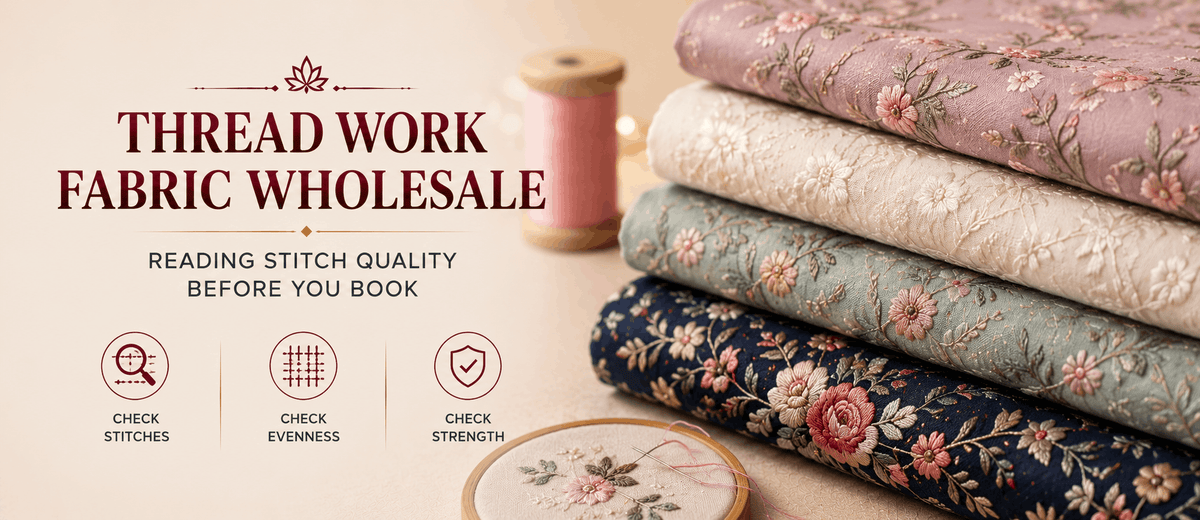
Thread Work Fabric Wholesale: Reading Stitch Quality Before You Book
Most embroidery arguments in this trade are about whether something will stay on. Will the stone hold. Will the sequin lift. Will the mirror pop out after a wash.
Thread work removes that whole conversation, because there is nothing sitting on the cloth to fall off. The design is stitched into the fabric rather than fixed onto it. What replaces the attachment question is a quieter set of problems that a buyer only meets after the lot is paid for: colour that walks into the next panel in the wash, a ground that has been pulled tight around its own motifs plus a reverse full of small jobs somebody has left for your karigar.
Quick answer: Thread work fabric wholesale means buying cloth by the thaan where the motif is built entirely from thread, with no zari, stones or sequins. Press a damp white swatch against the darkest thread for thirty seconds plus check for transfer. Hold the cloth to a window and look for a distorted halo around dense motifs. Count untrimmed jump threads on the reverse. Ask for stitch count per motif, not motif size. Delhi trade rates run roughly Rs 380 to Rs 1,900 per metre.
What counts as thread work once you strip out the metal
The trade uses the term loosely, so settle it before you quote. Thread work means the full motif is carried by thread. The moment a design takes a zari outline, a katdana filling or a sequin centre, it has moved into a mixed category with a different rate structure plus a different set of tests.
Within pure thread work, the thread itself splits three ways. Viscose rayon is the volume standard, because it takes dye beautifully plus it has the sheen that makes festive work look worked rather than printed. Polyester is stronger, holds colour far better plus reads slightly flatter, which is why it dominates export orders where wash testing is contractual. Silk thread appears on high end pieces, gives the softest hand plus costs several times the others. Most Delhi production is viscose, which is exactly why the first test below matters more than anything else in this guide.
A useful counter question: ask what thread the unit ran, not what thread they usually run. Units switch between viscose and polyester on the same design depending on what the mill supplied that month, so the answer for this lot is the only answer that helps you.
The bleed test that saves a whole festive lot
Viscose rayon thread bleeds. Not always, not on every dye, but often enough that this test belongs on every thread work sample you are shown.
Take a small white cotton swatch, damp it with plain water plus wring it almost dry. Lay it over the darkest thread on the sample, usually a maroon, a navy or a deep green, then press hard with your thumb for thirty seconds. Lift it plus look at the white. Any tint at all, even faint, means that colour will move in a wash. Do it once more on the second darkest colour, because a design can be sound in one shade plus loose in another from the same lot.
If the rub test shows anything, run the longer version before you book. Cut a ten centimetre piece, soak it in lukewarm water with a plain white cotton strip lying against the embroidery, leave it thirty minutes plus dry both flat without rinsing. What you are looking for is not just colour on the white strip. Check whether the dye has run into the ground fabric around the motif, since a red thread bleeding into a cream ground leaves a pink shadow that no cleaner will remove plus it turns the whole garment into a return. On light grounds treat any bleed as a rejection rather than a negotiation. On a dark ground you have some room, though a customer washing that garment with anything else at home will still find out.
Puckering is a ground problem, not a stitching one
A thread work panel that will not lie flat gets blamed on the tailor. It is almost always a mismatch between how dense the embroidery is plus how much the base cloth could take.
Every stitch pulls a little of the ground toward itself. A light buti scatter is nothing. A dense filled motif on a soft georgette is thousands of small pulls in the same square inch, so the ground draws in plus the area around the motif goes tight while the rest of the cloth stays relaxed. Hold the sample up against a window and look at the fabric immediately around each dense motif. A sound piece shows even light right up to the stitch line. A puckered one shows a halo, a ring of distorted weave where the ground has been dragged, plus the motif itself sits slightly domed rather than flat.
Lay it flat next, on the counter, with no tension at all. Run a palm across it. If the cloth ripples between motifs, or if a motif feels like a small hard plate rather than part of the fabric, that panel will fight your machine at the yoke plus it will never press out. The fix is not on your side, so raise it at the sample stage. Either the unit drops the stitch density, or it moves the same design onto a firmer base such as a dupion, a chanderi or a heavier georgette. Both are reasonable answers. Accepting the puckered sample and hoping is not.
Stitch count is the rate, motif size is not
Buyers compare thread work designs by how big and how full they look. Units price them by how long the machine head was running, which is stitch count.
Those two things separate more than people expect. A large open outline motif can carry three thousand stitches. A small dense filled motif of a quarter the area can carry eight thousand, because filling is what eats machine time. So a design that looks lighter on the rack can cost more per metre, plus a buyer who negotiates on visual weight ends up arguing about the wrong number. Ask for stitch count per motif plus motifs per metre as two separate lines on the quotation. Multiply them yourself. That figure, not the photograph, is what you are comparing between two suppliers.
Colour changes matter too. Every additional thread colour means a fresh needle, a thread change plus a machine stop, so a six colour design costs more than a two colour design at identical stitch count. Where your margin is tight, ask the unit what the same layout would cost at three colours instead of six. On festive volume lines that single question moves the rate more reliably than haggling does.
Jump threads plus backing residue on the reverse
Turn the cloth over. Two things there are pure cost to you, plus neither shows in the price you are quoted.
Jump threads are the loose links the machine leaves as it travels from one motif to the next. A finished lot has them trimmed. An unfinished lot has them hanging, plus every one is a scissor cut somebody in your workroom now has to make. Count them on a single square foot of sample. Under about ten is normal housekeeping. Forty or fifty means the unit skipped trimming altogether plus passed a full labour operation to you, which on a twenty thaan order is days of work. Price that in or ask for trimmed goods.
Backing is the second one. Machine embroidery needs a stabiliser behind the cloth, usually a tear-away paper or a non-woven sheet, plus it is meant to be removed after. Run a fingertip across the reverse of a dense motif. Smooth means the backing came away clean. Gritty or papery means residue is still locked inside the stitch, which makes the motif stiff, scratchy against skin plus prone to going patchy at the edges after two washes as the residue breaks up unevenly. Residue-heavy panels need a full lining, so factor that in before you agree a rate. Buyers working with dyeable ranges should check this even harder, since backing residue takes dye differently to the cloth around it plus shows as pale patches after the dye bath, which is why it is worth seeing how a clean reverse should look across our dyeable embroidery fabric range before you approve a sample.
Thread work qualities plus Delhi trade rates
| Quality | Thread type | Density | Best garment use | Delhi trade price (per metre) |
|---|---|---|---|---|
| Light buti scatter | Polyester, one or two colours | Sparse small motifs | Daywear kurtas, office suits | Rs 380 to Rs 520 |
| Border plus butti set | Viscose, three colours | Hem band plus scatter | Suit sets, dupattas | Rs 590 to Rs 820 |
| Floral jaal, medium fill | Viscose, four to six colours | Continuous layout | Festive kurtis, A-line sets | Rs 880 to Rs 1,250 |
| Shaded thread work | Viscose, tonal blending | Dense graded fill | Lehenga panels, blouse yokes | Rs 1,150 to Rs 1,600 |
| Heavy multi-colour jaal | Viscose or silk, six plus colours | Full ground coverage | Bridal, label overlays | Rs 1,400 to Rs 1,900 |
Read the thread type column against the end use rather than the price. Polyester on a light daywear line is the right call even where viscose is available, because those garments get washed at home every week plus polyester survives it. Viscose on a bridal panel that will be dry cleaned twice in its life is equally correct. The mistake is putting viscose on a washable everyday range to gain sheen, then meeting the bleed in customer complaints. You can compare how the two threads read side by side across our thread work fabric collection.
Order tiers plus specifying a dyeable thread work range
| Order tier | Typical quantity | Rate movement | Who it suits |
|---|---|---|---|
| Sample cut | 1 to 2 metres | Retail rate | Designers running bleed plus pucker tests |
| Small bulk | 1 thaan (about 18 to 22 m) | 6 to 10 percent off retail | Boutiques trialling one design |
| Trade bulk | 5 to 20 thaans | 12 to 20 percent off retail | Resellers, festive suit plus dupatta lines |
| Design booking | 25 thaans and above, one design | Stitch-count-linked rate on request | Exporters, labels holding a design file |
Dyeable thread work needs one extra instruction that buyers forget, plus it produces two completely different products. Viscose thread takes dye along with the ground, so the finished cloth comes out tone-on-tone, motif and base in the same shade with only the sheen separating them. Polyester thread resists most reactive dyes, so it stays close to its original colour while the ground moves, giving you a contrast piece from the same greige cloth.
Neither is better. What matters is that you say which one you want on the purchase order, because a unit will send whatever it ran last. Write it as a line: tone-on-tone with viscose thread, or contrast with polyester thread held at its original shade. Then dye one metre before the bulk lot goes to the dyer, since the thread reacts differently across shade families plus a pale ground shows any thread shift far more than a deep one does.
Five checks before you release a thread work booking
- Press a damp white swatch on the darkest thread for thirty seconds. Any tint on the white means that colour moves in a wash.
- Hold the cloth to a window. A halo of distorted ground around dense motifs means stitch density has outrun the base.
- Run a fingertip over the reverse of a dense motif. Gritty means backing residue left in the stitch, so budget for a lining.
- Count jump threads on one square foot. Past about ten, you are being handed a trimming job that belongs to the unit.
- Ask for stitch count per motif plus colour count. Those two numbers set the rate, so a photograph is not a comparison.
Thread work questions that come up at the counter
Does thread embroidery always bleed in the first wash?
No, plus the answer depends almost entirely on which thread was used. Polyester thread is dyed at high temperature plus the colour is locked into the fibre, so bleeding is rare on any decent quality. Viscose rayon takes surface dye more readily, which is what gives it the sheen buyers want, plus that same property is why it releases colour in water. Deep reds, maroons, navies plus emerald greens are the usual offenders because they carry the heaviest dye load. Test rather than assume, since a well finished viscose lot with proper fixing will pass cleanly while a rushed one in the same shade will not. Where a range is washable everyday wear, specify polyester at the order stage instead of testing your way through complaints later.
Can a puckered thread work panel be fixed after cutting?
Not properly, which is why it has to be caught at the sample stage. Puckering is the ground fabric having been drawn in permanently by the stitches around it, so it is a shortage of cloth in that area rather than a crease. Steam and pressing will flatten the look for a few hours plus the distortion returns as the fabric relaxes. A skilled tailor can hide mild puckering by placing the motif where a seam or a gather absorbs it, which works on a yoke plus not on an open panel. Heavy puckering leaves you two choices, both expensive: back the panel with a fusible interlining, which stiffens the garment, or cut around the worst areas and accept the wastage. Reject at sample instead.
Why do two thaans of the same thread work design look different?
Usually the thread lot rather than the ground. Embroidery units buy thread in cones plus a design running across several days will cross cone batches, so a maroon from one batch sits half a shade off a maroon from the next. On a single garment nobody notices. On a rack where two pieces hang side by side, a shopper sees it immediately. The second cause is machine tension drift, which makes the same motif read fuller on one thaan than another because the stitches are sitting tighter. Ask for the whole booking to run in one production window on one machine, record the design number plus the production date on the bill, then keep a half metre of the approved cloth as your physical reference for incoming lots.
How much extra should you order on thread work fabric?
Budget 6 to 9 percent above your flat requirement for scattered buti designs plus 10 to 14 percent for jaal and placed layouts. Thread work wastes less than patch work or applique, because the cloth is continuous underneath plus you can cut through a motif where you have to. The extra allowance covers placement rather than damage: motifs sitting symmetrical across left and right panels, borders landing at a fixed height on every piece plus the occasional panel lost to a bad float of tension. Add two percent more if the reverse showed heavy jump threads, since trimming damage during finishing does claim the odd piece.
Lock thread work fabric at trade rates
If you run a boutique, a label or a reselling line, the quickest way to secure trade pricing on thread work is to join the wholesale programme. You get thaan rates, thread type stated as viscose, polyester or silk rather than left vague, stitch count plus colour count declared against the design number, trimmed goods confirmed before dispatch, colour fastness checked on the darkest shade in the design, tone-on-tone or contrast specified in writing on dyeable ranges, whole bookings held to one production window so thread lots match plus design blocking across your festive and wedding calendar. See the tiers and register on our wholesale fabric page to start your first bulk thread work order.