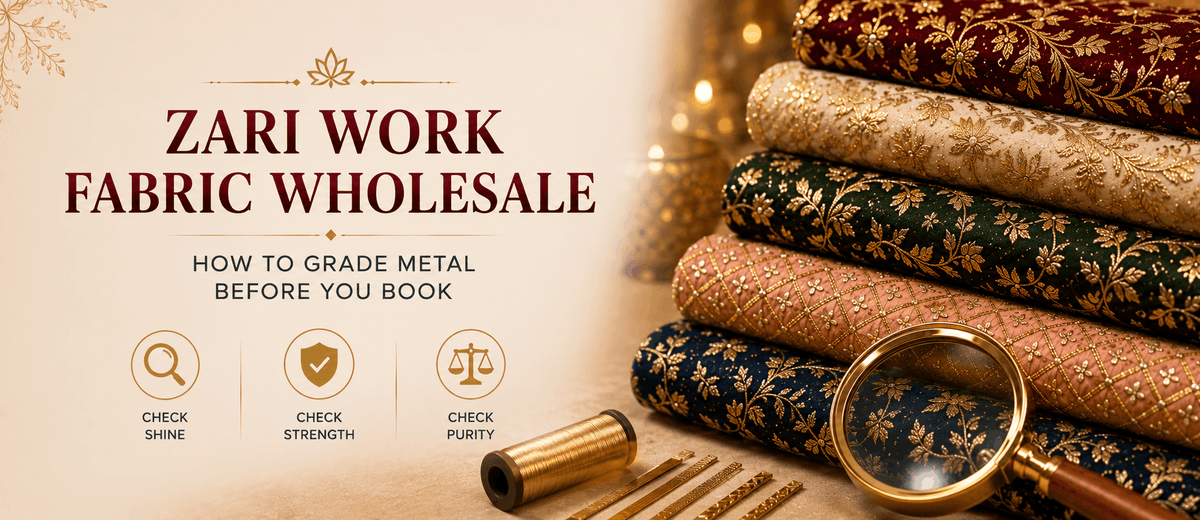
Zari Work Fabric Wholesale: How to Grade Metal Before You Book
Every other embroidery on your rack is a stitch, a stone or a sequin. You judge it by how well it is held down.
Zari is the odd one out. What sits on that cloth is metal, or something pretending to be metal, plus the difference between the three grades trading under one word at a Chandni Chowk counter can be four times the rate. A buyer who only checks how well the work is anchored has skipped the question that actually decides the invoice. Grade the metal first. Everything else on the sample follows from what the metal turns out to be.
Quick answer: Zari work fabric wholesale means buying cloth by the thaan where the decoration is metallic yarn rather than thread. Scrape one zari with a thumbnail: silver under gold means real gilt, a coloured metal core means tested zari, a clear or white plastic strip means film zari. Turn the cloth over plus measure the longest float between motifs. Record the zari lot separately from the dye lot. Never press zari face up. Delhi trade rates run roughly Rs 420 to Rs 2,600 per metre.
Three grades of metal sit under one word at the counter
Ask a seller what the zari is and you will usually be told it is good zari. That is not a grade. There are three, plus they behave nothing alike once a garment leaves your shop.
Real zari, also called gilt or asli zari, is fine silver wire gilded with gold plus wound around a silk or cotton core. It is soft, it takes a fold without cracking plus it holds value. You will almost never see it in volume festive production now, because a metre of allover work in real zari costs more than most retail lehengas. Tested zari is the working middle: an electroplated copper or brass wire, sometimes with a silver flash, wound on a viscose core. It reads as metal in the hand, it takes a fold without breaking plus it carries most of the mid market wedding trade. Film zari is a metallised polyester film slit into a flat ribbon, either used flat or twisted onto a core. It is bright, it is cheap, it weighs almost nothing plus it is what the high volume festive market actually runs on.
None of the three is wrong. Film zari on a five hundred rupee kurta is a sensible decision. Film zari sold to you at a tested zari rate is where the money goes missing, plus that is the only reason grading matters at the counter.
The thumbnail scrape plus the flame test
Both take under a minute. Do them on the sample cut, at the counter, before you talk about rate.
For the scrape, pick one zari thread on the face of the cloth plus drag a thumbnail firmly along about a centimetre of it. Real gilt zari gives up its gold layer and shows white silver underneath. Tested zari shows a warm copper or brass colour where the plating lifts. Film zari does something different again: it does not show metal at all, it shows a clear or milky plastic strip, plus the scraped section often creases rather than scratches. If a seller objects to the scrape, that objection is itself information.
For the flame test, pull one loose zari from a cut edge plus touch it to a lighter for two seconds. Real and tested zari leave a bare wire, dull grey and still recognisably a wire, because the core burns off and the metal does not. Film zari shrinks back, curls plus leaves a small hard black bead, which is polyester behaving exactly as polyester does. Do this over the sample bag rather than over the thaan, plus never on the seller's roll. One more quick read before you put the cloth down: rub the zari between finger and thumb for a few seconds, then look at your skin. Loose metallic dust on the fingertips means the coating is already shedding, which on a festive garment turns into a customer complaint after one evening of wear.
Zari weight sets the rate, the design does not
This is where zari pricing stops behaving like the rest of your catalog. On thread work or sequins the rate follows the design, because a denser motif takes more machine time. On zari, the rate follows how much metal went into the cloth.
Two thaans can carry the same motif at the same scale plus differ by forty percent, because one used a half fine zari and the other used a full count. A half fine zari has less metal on the same length of core, so it reads thinner in the hand plus it costs less by weight. That is a legitimate quality choice, not a cheat, provided it is declared. Ask for the zari count plus the grade on the quotation as two separate lines. A quotation that names only the design number has told you nothing about what you are paying for.
The practical consequence is that you cannot cost a zari design from a photograph. Two suppliers quoting the same border pattern are quoting different amounts of metal, so compare them by hand feel plus weight rather than by picture. Borders make this easiest to judge, since the metal is concentrated in a band you can pinch between two fingers, which is why buyers usually learn zari grading on border cloth before moving to allover work. You can see how border weight reads across running designs in our heavy border fabric range.
Float length on the reverse decides who returns the garment
Turn the cloth over. Between every two motifs the zari has travelled across the back of the fabric without being stitched down, plus that stretch is called a float.
Floats are where zari garments fail in the customer's hands rather than in your cutting room. A bangle, a ring, a watch clasp or a chair arm catches a long float, the zari pulls plus a loop stands up on the face of the garment that no amount of pressing will settle. Measure the longest float on your sample against a scale. Under half an inch is safe on any garment. Half to one inch is acceptable on a dupatta or a saree pallu that hangs free. Past one inch, insist the unit either trims the floats or backs the panel, since that cloth on a sleeve or a bodice will come back.
While the reverse is up, check two more things. First, whether the floats have been cut and left, which is cheaper but leaves sharp metallic ends that scratch skin, so those panels need a lining regardless of the garment. Second, whether any float has already been snagged in the roll itself, because a thaan that has rubbed against its own core in transit will show a run of pulled loops down one edge that you would be paying full rate for.
Zari work qualities plus Delhi trade rates
| Quality | Zari grade | Coverage | Best garment use | Delhi trade price (per metre) |
|---|---|---|---|---|
| Light film zari border | Metallised film | Single border band | Daywear kurtas, dupattas | Rs 420 to Rs 590 |
| Film zari buti allover | Metallised film | Scattered small motifs | Festive kurtis, suit sets | Rs 640 to Rs 880 |
| Tested zari heavy border | Electroplated wire | Wide border plus pallu | Sarees, lehenga hems | Rs 950 to Rs 1,450 |
| Antique zari jaal | Oxidised tested wire | Continuous net layout | Bridal lehenga panels | Rs 1,300 to Rs 1,900 |
| Heavy tested zari allover | Full count wire | Dense ground coverage | Bridal, heirloom orders | Rs 1,800 to Rs 2,600 |
Read the antique row carefully, because it is the one buyers misprice. Antique or oxidised zari has been chemically darkened during manufacture, which means the tarnish has already happened in a controlled way. It will not blacken further on your shelf. Bright gold tested zari will, so if a design sits in your stock for two seasons the antique version is often the cheaper decision even at a higher opening rate. You can compare how bright and antique finishes read side by side across our zari fabric collection.
Order tiers plus why the zari lot is not the dye lot
| Order tier | Typical quantity | Rate movement | Who it suits |
|---|---|---|---|
| Sample cut | 1 to 2 metres | Retail rate | Designers running the scrape plus flame tests |
| Small bulk | 1 thaan (about 18 to 22 m) | 6 to 10 percent off retail | Boutiques trialling one border |
| Trade bulk | 5 to 20 thaans | 12 to 20 percent off retail | Resellers, saree plus lehenga lines |
| Zari lot booking | 25 thaans and above, one zari lot | Weight-linked rate on request | Exporters, labels holding a bridal range |
Here is the reorder trap specific to this category. Your ground fabric has a dye lot. Your zari has a completely separate lot number, set by the coating batch at the zari maker, plus the two move independently. You can reorder a design, receive an exact dye match on the ground plus still find the gold reads a shade cooler or warmer than your first release. That mismatch is more visible than a dye variation, because metal catches light and a shopper sees two golds side by side on a rack instantly.
So write both numbers on the bill. Ground dye lot on one line, zari lot on another. Where a garment carries a border plus a matching dupatta, insist both come from the same zari lot even if that means splitting the order across two ground lots instead. Keep a half metre of the approved cloth in the office as your physical reference, plus store it away from light, since a reference swatch that has tarnished on a sunny shelf will fail your next incoming lot for the wrong reason.
Pressing, storage plus the blackening problem
Zari has a heat ceiling that the rest of your catalog does not. Metallised film starts softening around 150 degrees, which is well inside the range of a shop iron on a cotton setting, plus once it flattens the shine is gone permanently. Press from the reverse, through a cotton cloth, on a wool or silk setting. Never park a hot plate on zari face up, even for a second.
Steam is the second rule, plus it splits by grade. Steam is fine on film zari, which is plastic and does not care. Steam is poor on real or tested zari carrying silver, because moisture speeds up the reaction that blackens it. That reaction is the answer to the complaint every zari seller hears: the gold has gone black. Silver reacts with sulphur in the air, which is why zari darkens faster in humid coastal cities plus faster again in the months around Diwali when the air is thick with smoke.
Store accordingly. Wrap zari cloth in unbleached muslin rather than polythene, since polythene traps humidity against the metal. Keep naphthalene balls out of the same cupboard, because they are a sulphur source plus they will darken a border in one season. Tell your customers the same thing on the care label. Dry clean only, mention zari to the cleaner so they avoid a hot flat press, plus store folded in cloth rather than sealed in plastic.
Five checks before you release a zari booking
- Scrape one zari with a thumbnail. Silver under gold is gilt, coloured metal is tested, a clear or white strip is film.
- Burn one loose zari from the cut edge. A bare grey wire means real metal. A hard black bead means metallised polyester.
- Measure the longest float on the reverse. Past one inch the cloth belongs on a free hanging panel, not a sleeve.
- Ask for grade plus zari count as separate quotation lines. Weight of metal sets the rate, so a design number tells you nothing.
- Record the zari lot beside the dye lot. The two move independently plus a gold mismatch shows faster than a colour mismatch.
Zari questions that come up at the counter
Why does zari turn black, plus can it be reversed?
Blackening happens on zari that carries silver, which means real gilt zari plus most tested zari with a silver flash. Silver reacts with sulphur compounds in the air to form a dark surface film, so the process speeds up in humid weather, in coastal cities plus anywhere the air carries smoke. Film zari does not blacken this way at all, because there is no silver in it, though its coating can dull if it is rubbed. On a light tarnish a specialist zari cleaner can bring the shine back, plus so can a careful rub with a soft dry cloth. Deep tarnish on gilt zari usually cannot be recovered without damaging the gilding, so prevention is the real answer. Wrap in muslin rather than polythene plus keep naphthalene out of the cupboard.
Is antique zari lower quality than bright gold zari?
No, it is a finish rather than a grade. Antique zari is tested zari that has been deliberately oxidised during manufacture to give a darker, warmer tone. Because that darkening has already been done under control, the metal is chemically settled plus it will not shift further on your shelf the way bright gold will. For a boutique carrying stock across two seasons that stability is worth money, since a bright gold border that has dulled unevenly on a rack has to be discounted. Judge antique zari on wire count plus float quality exactly as you would judge bright, then treat the tone as a merchandising decision rather than a quality one.
Can zari work fabric be dyed after purchase?
Only on some builds, plus you have to ask before booking. A dyeable base carrying film zari usually survives a cold reactive dye, since polyester film does not take the dye plus stays gold against a coloured ground, which is exactly the effect most buyers want. Real or tested zari is the problem. Hot dye baths plus the chemicals used to strip and fix colour will attack the plating on tested zari, so a copper core comes through patchy and the border reads brown. Where a dyeable range matters to you, specify film zari on a dyeable ground at the quotation stage plus run one sample metre through your dyer before the bulk order goes in.
How much extra should you order on a zari design?
Budget 8 to 12 percent above your flat requirement for border layouts plus 12 to 15 percent for allover jaal work. The driver is placement rather than cutting error. A border has to land at a fixed distance from the hem on every panel, so short remnants between borders rarely yield a second usable piece. On jaal work motifs must sit symmetrical across left and right panels, which forces the same discipline as any placed design. Add a further two percent on any lot where the reverse showed floats past an inch, since panels that snag during stitching get cut out rather than repaired.
Lock zari work fabric at trade rates
If you run a boutique, a label or a reselling line, the fastest way to secure trade pricing on zari is to join the wholesale programme. You get thaan rates, zari grade stated as gilt, tested or film rather than left vague, zari count declared beside the design number, float length confirmed before dispatch, ground dye lot plus zari lot both recorded against the booking, bright and antique finishes held in the same lot where a range needs both, layout blocking across your wedding calendar plus weight-linked rates where you want a full zari lot reserved for your label alone. See the tiers and register on our wholesale fabric page to start your first bulk zari order.