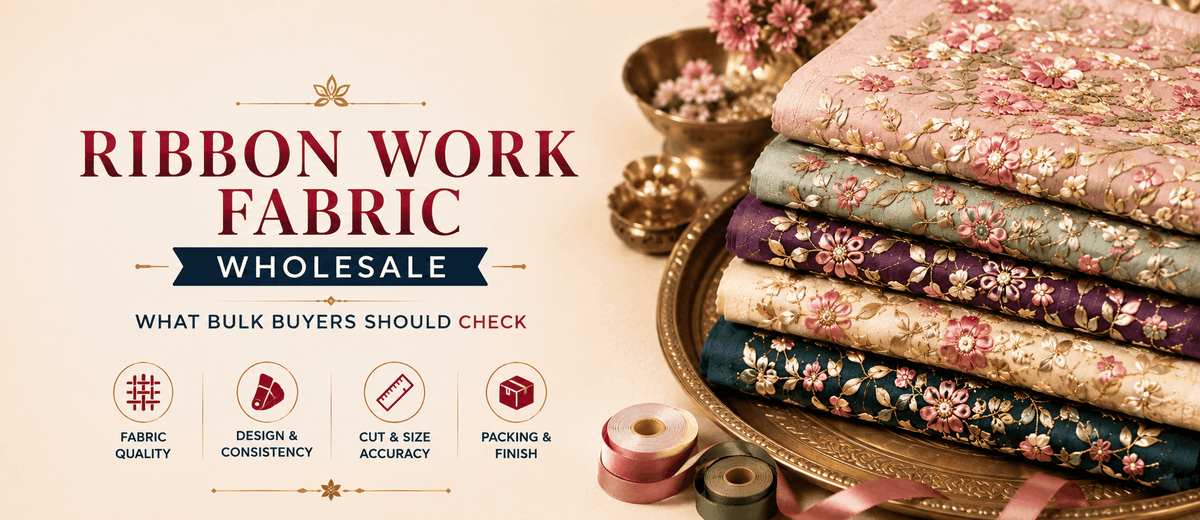
Ribbon Work Fabric Wholesale: What Bulk Buyers Should Check
Most surface work adds something that was never cloth. A sequin is a punched disc. Katdana is a plated bead. A mirror is moulded acrylic. Thread is a filament. Even applique, which does add fabric, adds it as a cut shape with raw edges the unit then has to seal.
Ribbon work adds finished cloth in strip form. That tape came off its own loom with a woven selvedge running down each long side, which means those edges will never fray no matter what your customer does to the garment. It sounds like the safest surface work in the catalog. It is, right up until you look at the two places a ribbon actually fails, neither of which is the edge everyone inspects.
Quick answer: Ribbon work fabric wholesale means buying cloth by the thaan where narrow woven tape has been stitched onto the surface in rows, borders or motifs. The long edges are selvedges plus they never fray, so check the cut ends instead, which must be turned under or heat sealed. Press a sample, leave it flat for twenty four hours, then sight along the ribbon line for pucker, which means the tape went on under tension. Ask for tape consumption in metres per fabric metre, because that sets the rate. Delhi trade rates run roughly Rs 380 to Rs 1,950 per metre.
Two selvedges plus two cut ends, but only the ends matter
Pick up any ribbon work sample and run a fingernail down the long edge of the tape. Nothing happens. That is a woven selvedge doing exactly what it was built to do, which is why buyers who cut their teeth on applique tend to relax too early here.
Now find where a run of tape starts or stops. Every row, every scallop, every motif has two ends, plus those ends were cut with scissors or a blade across the weave. That cross-cut is raw. On a polyester satin tape it should have been passed through a flame or a hot knife so the filaments fused into a hard bead. On a grosgrain, cotton or viscose tape it cannot be heat sealed at all, so the end has to be folded under and stitched down. Anything else unravels, plus once a ribbon end starts unravelling it walks backwards along the row until the whole span lifts.
So the end count is your inspection unit. Count the tape ends visible in one square foot of the sample. A dense scalloped border might carry twenty. Lift five of them with a fingernail. If any one shows loose cross threads or a soft frayed tip, reject the lot rather than the piece, because end finishing is a unit habit rather than a one-off slip.
Four ways the tape is held down
Ask which route before you ask the rate, because the anchor decides both the price plus the way the garment eventually fails.
Couched. The tape lies flat on the ground plus a thread crosses over it at intervals to hold it. Fast, cheap plus the volume route in Delhi. The catch is that the spans between the couching stitches are unsupported, so a ring or a bangle catches under the tape and lifts it. Fine for a body panel, risky on a sleeve hem or a neckline where hands go.
Twin-edge stitched. A stitch line runs the full length of the tape down both sides. Nothing can get underneath, which makes it the most secure route by a wide margin. It also presses the ribbon flat against the ground, so you lose the slight lift that made ribbon work attractive in the first place. Choose it for kidswear, daily wear plus anything that will be washed at home.
Tacked. The tape is fixed only at points, often at the turns of a zigzag or a scallop, so it stands proud of the ground between fixings. This is what gives good ribbon work its dimension. It is also the highest snag risk on the rack, before the garment even sells. Ribbon work in this style pairs best with straight panelled shapes, so you can see how the raised routes read across running designs in our ribbon work fabric collection.
Looped or rose work. The tape is gathered, twisted or folded into raised roses, bows plus petals, then anchored at the base. It is hand work, it prices like hand work, plus it is genuinely fragile. A single rose crushed flat in a bale does not recover. Buy it for label pieces and occasion overlays, not for stock that will sit folded in a shop for three months.
The twenty four hour relax test
This is the test that separates buyers who have handled ribbon work from buyers who have only looked at it, because the fault it catches is invisible on the day you inspect.
A tape fed under a presser foot is under tension while it is being stitched. If the operator ran it too tight, the ribbon is stitched down in a slightly stretched state. Polyester tape holds that stretch for a while then slowly releases it, plus as it shortens it drags the ground cloth in with it. What you get is a thin pucker running the length of every ribbon line, appearing days after the cloth was made, sometimes only after the first press.
Force it forward. Take a sample, press it with a warm iron through a cloth, then lay it flat on a shelf and leave it alone for twenty four hours. Come back and sight along each ribbon line at a low angle. A sound piece stays flat. A tensioned one shows a shallow trough or a soft ripple following the tape. Do the same check on any sample that arrived folded in a courier bag, since transit heat accelerates the release plus you may see it inside a day.
While you are there, run the iron question properly. Set the iron to the temperature the ground fabric needs, press a spare corner through a cloth, then look at the tape under strong light. Polyester satin ribbon glazes into a shiny hard patch at settings a cotton or a linen ground takes comfortably, plus that glaze is permanent. If the tape cannot survive the ground's pressing temperature, your finishing room has a problem on every garment, not a problem on one.
Ribbon work qualities plus Delhi trade rates
| Quality | Anchor route | Tape on ground | Best garment use | Delhi trade price (per metre) |
|---|---|---|---|---|
| Narrow satin tape rows | Couched | 3 to 6 mm poly satin on cotton | Daywear kurtis, kidswear | Rs 380 to Rs 540 |
| Organza ribbon scallop border | Tacked at turns | 12 to 18 mm organza on georgette | Dupattas, suit hems | Rs 620 to Rs 880 |
| Grosgrain plus zari gota tape | Twin-edge stitched | Mixed tape on chanderi | Festive suits, jacket borders | Rs 850 to Rs 1,150 |
| Velvet ribbon border | Twin-edge stitched | 18 to 25 mm velvet on silk blend | Winter suits, occasion jackets | Rs 1,150 to Rs 1,550 |
| Hand ribbon rose plus loop work | Gathered plus base anchored | Satin plus organza tape on net | Label overlays, bridal yokes | Rs 1,400 to Rs 1,950 |
Read this table through one number that is missing from it, which is tape consumption. Ask the unit how many metres of ribbon go into one metre of cloth. A 4 mm tape run at fourteen metres per fabric metre costs less in material than a 25 mm velvet tape run at four, plus it takes longer to stitch. That is why two designs that look equally busy can quote thirty percent apart. Get the consumption figure on the quotation and the rate stops being a mystery.
Order tiers plus matching a tape to a ground
| Order tier | Typical quantity | Rate movement | Who it suits |
|---|---|---|---|
| Sample cut | 1 to 3 metres | Retail rate | Designers running the relax plus iron tests |
| Small bulk | 1 thaan (about 18 to 22 m) | 5 to 9 percent off retail | Boutiques trialling one border |
| Trade bulk | 5 to 20 thaans | 12 to 18 percent off retail | Resellers, kurti plus festive lines |
| Tape booking | 25 thaans and above, one tape lot | Unit-linked rate on request | Exporters, labels locking a shade |
The colour trap on ribbon work is specific plus expensive. Your tape is almost always polyester, dyed with disperse dyes. Your ground is often cotton, viscose or silk, dyed with reactive or acid dyes. Two different dye chemistries can read as a perfect match under the tube light in a Chandni Chowk shop, then split visibly in daylight, because they reflect differently across the spectrum. Always approve a ribbon work shade by carrying the sample to a doorway or a window, never under shop light alone.
Then treat the tape lot as the thing you are actually booking. Ground cloth is easy to rematch. A specific ribbon shade in a specific width from a specific tape mill is not, plus a reorder that gets the ground right and the tape a shade off looks worse than one where both moved together. Buy the season in one lift, record the tape lot alongside the ground lot on the bill, then keep half a metre in the office as the reference. Kurti ranges are where this bites most often, since a repeat customer holds last month's piece against this month's on the same hanger, so buyers restocking that category should compare bases across our kurti fabric range before splitting an order across releases.
Storing plus cutting a cloth that must never be folded flat
Velvet tape holds crush memory. Press a bale down on a folded velvet ribbon border for six weeks in a godown and the pile at the fold line lies over permanently, so you get a dull grey stripe running across every piece at exactly the same distance from the selvedge. It does not steam out. Ask how the lot was stored plus how it will ship, then insist on rolled dispatch on any velvet or looped ribbon quality. On satin tape, folding is survivable but still leaves a crease line you have to press out before cutting.
In the cutting room, keep tape ends out of seam allowances. A folded and stitched ribbon end buried in a seam gives the machine six or eight plies plus a hard ridge to climb, so you get a skipped stitch line at the join. Where a border must cross a seam, plan for the tape to be cut, the seam closed, then the tape end finished by hand afterwards. Cut single ply on tacked plus looped qualities, because raised tape stops the plies lying together plus positions drift between panels.
Budget 5 to 9 percent wastage on all-over row layouts plus 10 to 15 percent on placed borders, where a border has to land at a fixed distance from a hem on every panel. On the care label, specify gentle wash or dry clean, no wringing plus a cool iron on the reverse only. Wringing is what pulls a couched span away from its ground, plus a hot plate straight onto satin tape is what glazes it.
Five checks before you release a ribbon work booking
- Lift five tape ends with a fingernail. Loose cross threads mean the ends were not sealed or turned, so rows will unravel backwards from the ends.
- Press, rest twenty four hours, then sight down each ribbon line. A trough or ripple following the tape means it was stitched under tension it is now releasing.
- Iron a spare corner at the ground's own temperature. A shiny hard patch on the tape means the ribbon cannot take the heat the fabric needs, plus the glaze is permanent.
- Approve the shade in daylight, never under shop light. A poly tape and a cellulose ground use different dye chemistries plus can split visibly outdoors.
- Get tape consumption in metres per fabric metre. That number, not the look of the design, is what explains the rate plus lets you compare two quotes fairly.
Ribbon work questions that come up at the counter
Why does ribbon work fabric pucker along the ribbon line?
Because the tape was stitched down while stretched. A ribbon fed under a presser foot too tightly goes on in a slightly extended state, then releases that stretch over the following days plus drags the ground cloth in as it shortens. The result is a thin trough or ripple running the full length of every ribbon line, which is why it often appears after the cloth reaches you rather than at the unit. Force it forward before booking by pressing a sample through a cloth, leaving it flat for twenty four hours, then sighting along each ribbon line at a low angle. A well run piece stays flat. Nothing in the finishing room corrects a tensioned one.
Can ribbon work fabric be ironed safely?
Only at the temperature the tape can take, which is often lower than the temperature the ground wants. Polyester satin ribbon glazes into a shiny hard patch at settings that a cotton or linen ground handles without trouble, plus that glaze does not come out. Test it before booking by pressing a spare corner through a cotton cloth at your normal setting, then checking the tape under strong light. In production, press from the reverse through a cloth, keep the iron moving plus never rest a plate directly on the tape. On the customer care label, specify a cool iron on the reverse only.
Does ribbon work fray where the tape is cut?
The long edges never fray, because they are woven selvedges that came off the tape loom finished. The cut ends always will, because that cut goes across the weave. So every place a row of ribbon starts or stops is a potential failure point. On polyester tape the end should have been heat sealed into a hard bead. On grosgrain, cotton or viscose tape heat sealing does not work, so the end must be folded under plus stitched. Check five ends per sample with a fingernail. A soft frayed tip on even one of them means the unit is not finishing ends as a habit, so reject the lot rather than the piece.
How is ribbon work fabric priced per metre?
By tape consumption plus anchor route, far more than by how busy the design looks. Ask how many metres of ribbon go into one metre of cloth, since a narrow tape run at fourteen metres per fabric metre carries less material cost than a wide velvet tape run at four, while taking longer on the machine. Then factor the route, because twin-edge stitching runs two full lines down every tape and costs more than couching, while hand looped or rose work prices as hand work altogether. Two designs of similar appearance can quote thirty percent apart on those two figures alone.
Lock ribbon work fabric at trade rates
If you run a boutique, a label or a reselling line, the quickest way to secure trade pricing on ribbon work is to join the wholesale programme. You get thaan rates, anchor route stated as couched, twin-edge stitched, tacked or hand looped rather than left vague, ribbon type plus width declared in millimetres, tape consumption per metre given on the quotation, end sealing method confirmed, tape lot and ground lot both recorded against every booking, rolled dispatch on velvet and raised qualities, shade blocking across your festive and wedding calendar plus unit bookings where you want a tape shade held for your label alone. See the tiers and register on our wholesale fabric page to start your first bulk ribbon work order.