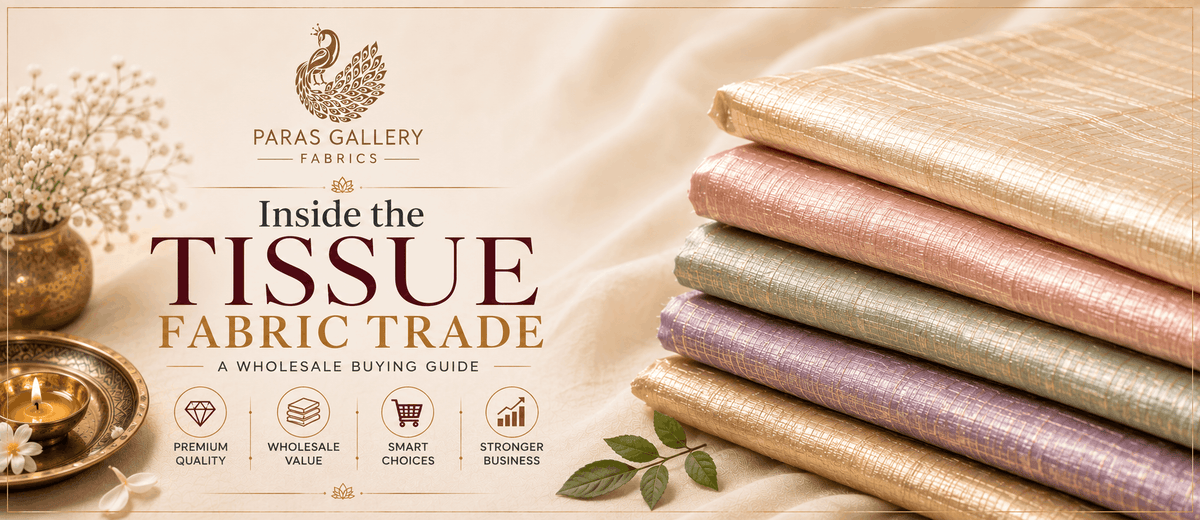
Inside the Tissue Fabric Trade: A Wholesale Buying Guide
Tissue is the fabric that sells on shimmer and gets returned on strength. A roll catches the light beautifully on the shelf. Then a customer snags it once on a bangle and the whole panel runs, because nobody checked how thin the base really was.
Twelve years at a Lajpat Nagar counter teaches you that tissue is bought with two hands. One for the shine, one for the strength. Before a first bulk order, three things decide whether the lot earns its money.
- Base strength. A base that thins under a light tug will run at the first snag on a finished saree.
- Zari type. Cheap coated zari dulls within months so the gold you sold turns grey on the customer.
- Colour hold. Weak dye on dark shades bleeds and stains the zari itself.
Get those three right and the shimmer sells the piece for you. This is the working reference I give new bulk buyers. Not a sales pitch. A guide to buying tissue fabric wholesale the way trade buyers who stay in business actually buy it.
Quick answer: Buying tissue fabric wholesale means purchasing tissue by the thaan or in bulk metres at trade rates. Tissue is a light sheer fabric woven with metallic zari for shimmer. Common types are kora tissue, tissue silk and crush tissue. Delhi trade prices run about Rs 150 to Rs 400 per metre for plain tissue. Zari heavy and silk tissue runs Rs 400 to Rs 1200 per metre. Rates drop as your minimum order quantity rises.
What tissue fabric actually is
Tissue is a lightweight, sheer fabric woven with a metallic zari thread running through it. That zari is what gives tissue its soft glow. It is also what decides most of the price and most of the problems.
Two things matter more than the shine. The zari and the base. The zari can be real, metallic or plastic coated. Each ages differently. The base can be crisp cotton, soft silk or a synthetic blend. That decides the fall and the strength.
Hold a tissue roll up to the light. You should see through it slightly. That sheerness is the point of tissue, but it is also why the base strength check below is not optional.
Types of tissue fabric worth stocking at wholesale
This is the table I pull out at the counter. Match the tissue type to what your karigar is actually stitching for the customer.
| Tissue type | Feel and fall | Best garment use | Delhi trade price (per metre) |
|---|---|---|---|
| Kora tissue | Crisp, holds shape, light | Structured sarees, dupattas, overlays | Rs 150 to Rs 400 |
| Tissue silk | Soft, fluid, gentle shine | Festive sarees, lehengas, gowns | Rs 400 to Rs 900 |
| Crush tissue | Textured, wrinkled surface, ready volume | Ready sarees, dupattas, layering | Rs 180 to Rs 450 |
| Zari heavy tissue | Dense metallic shimmer, weighted | Bridal sarees, hero dupattas | Rs 500 to Rs 1200 |
| Tissue with embroidery | Worked at borders, festive finish | Festive suits, dupattas, saree pallus | Rs 450 to Rs 1100 |
Prices above reflect Delhi wholesale rates as of this week for standard widths of 44 to 58 inches. Tissue rates move with the zari and festive market, so treat them as a working band rather than a fixed number. You can match a shade against live running stock in our tissue fabric collection before you lock an order.
How to judge tissue fabric before you commit a thaan
A tissue thaan carries real risk because torn or tarnished stock cannot be re-sold. Run these five checks first.
- Base strength. Tug a small section gently across the width. A good tissue holds. A weak base gives and thins, which means it will run at the first snag on a finished saree.
- Zari tarnish. Ask how old the roll is and check the zari colour. Real and better metallic zari stays bright. Cheap coated zari dulls and blackens within months, which shows up as customer complaints long after the sale.
- Zari hold. Scratch a zari line with your nail. Good zari stays woven in. Poor zari flakes or lifts. Once it flakes the shimmer is gone for good.
- Colour bleed. Rub a damp white cloth over dark shades. Tissue on cheap dye bleeds on deep shades and stains the zari itself. Catch it now, not after delivery.
- Crease recovery. Crush a corner and release. Kora tissue creases and that is normal, but a permanent hard fold line tells you the finish is brittle and will crack at the seams.
The tarnish problem nobody warns you about
Here is the tissue mistake that costs boutiques repeat customers. The zari looks perfect at the counter, so the buyer never asks about tarnish. Three months later the saree that sold as gold has gone dull and grey. The customer blames the shop, not the fabric.
Protect yourself at the buying stage. Ask whether the zari is real, metallic or plastic coated. Buy fresh stock rather than old rolls that have sat in a warehouse. Store tissue away from damp and never in a sealed plastic bag for long, because trapped moisture speeds up tarnish. That single line of questioning saves more tissue orders than any bargaining.
Minimum order quantity, pricing bands and boutique margin
Every new bulk buyer asks the same question. Where does the rate break. Here is the honest structure most Delhi suppliers work with, ours included.
| Order tier | Typical quantity | Rate movement | Who it suits |
|---|---|---|---|
| Sample cut | 1 to 5 metres | Retail rate | First time buyers testing base and zari |
| Small bulk | 1 thaan (about 15 to 20 m) | 5 to 10 percent off retail | Boutiques running one festive design |
| Trade bulk | 5 to 20 thaans | 12 to 20 percent off retail | Resellers, repeat festive and saree labels |
| Manufacturer lot | 50 thaans and above | Mill linked rate on request | Exporters, large labels |
One habit protects your tissue margin more than any bargaining. Pool your colours into one order. Ten buyers each taking two thaans of different shades still count as one trade lot at the counter.
This is the whole reason a wholesale community works. Fifteen boutiques buying together reach a rate none of them would touch alone.
Where tissue earns its keep in a boutique line
Tissue sells because it delivers a festive look at a light weight and a fair price. A tissue saree photographs rich, wears light through a long function and costs less to stitch than a heavy silk. That combination moves fast through the festive and wedding guest segment.
If you build saree lines, keep kora tissue and tissue silk as your core festive stock. Our saree fabric range shows the tissue pairings boutiques order most for festive and guest wear.
For layering and ready pieces, crush tissue is the quiet volume seller. It needs no ironing, it adds instant shimmer over a plain base and it suits the fast festive turnaround. That kind of low effort fabric earns its shelf space through repeat orders, not one big bridal buy.
Common mistakes bulk buyers make with tissue fabric
- Skipping the tarnish question. Cheap coated zari dulls within months and the complaint lands on the shop. Always ask the zari type before you buy.
- Ignoring base strength. Tissue is meant to be sheer, but a base that thins under a light tug will run at the first snag. Test every roll.
- Buying old warehouse rolls. Tissue tarnishes with age and damp. A discounted old roll is discounted for a reason.
- Storing tissue sealed in plastic. Trapped moisture blackens zari fast. Keep rolls breathing in a dry space.
- Over ordering heavy zari tissue. Zari heavy and bridal tissue dates faster than plain kora. Keep light tissue as your base and order heavy zari to real demand.
Storing tissue stock without tarnish or tears
Tissue is delicate and tarnish prone, so storage decides how much stock you can still sell in three months. A few habits keep it sale ready.
- Store tissue rolled on a tube, never tightly folded, so no hard crease cracks the finish.
- Keep rolls in a dry space away from damp walls and floors, because moisture is what blackens the zari.
- Use a breathable cover, not a sealed plastic bag, so trapped humidity does not build up.
- Never stack heavy thaans on tissue. The base marks and dents under weight.
Questions bulk buyers ask me at the counter
What is the minimum order for tissue fabric wholesale?
Trade rates usually begin at one full thaan of about 15 to 20 metres. Below that you pay close to retail. To reach the sharper 12 to 20 percent trade discount you generally need five thaans or more, which is where pooling colours across buyers helps.
How do I stop tissue zari from tarnishing?
Buy fresh stock, ask whether the zari is real, metallic or coated and store rolls dry with a breathable cover. Coated zari tarnishes fastest, so for pieces meant to last, pay up for better metallic or real zari.
Which tissue is best for a festive saree?
Kora tissue for a crisp structured saree that holds pleats, tissue silk for a softer fluid drape. Both photograph rich and wear light, which is why the festive guest segment repeats on them.
Is crush tissue worth stocking for ready lines?
Yes for fast festive turnaround. Crush tissue needs no ironing, adds instant shimmer over a plain base and suits ready sarees and layering, so it earns repeat volume better than a heavy zari base.
Ready to order tissue fabric at trade rates?
If you run a boutique, a festive wear label or a reselling line, the fastest way to lock trade pricing is to join the wholesale programme. You get thaan rates, shade booking and colour pooling with other buyers. See the tiers and register on our wholesale fabric page to start your first bulk tissue order.