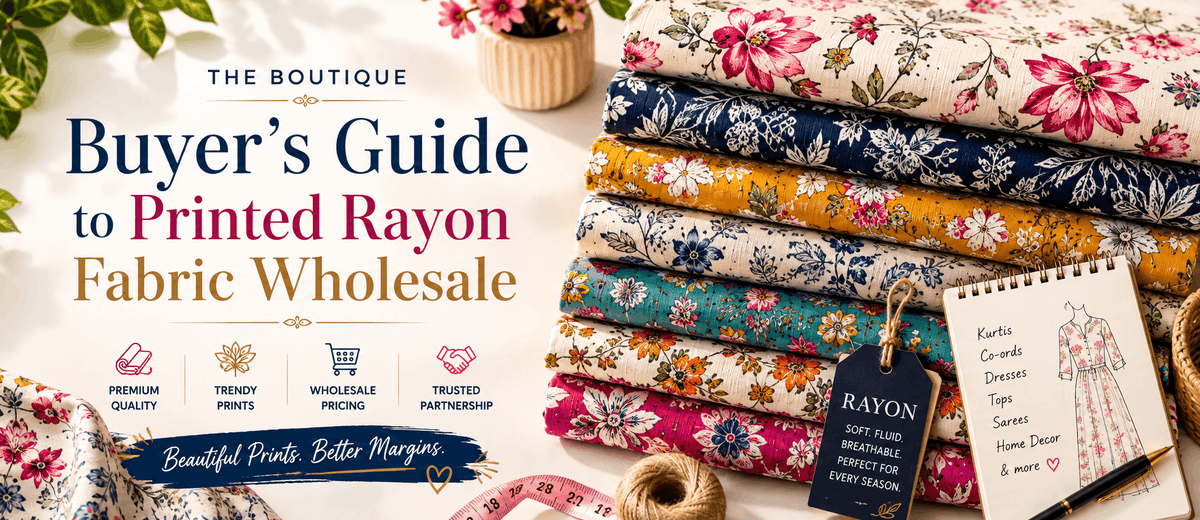
The Boutique Buyer's Guide to Printed Rayon Fabric Wholesale
Rayon is the fabric that makes and breaks a summer kurti label. It drapes like nothing else at its price, it takes a print beautifully and it moves in volume when the print is right. It also bleeds, shrinks and varies wildly between weights, so a rate that looks sharp on paper can turn into a return pile after the first wash. Most of those losses trace back to one skipped question at the counter.
So this is the reference I give bulk buyers before their first printed rayon order. Not a sales page. A working guide to buying printed rayon fabric wholesale the way trade buyers actually buy it, weight by weight.
Quick answer: Buying printed rayon fabric wholesale means purchasing by the thaan at trade rates. Rayon is graded by weight quality, commonly 14 kg to 20 kg, running about 100 to 150 GSM. Delhi trade prices run roughly Rs 90 to Rs 200 per metre depending on weight and print method. Rates drop as your minimum order quantity rises.
What rayon actually is (and why weight matters more than name)
Rayon is viscose, a fabric spun from processed wood pulp. That is why it feels soft and breathes like a natural fibre while costing less. The trade rarely talks about rayon in GSM though. It talks in weight quality, the old reed count language you hear at the counter as 14 kg, 16 kg or 20 kg. A higher number means a denser, heavier weave.
This is the number that decides your garment. A 14 kg rayon falls light and flowing, perfect for a summer dress that needs movement. A 20 kg rayon holds more body for a structured kurti that should not cling. Buyers who only ask for "rayon print" and never check the weight end up with the wrong fall for their design, then blame the tailor.
Printed rayon qualities worth stocking at wholesale
This is the table I pull out at the counter. Match the weight to what your karigar is stitching, not to the cheapest rate on the shelf.
| Printed rayon quality | Typical GSM | Hand feel | Best garment use | Delhi trade price (per metre) |
|---|---|---|---|---|
| 14 kg rayon | 100 to 115 | Light, flowing | Dresses, dupattas, nightwear | Rs 90 to Rs 140 |
| 16 kg rayon | 115 to 130 | Balanced drape | Kurtis, co-ord sets | Rs 110 to Rs 160 |
| 20 kg rayon | 130 to 150 | Heavier, more body | Structured kurtis, straight suits | Rs 130 to Rs 190 |
| Rayon slub | 120 to 145 | Textured surface | Casual kurtis, tunics | Rs 120 to Rs 200 |
Prices above reflect Delhi wholesale rates as of this week for standard widths of 44 to 58 inches. Rayon rates track the viscose yarn market, so treat them as a working band rather than a fixed number. You can match a print against live running stock in our printed rayon collection before you book a shade.
How to judge printed rayon before you commit a thaan
A thaan is a commitment. Once it is cut to your order it is yours. Run these five checks first.
- Confirm the weight quality. Ask whether it is 14 kg, 16 kg or 20 kg, then feel it against a known sample. Weight decides fall, so get it on the bill rather than trusting the label.
- Bleeding test. This is the one that saves you. Dip a corner of a dark print in water. If colour runs heavily, that print will bleed onto lighter panels in a stitched set. Reject heavy bleeders.
- Shrinkage sample. Rayon can drop five to eight percent on the first wash. Take a small cut, wash it, measure before and after so your matched sets do not pull out of size.
- Print sharpness. Check the print at the repeat. A crisp registration tells you the table print or digital run was controlled. Ghosting means a rushed job.
- Wet strength. Rayon weakens when wet. Tug a wet corner gently. Fabric that tears too easily will not survive rough laundering by the end customer.
Minimum order quantity, pricing bands and boutique margin
The first question every new bulk buyer asks is where the rate breaks. Here is the honest structure most Delhi suppliers work with, ours included.
| Order tier | Typical quantity | Rate movement | Who it suits |
|---|---|---|---|
| Sample cut | 1 to 5 metres | Retail rate | First-time buyers testing a print |
| Small bulk | 1 thaan (about 18 to 22 m) | 5 to 10 percent off retail | Boutiques running one design |
| Trade bulk | 5 to 20 thaans | 12 to 20 percent off retail | Resellers, repeat kurti labels |
| Manufacturer lot | 50 thaans and above | Mill-linked rate on request | Garment exporters, large labels |
One habit protects your margin on rayon. Pool your prints into one order. Ten buyers each taking two thaans of different prints still counts as one trade lot at the counter. This is why the wholesale community works. Fifteen boutiques buying together reach a rate none of them would touch alone.
Where printed rayon earns its keep in a boutique line
Printed rayon sells because it gives volume at a working price. A good floral rayon print moves through a kurti line faster than almost any other summer fabric because customers love the soft feel at an easy rate. For daywear, 16 kg rayon kurtis are the workhorse of the season. They stitch clean, they carry a print well and they leave room in the margin. Light 14 kg rayon also makes an easy dupatta, so a matched dupatta in the same print lifts a plain kurti into a set. Our dupatta range shows the pairings boutiques reach for when they build rayon sets.
For dresses, the fluid fall of light rayon does work no stiff cotton can. A tiered rayon dress in a fresh print becomes a repeat online seller, which is where a boutique earns beyond the festive rush.
Common mistakes bulk buyers make with printed rayon
- Skipping the bleeding test. This is the number one rayon complaint. A dark print that bleeds ruins a whole set. Test before you buy volume.
- Ignoring weight quality. A 14 kg rayon cut for a structured kurti will cling and disappoint. Match weight to silhouette every time.
- Skipping the wash test. Rayon shrinks more than cotton. Pre-check or pre-shrink so matched sets stay aligned.
- Over-ordering loud prints. Bold trend prints date fast. Keep small florals and geometrics as your volume base. Order statement prints to demand.
- No print lock. Rayon print runs shift between lots. If you need a repeat in two months, book the print now or accept a slight change.
Storing printed rayon stock without damage
Rayon absorbs moisture, so damp is its enemy. Keep thaans off the floor and away from monsoon walls, because rayon mildews faster than cotton and the stain sets into a light print. Store rolls covered to keep dust off pale grounds. Do not stack heavy fabric on rayon rolls, since the soft weave takes a crease under weight that shows badly once the fabric is cut.
Questions bulk buyers ask me at the counter
What is the minimum order for printed rayon fabric wholesale?
Trade rates usually begin at one full thaan of about 18 to 22 metres. Below that you pay close to retail. To reach the sharper 12 to 20 percent trade discount you generally need five thaans or more, which is where pooling prints across buyers helps.
What does 14 kg or 20 kg rayon mean?
It is the trade weight quality, an old reed count language for how dense the weave is. A 14 kg rayon is lighter and more flowing. A 20 kg rayon is heavier with more body. Higher weight suits structured garments, lighter weight suits flowing ones.
Does printed rayon bleed or shrink?
It can do both if you skip testing. Dark prints may bleed, so run a water test on a corner. Rayon also shrinks five to eight percent on the first wash, so always pre-check a sample before bulk cutting matched sets.
Which printed rayon is best for kurti manufacturing?
A 16 kg rayon is the reliable middle for kurtis, with balanced drape and easy stitching. Move to 20 kg for a more structured straight kurti, or drop to 14 kg when you want a soft flowing tunic or a matched dupatta.
Ready to order printed rayon at trade rates?
If you run a boutique, a label or a reselling line, the fastest way to lock trade pricing is to join the wholesale programme. You get thaan rates, print booking and colour pooling with other buyers. See the tiers and register on our wholesale fabric page to start your first bulk printed rayon order.