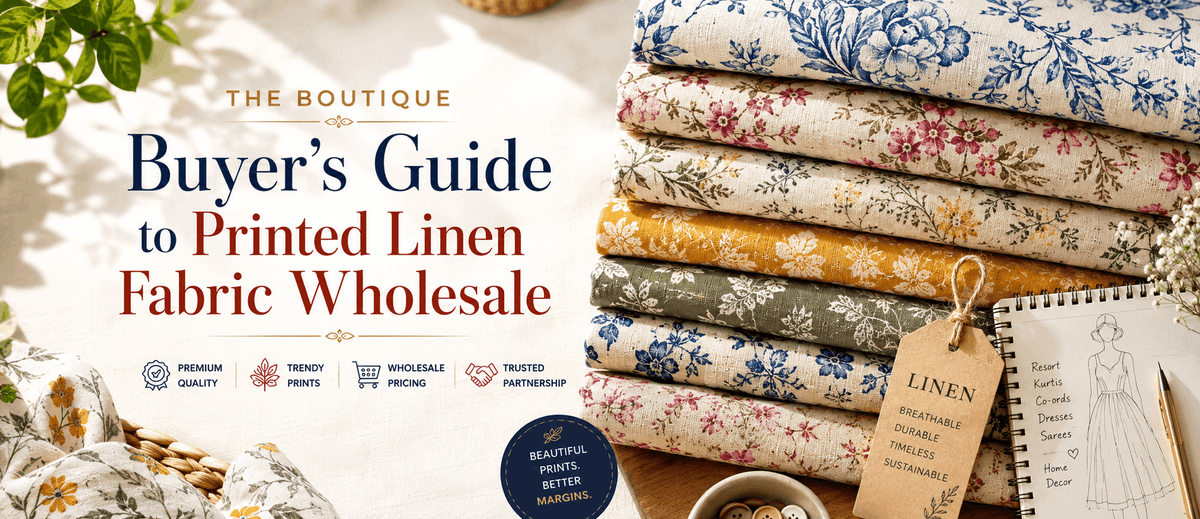
The Boutique Buyer's Guide to Printed Linen Fabric Wholesale
Every summer the same order lands on the counter. A boutique wants "pure printed linen" for a kurti line, at a rate that pure linen has never once sold for. That gap between what buyers ask for and what the market actually weaves is where money leaks. Printed linen is the fabric where this confusion costs the most, because the word linen carries a price weight the running stock rarely earns.
So this is the reference I give bulk buyers before their first printed linen order. Not a pitch. A working guide to buying printed linen fabric wholesale the way trade buyers actually buy it, blend by blend.
Quick answer: Buying printed linen fabric wholesale means purchasing by the thaan at trade rates. Most printed linen in the market is a blend such as cotton linen, viscose linen or linen satin, woven between 100 and 180 GSM. Delhi trade prices run about Rs 120 to Rs 320 per metre depending on blend and print method. Rates drop as your minimum order quantity rises.
What "printed linen" actually means at wholesale
Here is the first thing to accept. Very little of the printed linen moving through the bulk market is pure linen. Pure linen creases hard, costs a lot and prints unevenly on a slub weave. What sells as printed linen is almost always a blend built to keep the linen look while fixing the price and the print surface.
The three you will meet most are cotton linen, viscose linen and linen satin. Cotton linen mixes cotton with a small share of linen for a crisp dry hand. Viscose linen adds viscose for a softer fall that drapes on the body. Linen satin runs a satin weave over the blend for a light sheen on the print. Order the wrong one for your garment and the fall will fight you at the tailor's table.
Printed linen blends worth stocking at wholesale
This is the table I pull out at the counter. Match the blend to what your karigar is stitching, not to the name that sounds richest.
| Printed linen blend | Typical GSM | Hand feel | Best garment use | Delhi trade price (per metre) |
|---|---|---|---|---|
| Cotton linen | 120 to 160 | Crisp, dry, structured | Kurtis, shirts, summer suits | Rs 120 to Rs 220 |
| Viscose linen | 110 to 150 | Softer, fluid drape | Dresses, co-ord sets, dupattas | Rs 160 to Rs 280 |
| Linen satin | 120 to 170 | Light sheen, smooth face | Festive kurtis, straight suits | Rs 180 to Rs 320 |
| Slub cotton linen | 140 to 180 | Textured, heavier body | Structured kurtis, jackets | Rs 150 to Rs 260 |
Prices above reflect Delhi wholesale rates as of this week for standard widths of 44 to 58 inches. Rates move with cotton and viscose yarn markets, so treat them as a working band rather than a fixed number. You can match a print against live running stock in our printed linen collection before you book a shade.
How to judge printed linen before you commit a thaan
A thaan is a commitment. Once it is cut to your order it is yours. Run these five checks first.
- Confirm the blend in writing. Ask for the exact ratio. A fabric sold as linen that is mostly viscose behaves very differently in shrinkage and fall. Get it on the bill.
- Slub consistency. Linen slub should look intentional across the width, not clustered in patches. Uneven slub means uneven yarn that will show badly under a light print.
- Print registration. Hold the fabric flat. Check that the print sits sharp with no ghosting or shift at the repeat. Loose registration is common on cheaper pigment runs.
- Shrinkage sample. Take a small cut. Wash it. Measure before and after. Linen blends can drop four to seven percent, which wrecks a matched kurti set if you skip this.
- Crock and colour fastness. Rub a damp white cloth over the print. Pigment prints on linen rub off more than reactive prints, so test dark grounds before you buy volume.
Minimum order quantity, pricing bands and boutique margin
The first question every new bulk buyer asks is where the rate breaks. Here is the honest structure most Delhi suppliers work with, ours included.
| Order tier | Typical quantity | Rate movement | Who it suits |
|---|---|---|---|
| Sample cut | 1 to 5 metres | Retail rate | First-time buyers testing a print |
| Small bulk | 1 thaan (about 18 to 22 m) | 5 to 10 percent off retail | Boutiques running one design |
| Trade bulk | 5 to 20 thaans | 12 to 20 percent off retail | Resellers, repeat kurti labels |
| Manufacturer lot | 50 thaans and above | Mill-linked rate on request | Garment exporters, large labels |
One habit protects your margin on printed linen. Pool your prints into one order. Ten buyers each taking two thaans of different prints still counts as one trade lot at the counter. This is why the wholesale community works. Fifteen boutiques buying together reach a rate none of them would touch alone.
Where printed linen earns its keep in a boutique line
Printed linen sells because it does the summer job no heavy fabric can. It breathes, it carries a print cleanly and it reads as a considered fabric rather than a cheap poly. For a daywear line, cotton linen kurtis move fast from March through the monsoon because customers want something dry that survives Delhi heat. Our women's kurti range shows the silhouettes that boutiques cut most from printed linen, so you can plan yardage against real demand.
For co-ord sets, viscose linen has become the quiet winner. The softer drape lets a wide trouser move, while the same print on a short kurti keeps the set matched. That repeat co-ord business often outperforms any one festive order across a full season.
Common mistakes bulk buyers make with printed linen
- Paying pure-linen money for a blend. Confirm the ratio before you accept the rate. A viscose-heavy blend should never cost what pure linen costs.
- Skipping the wash test. Linen blends shrink more than cotton. A matched kurti set will pull out of line if you do not pre-check.
- Ignoring print method. Reactive prints hold better than pigment on dark grounds. Buy pigment for pastels, reactive for deep colours.
- Over-ordering trend prints. Bold seasonal prints date fast. Keep small florals and textures as your volume base. Order trend prints to demand.
- No shade or print lock. Print runs vary between lots. If you need a repeat in two months, book the print now or accept a slight shift.
Storing printed linen stock without damage
Linen holds creases harder than most cottons. Store thaans rolled, not folded, so no permanent crease line sets across a print. Keep rolls off damp floors because linen blends can mildew at the core in a Delhi monsoon. A dust cover on each roll saves you re-pressing before every sale, which matters most on the satin blends where a crease shows under the sheen.
Questions bulk buyers ask me at the counter
What is the minimum order for printed linen fabric wholesale?
Trade rates usually begin at one full thaan of about 18 to 22 metres. Below that you pay close to retail. To reach the sharper 12 to 20 percent trade discount you generally need five thaans or more, which is where pooling prints across buyers helps.
Is printed linen actually pure linen?
Rarely at bulk rates. Most printed linen is a blend such as cotton linen, viscose linen or linen satin. Pure linen costs far more and prints unevenly on a heavy slub. Ask for the exact ratio so you price and stitch it correctly.
Which printed linen blend is best for kurti manufacturing?
Cotton linen for a crisp structured kurti, viscose linen for a softer dress or co-ord, linen satin when you want a light festive sheen. Match the GSM to the silhouette so a straight kurti holds shape without a heavy lining.
How much does printed linen shrink?
Linen blends commonly drop four to seven percent on the first wash. Always run a wash sample before bulk cutting, or pre-shrink the thaan, so matched sets stay aligned after stitching.
Ready to order printed linen at trade rates?
If you run a boutique, a label or a reselling line, the fastest way to lock trade pricing is to join the wholesale programme. You get thaan rates, print booking and colour pooling with other buyers. See the tiers and register on our wholesale fabric page to start your first bulk printed linen order.