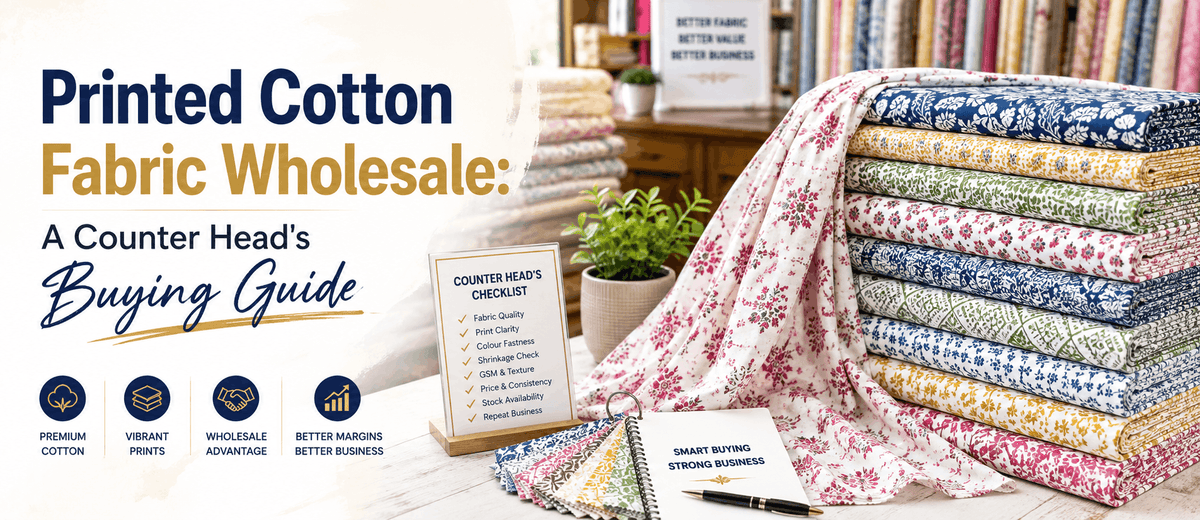
Printed Cotton Fabric Wholesale: A Counter Head's Buying Guide
Printed cotton is the fabric that pays your rent between wedding seasons. It moves all year, it stitches into everything from a college kurti to an office suit and every boutique needs it on the shelf. It is also the fabric buyers judge worst, because they fall for the print on the roll and forget to ask the one question that decides whether the customer comes back. Does the colour survive the wash.
Fourteen years across a Chandni Chowk counter teaches you that a printed cotton complaint is almost never about the design. It is about a print that faded, bled onto a lining or rubbed off at the seams. Before a first bulk order, three things decide whether a printed cotton lot earns its money.
- Colour fastness. A print that runs in the first wash kills the repeat order, so wash and rub fastness matter more than the design.
- Cotton base. Light cambric, fine cotton, glaze cotton or cotton linen behave very differently once the garment is stitched and worn.
- Print method. Screen, digital or hand-block prints carry different costs, different sharpness and different minimum runs.
Get those three right and printed cotton becomes the steadiest earner in your line. This is the working reference I hand new bulk buyers. Not a sales pitch. A guide to buying printed cotton fabric wholesale the way trade buyers who stay in business actually buy it.
Quick answer: Buying printed cotton fabric wholesale means purchasing cotton with screen, digital or hand-block prints by the thaan at trade rates. The base decides the feel, from light cambric and fine cotton to cotton linen and cotton silk. Delhi trade prices run about Rs 60 to Rs 120 per metre for screen printed cambric, Rs 120 to Rs 250 for digital printed cotton and Rs 140 to Rs 280 for printed cotton silk or linen. Rates drop as your minimum order quantity rises.
What printed cotton actually is at the counter
Printed cotton is really two decisions in one roll. The base is the cotton itself, which sets the weight, the feel and how the garment wears. The print is the design laid on top, which sets the look and, more importantly, how well the colour holds. Buyers who only look at the print are judging half the fabric.
The base cotton runs from light cambric and fine cotton, which suit summer kurtis, through firmer rich and glaze cotton for suits, up to cotton linen and cotton silk blends that carry a little structure or sheen. The GSM, the weight per square metre, tells you where a cloth sits. Roughly 80 to 110 GSM is light summer weight, while 120 GSM and up gives you the body a structured suit needs.
The print sits on that base by one of three methods. Screen printing pushes colour through a mesh, which is cheap and fast for volume. Digital printing sprays the design straight onto the cloth, which gives sharp fine detail at a higher rate. Hand-block printing stamps the design by hand, which suits small artisan runs with a soft, slightly irregular charm. Each method changes the price, the sharpness and the smallest order a supplier will run.
Printed cotton bases worth stocking at wholesale
This is the table I pull out at the counter. Match the cotton base to what your karigar is actually stitching for the customer.
| Printed cotton base | Feel and weight | Best garment use | Delhi trade price (per metre) |
|---|---|---|---|
| Cambric or fine cotton | Light, soft, matte | Summer kurtis, day suits, dupattas | Rs 60 to Rs 120 |
| Rich or glaze cotton | Mid weight, slight sheen | Suits, festive kurtis, kurtas | Rs 90 to Rs 170 |
| Cotton linen | Textured, firm, structured | Structured suits, palazzos, jackets | Rs 130 to Rs 240 |
| Cotton silk or shimmer | Soft, gentle sheen, fluid | Festive kurtis, dupattas, light sarees | Rs 140 to Rs 280 |
Prices above reflect Delhi wholesale rates as of this week for standard widths of 42 to 44 inches. Printed cotton rates move with the cotton yarn market and the print method, so digital designs sit at the top of each band. Treat them as a working band rather than a fixed number. You can see the running prints in our printed cotton collection before you lock an order.
How to judge printed cotton before you commit a thaan
A printed cotton thaan is easy to over-order on looks alone, so a lot that bleeds cannot be re-sold at the rate you paid. Run these five checks first.
- Wash fastness. Ask for a wash-tested sample or test one yourself. Wash a swatch in mild detergent and check whether the colours hold or fade. This one check prevents most printed cotton returns.
- Rubbing fastness. Rub a damp white cloth across the print. If colour lifts onto the cloth, the print will rub off at the seams and cuffs where the garment moves most.
- Base and GSM. Match the cotton weight to the garment. Light cambric for summer kurtis, firmer glaze or cotton linen for structured suits. A base too thin for the design shows the stitching and creases badly.
- Print register. On repeated and placement prints, check the design lines up across the width and along the length. A print out of register wastes cloth at the cutting table because panels will not match.
- Print method. Confirm whether it is screen, digital or hand-block. Digital gives the sharpest fine detail, screen suits bold repeats at volume and hand-block carries a soft handmade edge. The method should match both the design and the rate you are paying.
Screen against digital print, the question that decides your margin
Every printed cotton buyer eventually has to choose between screen and digital. The right answer depends on the design and the volume, not on which sounds better.
Screen printing wins on volume and price. It lays bold, flat colour cheaply, so it suits large runs of simple repeats where you want the lowest rate per metre. The trade off is limited fine detail and a colour count that pushes the cost up with every extra shade in the design. For everyday kurti and day-suit volume, screen print is usually the sharper business choice.
Digital printing wins on detail and small runs. It reproduces fine lines, shaded blends and photo-like designs that a screen cannot hold, plus it runs small quantities without the screen setup cost. The trade off is a higher rate per metre and, on cheaper units, a print that sits lighter on the cloth. Keep digital for detailed boutique designs where the customer pays for the print. Hold screen for your bread-and-butter volume.
Minimum order quantity, pricing bands and boutique margin
Every new bulk buyer asks where the rate breaks. Here is the honest structure most Delhi suppliers work with, ours included.
| Order tier | Typical quantity | Rate movement | Who it suits |
|---|---|---|---|
| Sample cut | 1 to 5 metres | Retail rate | First time buyers testing print and fastness |
| Small bulk | 1 thaan (about 18 to 20 m) | 5 to 10 percent off retail | Boutiques running one print design |
| Trade bulk | 5 to 20 thaans | 12 to 20 percent off retail | Resellers, kurti and suit labels |
| Manufacturer lot | 50 thaans and above | Mill linked rate on request | Exporters, large labels |
One habit protects your printed cotton margin more than any bargaining. Pool designs on the same base rather than jumping bases with every print. A single cambric quality bought across several prints still counts as one trade lot, so you hold the discount while your shelf still looks varied to the customer.
This is the whole reason a wholesale community works. Fifteen boutiques pooling one cotton base reach a rate none of them would touch alone.
Where printed cotton earns its keep in a boutique line
Printed cotton carries the everyday volume in a boutique line, so treat it as your year-round base rather than a seasonal buy. Two garments do most of the work.
The kurti is where printed cotton sells hardest. Light cambric and fine cotton prints stitch into summer kurtis a customer buys in twos and threes, so a good print in a fast base repeats through the year. Our women's kurti range shows the printed cotton weights boutiques order most for daily and office wear.
Day suits and coordinated sets are the second earner. Firmer glaze cotton and cotton linen prints hold the structure a stitched suit needs, while a matched printed dupatta turns a plain suit body into a full set. Between fast kurti prints and steady suit bases, printed cotton keeps your shelf earning across the whole calendar instead of only in festive months.
Common mistakes bulk buyers make with printed cotton
- Buying the print, ignoring the fastness. A design that fades or bleeds after one wash loses the customer. Test wash and rub fastness before you scale any print.
- Mismatching base to garment. A thin cambric will not hold a structured suit and a heavy cotton linen sits wrong on a soft summer kurti. Match the base to the stitch.
- Skipping the print register check. An out-of-register repeat wastes cloth because panels will not line up. Check alignment across the full width before you order a thaan.
- Paying digital rates for screen work. Know which method you are buying. Bold flat repeats are screen work and should not carry a digital price.
- Skipping the width check. Printed cotton widths swing from 42 to 44 inches. Order on the wrong width and your panel maths breaks at the cutting table.
Storing printed cotton stock without fading or crease marks
Printed cotton fades in light and sets hard crease lines if folded badly, so a few storage habits keep your stock sale ready.
- Store printed cotton rolled where you can, so no hard fold line sets a permanent crease across a print.
- Keep rolls out of direct sunlight, because light fades a print faster than wear does.
- Keep stock off damp floors and walls, because moisture leaves patch stains that a light cotton will not hide.
- Rotate older thaans to the front so no print sits long enough to fade at the exposed edge.
Questions bulk buyers ask me at the counter
What is the minimum order for printed cotton fabric wholesale?
Trade rates usually begin at one full thaan of about 18 to 20 metres. Below that you pay close to retail. To reach the sharper 12 to 20 percent trade discount you generally need five thaans or more, which is where pooling prints on one cotton base across buyers helps.
How do I check if a printed cotton will bleed or fade?
Run two tests. Wash a swatch in mild detergent and see if the colours hold, then rub a damp white cloth across the print and check whether colour lifts. If the swatch fades or the cloth picks up colour, the print will not survive real washing and wear.
Which is better, screen or digital printed cotton?
Screen print for bold repeats at volume and the lowest rate, digital print for fine detailed designs and small runs. Most boutiques hold screen prints for everyday kurti volume and use digital for detailed designs where the customer pays for the print.
Which printed cotton is best for summer kurtis?
Light cambric or fine cotton around 80 to 110 GSM, because it stays soft and breathable on the body. Keep firmer glaze cotton and cotton linen for structured suits where you need the base to hold shape.
Ready to order printed cotton at trade rates?
If you run a boutique, a kurti label or a reselling line, the fastest way to lock trade pricing is to join the wholesale programme. You get thaan rates, print booking and base pooling with other buyers. See the tiers and register on our wholesale fabric page to start your first bulk printed cotton order.