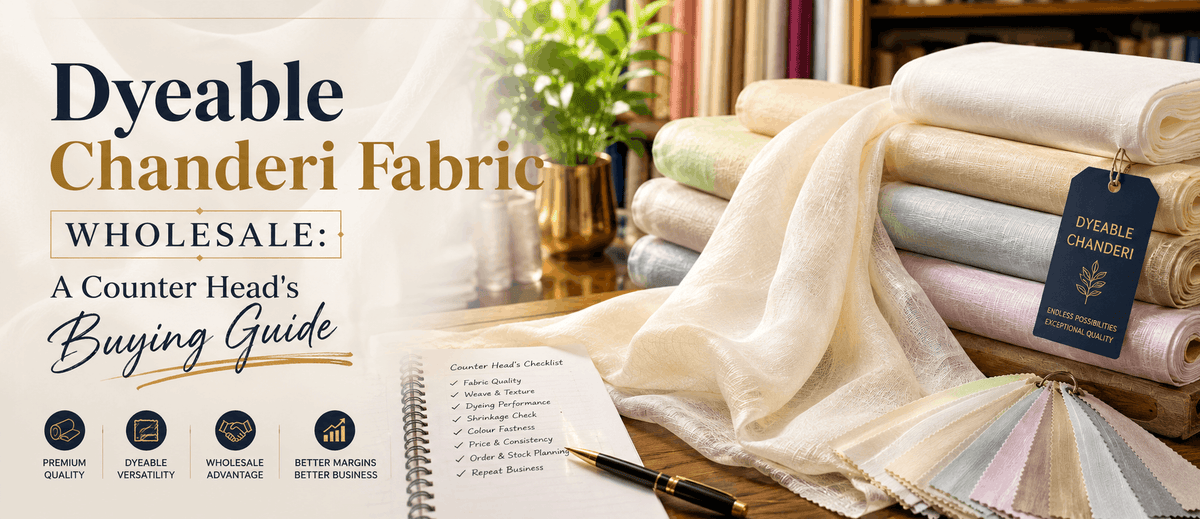
Dyeable Chanderi Fabric Wholesale: A Counter Head's Buying Guide
Most buyers walk in asking for chanderi in a fixed colour. The smarter ones ask for it plain. Dyeable chanderi arrives off-white, almost dull, so half the first-time buyers frown at it. Then you explain the trick. That plain roll can become any of forty shades your customer names next week, dyed in a small run, with no dead stock left rotting on your shelf in a colour nobody wanted.
Fourteen years across a Chandni Chowk counter teaches you that dyeable stock is where a boutique actually protects its money. You are not buying a colour. You are buying the option on every colour. Before a first bulk order of dyeable chanderi, three things decide whether the lot earns its keep.
- Fibre content. Cotton chanderi, silk chanderi and pure katan chanderi take dye differently and stitch into very different garments.
- Weave evenness. A greige with uneven yarn dyes patchy, so faults you cannot see in off-white jump out the moment colour goes in.
- Dyeing cost. The cheap greige rate means nothing until you add the dyer's charge and the shrinkage you lose in the vat.
Get those three right and dyeable chanderi becomes the most flexible buy on your shelf. This is the working reference I hand new bulk buyers. Not a sales pitch. A guide to buying dyeable chanderi fabric wholesale the way trade buyers who stay in business actually buy it.
Quick answer: Buying dyeable chanderi fabric wholesale means purchasing undyed, ready for dyeing chanderi by the thaan at trade rates, then dyeing it to your own shade. Common grades are cotton chanderi, silk chanderi and pure katan chanderi. Delhi trade prices run about Rs 80 to Rs 150 per metre for cotton chanderi, Rs 130 to Rs 260 for silk chanderi and Rs 260 to Rs 450 for pure katan chanderi. Add roughly Rs 20 to Rs 45 per metre for dyeing. Rates drop as your minimum order quantity rises.
What dyeable chanderi actually is at the counter
Chanderi is a light, slightly sheer fabric woven the traditional way in Chanderi in Madhya Pradesh, usually as a silk and cotton mix that gives it a soft glass-like sheen. Dyeable chanderi is that same cloth sold in its raw, undyed state. In the trade you will hear it called RFD, ready for dyeing or simply greige. It has been woven but not coloured, so the buyer decides the shade.
The value sits in that one fact. A dyed roll locks you into whatever colour the mill ran. A dyeable roll leaves the colour decision with you, so you dye small batches to real orders instead of guessing shades months ahead. For a boutique that lives or dies on matching a customer's exact maroon or bottle green, that control is the whole point.
Judge quality before dye goes in, never after. Hold the greige to the light and look at the weave. A good chanderi shows an even, fine grid with a quiet sheen running through it. Rub it and feel for body. Too thin and it will dye pale and tear at a stitched dupatta edge. Too coarse and the sheen that makes chanderi worth buying disappears once colour dulls it further.
Grades of dyeable chanderi worth stocking at wholesale
This is the table I pull out at the counter. Match the chanderi grade to what your karigar is actually stitching for the customer.
| Chanderi grade | Feel and sheen | Best garment use | Delhi trade price (per metre, greige) |
|---|---|---|---|
| Cotton chanderi | Soft, matte, light body | Day suits, everyday dupattas, kurtis | Rs 80 to Rs 150 |
| Silk chanderi | Fine, gentle sheen, fluid | Festive suits, light sarees, dupattas | Rs 130 to Rs 260 |
| Pure katan chanderi | Firmer body, richer sheen | Occasion suits, structured dupattas, sarees | Rs 260 to Rs 450 |
| Tissue chanderi | Crisp, shimmery, very light | Festive dupattas, layered saree drapes | Rs 180 to Rs 340 |
Prices above reflect Delhi wholesale rates as of this week for standard widths of 44 to 46 inches in greige, before dyeing. Chanderi rates move with the silk yarn market and climb through the wedding season, so treat them as a working band rather than a fixed number. You can see the running dyeable stock in our dyeable chanderi collection before you lock an order.
How to judge dyeable chanderi before you commit a thaan
A greige thaan is a real commitment because a weak or uneven lot only shows its faults once it is dyed, so by then you have paid for the dye run too. Run these five checks first.
- Fibre check. Ask the supplier plainly whether the yarn is cotton, silk mix or pure silk katan. If you are allowed, burn a selvedge thread. Cotton burns to soft grey ash smelling of paper. Silk curls slow and smells of burnt hair. The fibre decides the rate, so never guess it.
- Weave evenness. Hold the greige to a strong light and scan the width. The grid should read even edge to edge. Slubs, thin bands or thick yarn lines will dye unevenly and stand out once colour lifts them.
- Body and hand. Match the weight to the garment. Light cotton chanderi for flowing dupattas and kurtis. Firmer silk or katan chanderi for suits and sarees that need to hold shape. A chanderi that feels papery thin will not survive a lined suit seam.
- Dye test on a metre. Never scale a shade off a promise. Dye one test metre in the target colour first. It tells you the true shade uptake, the shrinkage and whether the sheen survives the vat.
- Shrinkage margin. Chanderi tightens in the dye bath. Ask the dyer for the shrinkage on that quality and add that margin to your metre maths so your cut panels still come out to size.
Dyeable against pre-dyed chanderi, the question that decides your margin
Every buyer eventually asks whether the extra step of dyeing is worth it over buying ready-coloured chanderi. The honest answer depends on how you sell, not on the fabric.
Dyeable chanderi wins when you sell to order or in tight custom shades. You buy the greige cheap, dye small runs to exact colours and carry almost no dead stock. A boutique matching bridal palettes or a label building coordinated suit-and-dupatta sets earns more this way, because the shade is theirs to control. The trade off is the dyeing lead time and a minimum batch the dyer will accept per colour.
Pre-dyed chanderi wins when you sell fast off the shelf in safe running shades. There is no dyeing wait, so you restock the same colours quickly. The cost is flexibility. You are stuck with whatever the mill ran, which means slow shades tie up money. Most steady boutiques keep both, dyeable for custom work and a small pre-dyed base in the shades that always move.
Minimum order quantity, dyeing economics and boutique margin
Every new bulk buyer asks where the rate breaks. Here is the honest structure most Delhi suppliers work with, ours included, remembering that dyeable carries a second cost at the dyer.
| Order tier | Typical quantity | Rate movement | Who it suits |
|---|---|---|---|
| Sample cut | 1 to 5 metres | Retail rate | First time buyers testing fibre and dye uptake |
| Small bulk | 1 thaan (about 18 to 20 m) | 5 to 10 percent off retail | Boutiques dyeing one shade per order |
| Trade bulk | 5 to 20 thaans | 12 to 20 percent off retail | Resellers, suit and dupatta labels |
| Manufacturer lot | 50 thaans and above | Mill linked rate on request | Exporters, large labels |
The dyeing side has its own break point. Dyers charge less per metre as the batch grows, so a large single-shade run costs far less to colour than five small ones. This is why a boutique that dyes ten metres each of five shades pays more per metre than one that pools an order into two bigger colour runs. Plan your shade card around fewer, larger dye batches and your margin holds.
This is the whole reason a wholesale community works. Fifteen boutiques pooling one chanderi quality reach both a greige rate and a dyeing rate none of them would touch alone.
Where dyeable chanderi earns its keep in a boutique line
Chanderi carries two jobs in a boutique line, so do not treat it as one buy. There is the suit body that sells the outfit and there is the dupatta that finishes it. Dyeable stock lets you match the two exactly.
For suit sets, cotton and silk chanderi are your workhorses. They stitch into light day suits and festive kurta sets that a customer wears through the season. Because you dye them yourself you can run the exact shade a bride's family asks for. The control is what keeps custom orders coming back to you instead of going to a larger label.
The dupatta is where dyeable chanderi quietly earns the most. A matched or tonal dupatta lifts a plain suit into a full outfit, so dyeing your dupatta length in the same vat as the suit body guarantees the shades sit together. Our dyeable dupatta range shows the lengths boutiques order most to pair with a chanderi suit body.
Common mistakes bulk buyers make with dyeable chanderi
- Judging the greige by its dull look. Off-white tells you nothing. Read the weave and the fibre, because a plain-looking roll can dye into your best seller while a bright one can dye patchy.
- Skipping the dye test. Shade uptake and shrinkage change with every quality. One test metre saves a whole thaan from coming out the wrong colour or the wrong size.
- Forgetting the dyeing cost in the price. The cheap greige rate is only half the number. Add the dyer's charge and the vat shrinkage before you set your selling price.
- Dyeing too many tiny batches. Small runs cost more per metre to colour. Pool shades into fewer, larger dye lots to protect the margin.
- Skipping the width check. Chanderi widths swing around 44 to 46 inches and tighten in the dye bath, so order on the finished width, not the greige width. Get it wrong and your panel maths breaks at the cutting table.
Storing dyeable chanderi stock without yellowing or crush
Greige chanderi picks up damp stains and yellows if it sits badly, so a few storage habits keep your stock dye ready.
- Store greige rolled, never folded hard, so no crush line sets a mark that survives the dye and shows on a finished panel.
- Keep rolls off the floor and away from damp walls, because moisture leaves patch stains that dye unevenly later.
- Wrap stock in soft cotton cloth, not plastic that traps humidity and yellows the greige at the folds.
- Rotate older thaans to the front so no piece sits long enough to yellow before it reaches the dyer.
Questions bulk buyers ask me at the counter
What is the minimum order for dyeable chanderi fabric wholesale?
Trade rates usually begin at one full thaan of about 18 to 20 metres of greige. Below that you pay close to retail. To reach the sharper 12 to 20 percent trade discount you generally need five thaans or more. Remember the dyer also has a minimum batch per shade, so plan your colours around that too.
What does RFD or dyeable chanderi mean?
RFD stands for ready for dyeing. It is chanderi that has been woven but left undyed, so you colour it yourself to any shade you want. It lets a boutique control the exact colour and dye small runs to real orders instead of buying fixed mill shades.
Which dyeable chanderi is best for a suit set?
Cotton chanderi for light day suits and silk chanderi for festive suits, because both dye evenly and stay light on the body. Keep pure katan chanderi for occasion suits and structured dupattas where you want more body and a richer sheen.
Does dyeable chanderi shrink after dyeing?
Yes, chanderi tightens in the dye bath, usually by a small but real margin. Always dye a test metre first, note the shrinkage on that quality and add it to your metre maths so your cut panels still come out to the size you need.
Ready to order dyeable chanderi at trade rates?
If you run a boutique, a suit label or a reselling line, the fastest way to lock trade pricing is to join the wholesale programme. You get thaan rates on greige, shade planning and colour pooling with other buyers. See the tiers and register on our wholesale fabric page to start your first bulk dyeable chanderi order.