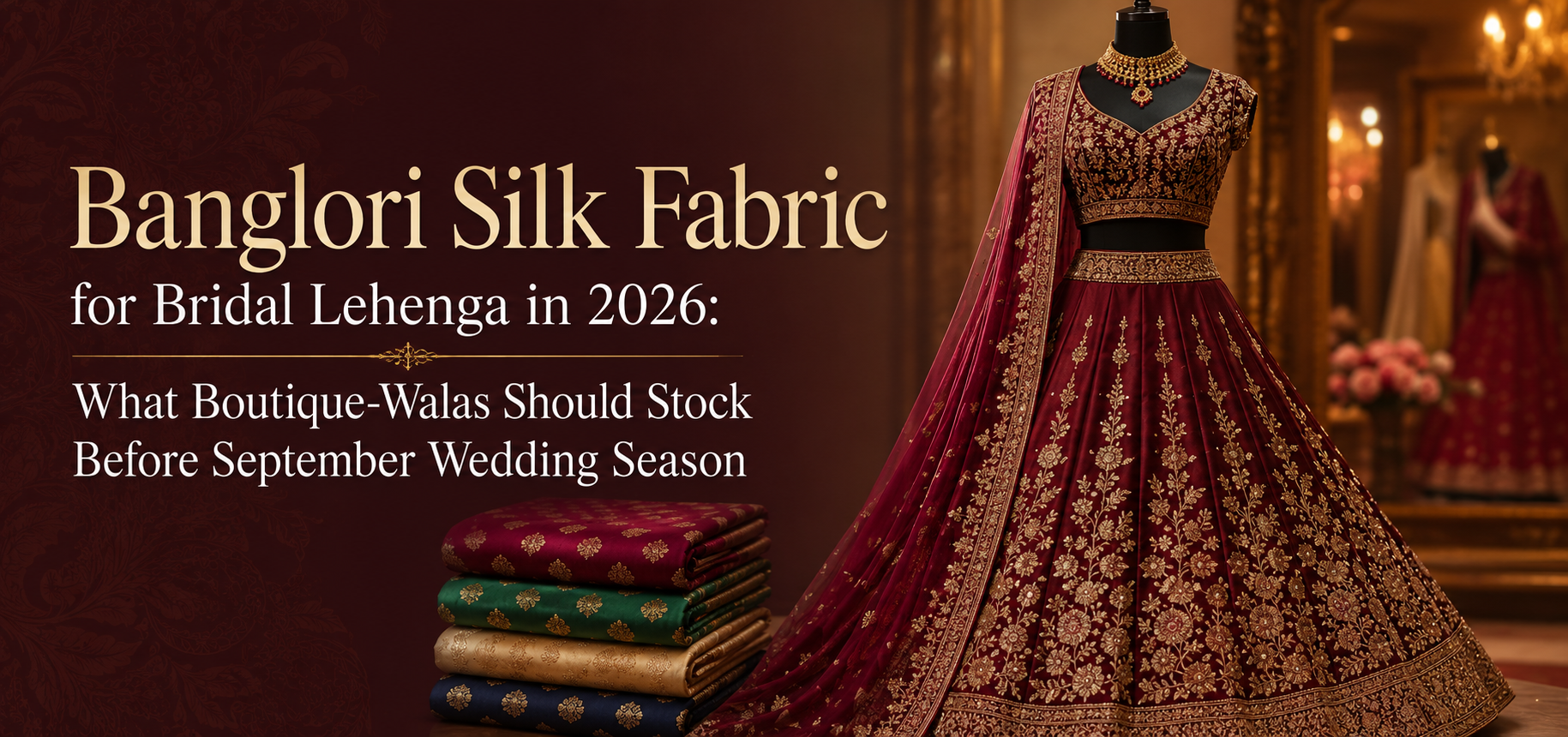
Banglori Silk Fabric for Bridal Lehenga in 2026: What Boutique-Walas Should Stock Before September Wedding Season
Banglori Silk Fabric for Bridal Lehenga in 2026: What Boutique-Walas Should Stock Before September Wedding Season
Last Tuesday a boutique-wala from Sarojini Nagar walks into my shop. Panicking. His bridal order book is fat from October to February but his usual banglori thaan supplier in Surat has hiked rates 18 percent overnight. Sit down bhaiya, I told him. Chai mangwao. Then for one full hour we worked the maths together on the back of his order pad.
This guide is basically that conversation. Written down for the next bhaiya landing at my counter with the same panic. Also useful if you are a bride shopping her own fabric before handing it to the karigar.
No theory here. No fancy textbook words. Just what I have actually seen across thousands of banglori rolls landing in our market.
Pull up a chair.
What Banglori Silk Actually Is (and Why the Name Confuses Everyone)
Banglori silk is not pure silk. Let us settle that part first.
What you are actually buying is a satin-weave cloth where both warp and weft are synthetic filaments. Mostly polyester. Sometimes a polyester-viscose blend in the better-quality rolls. Weave sits tight enough that the surface catches light the same way real silk does. Most thaans landing at Lajpat Nagar come from Surat power-looms. A smaller share, the costlier kind, still comes from Bangalore mills.
People also call it banglori satin. Or banglore silk. Or even mashroo silk in some Hyderabad shops. Same fabric family. The naming chaos is just market habit, nothing more.
Why does it dominate bridal lehenga base cloth in India? Three honest reasons. It photographs almost identical to real silk under wedding lighting. It costs roughly one-third of what pure silk does. The karigar can actually move a needle through it without wrestling the body of the cloth.
For brides shopping the silk lehenga fabric range, banglori sits in the synthetic-silk bracket. Always ask the shopkeeper which is which. Genuinely. Most won't volunteer it.
The Four Banglori Silk Weights I Keep Stocked Year-Round
Bridal lehenga is the heart of this fabric. Each weight maps to a specific use case. Mixing them up is where boutique-walas lose money.
Light Banglori Silk (180 to 220 GSM)
Soft. Fluid. Sits lighter on the hand than you'd expect. Good for kurta-style indo-western lehengas, lighter sangeet outfits, bridesmaid pieces with simple aari work. The fall is more like a heavy crepe than a true bridal silk. Rate in current Lajpat Nagar wholesale, 220 to 340 rupees per metre.
Medium Banglori Silk (240 to 290 GSM)
This is the workhorse. Most embroidered bridal lehengas you see across North Indian boutiques run on this exact weight. Zardozi sits clean on it. Sequins behave. Dabka and aari are no problem. Price band sits around 340 to 480 per metre at wholesale.
Heavy Banglori Silk (300 to 360 GSM)
Mother-of-bride favourite. Falls in those heavy ghera pleats that photograph so well under indoor wedding lighting. Cloth is thick enough that skirt lining sometimes becomes optional. Rate sits between 480 and 680 a metre.
Crepe Banglori Silk (220 to 260 GSM)
A textured surface variant. Less shine. Slightly more sophisticated look that some boutique brides specifically request now. Roka and engagement lehengas mostly. Around 380 to 540 per metre depending on the mill.
For boutique resellers planning the September stock, browse the full bridal fabric collection before locking quantities. Stock balance matters more than chasing the cheapest rate.
How to Check Banglori Silk Quality Before Paying
Buying banglori silk from an Instagram reel is the single biggest cause of bridal lehenga returns I see at my counter. Every single time.
Here is what every buyer should do before money leaves their hand.
Burn test (if the seller allows). Real banglori smells like burning plastic. Never like burning hair. Hair smell means it is actually a viscose-silk blend being sold to you as banglori. That is fine if you wanted that, but pay 30 percent less.
Coin rub test. Run a one-rupee coin across the surface with light pressure. Good cloth shows no scratch or dull patch. Loose-weave cloth scuffs immediately. Skip it.
Hold against bright light. Quality banglori has an even glow across the entire body. Patchy gloss means inconsistent yarn tension on the loom. Walk out.
Sharp fold for thirty seconds. If the crease holds like an iron line, the thaan has been over-starched. One wash kills the body completely. A soft memory line means weave density is correct.
Selvedge check. Ask the shopkeeper to point out the mill batch number on the selvedge edge. Blank or hand-written selvedge usually means a job-lot run. No quality guarantee across the thaan.
Embroidery and Karigar Workflow
Banglori shines specifically because karigars don't fight the cloth.
Heavy zardozi work needs medium or heavy banglori as base. The body absorbs the weight of the wire and stones without sagging at the waist seam later. Lighter weight cloth will droop within three wears.
Aari and crystal work runs best on medium banglori. Smooth satin surface lets your karigar move the needle fast. A skilled hand in Karol Bagh finishes a bridal lehenga panel set on banglori in 18 to 24 days. Faster if you split the work between two karigars.
Computer machine embroidery is forgiving. Light banglori is enough. Thread tension on machines is more controllable, plus the lighter cloth keeps the final outfit comfortable for dance numbers.
What you should never do is pair banglori with hand-block printing. The synthetic surface refuses dye colour evenly. Print bleeds at edges. Bride ends up with patchy lehenga and a returned order.
For boutique production using zari embroidery fabric or sequins embroidery fabric, banglori is the sensible base cloth. I have stocked it that way for years.
Stitching and Metreage for Bridal Lehenga
This part is where boutique-walas burn money by undercutting metreage. Don't.
Standard bridal ghera lehenga on medium banglori needs 7 to 9 metres for a full kali cut. Add 0.5 metres extra to match embroidery placement. Throw in another 0.3 metres if the karigar wants a separate motif strip on the waistband.
Slim A-line bridal silhouette on heavy banglori sits at 6 to 7 metres. No more.
Mermaid cut needs only 5.5 metres because the lower flare gets added as a separate cloth panel anyway.
For the inner lining, cotton satin or shantung in the same dye tone. Polyester lining inside banglori traps body heat. Bride sweats by the third sangeet round. Trust me on this. Three brides have called me from their own functions complaining about this exact issue.
Not sure how much fabric your design needs? Use the fabric estimator tool on our site before placing the cutting order.
Boutique resellers buying for retail stock, my honest advice. Stock the medium weight in jewel tones (deep ruby, peacock teal, golden mustard). Then a smaller stock of pastels (champagne, dusty rose) covering your engagement and roka segment. That ratio moves fastest in our market right now.
For larger production orders, the bulk fabric order desk handles boutique requirements directly.
When NOT to Use Banglori Silk (Honest Talk)
Some situations where I actively talk customers out of banglori.
Beach destination weddings give me the most returns. Salt air pulls the gloss off banglori within three months of storage. Goa, Pondicherry, anywhere coastal, switch to organza fabric or chanderi instead.
Confirmed silk allergy is another red flag. Synthetic silks can still trigger contact reactions on some skin types. One hour patch test on the inner wrist usually settles the question before stitching begins.
Outdoor daytime weddings above 32 degrees? Skip it. Synthetic body traps heat aggressively. Bride is miserable inside two hours. For day weddings switch to silk jacquard or chanderi without arguing.
Deep back necklines on the blouse are tricky too. Cloth slips on bare skin without inner lining. Blouse rides up during dance numbers. Embarrassing for everyone involved.
What Is Trending in 2026 Bridal Banglori
Three honest trends I am seeing land at my counter every week.
Self-tonal banglori lehengas with same-colour dabka and crystal work are everywhere now. Champagne, dusty rose, deep wine, midnight teal. Going viral on reels because of how they photograph in low-light reception lighting.
Heavy banglori lehenga paired with a contrast organza dupatta. Weight contrast helps the bride dance at sangeet without the dupatta dragging on the floor. Functional plus photogenic.
Mother-of-bride drape-style sarees stitched out of crepe banglori. Six metres of cloth, fixed pleats, ready-attached blouse. These walk off the rack within 48 hours of being stocked here in Lajpat Nagar. Boutique-walas who figured this out early are minting money this season.
For more on this year's bridal fabric shifts, read our companion piece on the most popular bridal lehenga fabrics in India right now.
Q: What is banglori silk and is it real silk?
It is a satin-weave synthetic fabric made from polyester or polyester-viscose blend, not real silk at all. This satin mimics the shine and body of pure silk at roughly one-third the price, which is why it dominates bridal lehenga base cloth across India. Most thaans come from Surat power-looms or Bangalore mills.
Overview
For bridal lehenga in 2026, banglori silk comes in four practical weights: light (180-220 GSM, Rs 220-340/m), medium (240-290 GSM, Rs 340-480/m), heavy (300-360 GSM, Rs 480-680/m). Crepe variant sits at 220-260 GSM around Rs 380-540/m. Medium weight is the workhorse for most embroidered bridal lehengas. A full kali ghera lehenga needs 7-9 metres of medium banglori plus 0.5 metres extra for embroidery alignment. This cloth is unsuitable for beach weddings, daytime outdoor functions above 32 degrees, or brides with confirmed silk allergies.
FAQ Section
Is banglori silk pure silk? No, not at all. Banglori is a synthetic satin made from polyester or polyester-viscose blend filaments. The fabric mimics real silk shine and body at roughly one-third the price.
What is the price of banglori silk fabric per metre in 2026? At Lajpat Nagar wholesale rates currently, light banglori runs 220 to 340 rupees, medium sits at 340 to 480, heavy goes 480 to 680, crepe variant 380 to 540. Boutique retail typically sits 1.8 to 2.4 times these numbers.
How much banglori silk is needed for a bridal lehenga? A full kali bridal ghera needs 7 to 9 metres of medium banglori plus 0.5 metres for embroidery alignment. Slim A-line cuts need 6 to 7 metres. Mermaid cuts need only 5.5 metres because the flare gets added as a separate panel.
Can banglori silk be machine washed? Never machine wash. Dry-clean only after the first wear. Spot-clean small stains with cold water and a soft cotton cloth before sending the full lehenga for professional dry-cleaning.
Is banglori silk good for summer day weddings? Not for outdoor daytime functions above 32 degrees. The synthetic body traps heat aggressively. For day weddings, silk jacquard or chanderi work better. Banglori shines best for indoor and evening events.
Which banglori silk weight is best for boutique resale? Medium banglori in jewel tones moves fastest during the September to January bridal cycle. Heavy banglori in mother-of-bride tones gives the strongest margin. Stock the medium for volume, the heavy for higher-ticket retail.
CTA: Final Word from the Counter
Twelve years at this counter has taught me one thing clearly. Banglori silk is the most misunderstood fabric in the bridal trade. Bought right, it gives the bride a lehenga that photographs like a million-rupee piece. Bought wrong, it embarrasses everyone by the third function.
If you are stocking for September weddings, don't wait past July. Surat mills hike rates every fortnight from August onwards. If you are a bride shopping your own cloth, bring this guide with you. Show it to the shopkeeper. Watch how quickly his pricing softens.
For curated banglori silk and the full bridal range, explore our bridal fabric collection or write directly to the bulk fabric order desk for boutique-grade quantities.
Questions? Drop them in the comments. I read every one.