Kota Doria Saree Fabric in 2026: A Lajpat Nagar Shopkeeper's Honest Guide for July Buyers, Boutique-Walas and Bridesmaids
Kota Doria Saree Fabric in 2026: A Lajpat Nagar Shopkeeper's Honest Guide for July Buyers, Boutique-Walas and Bridesmaids
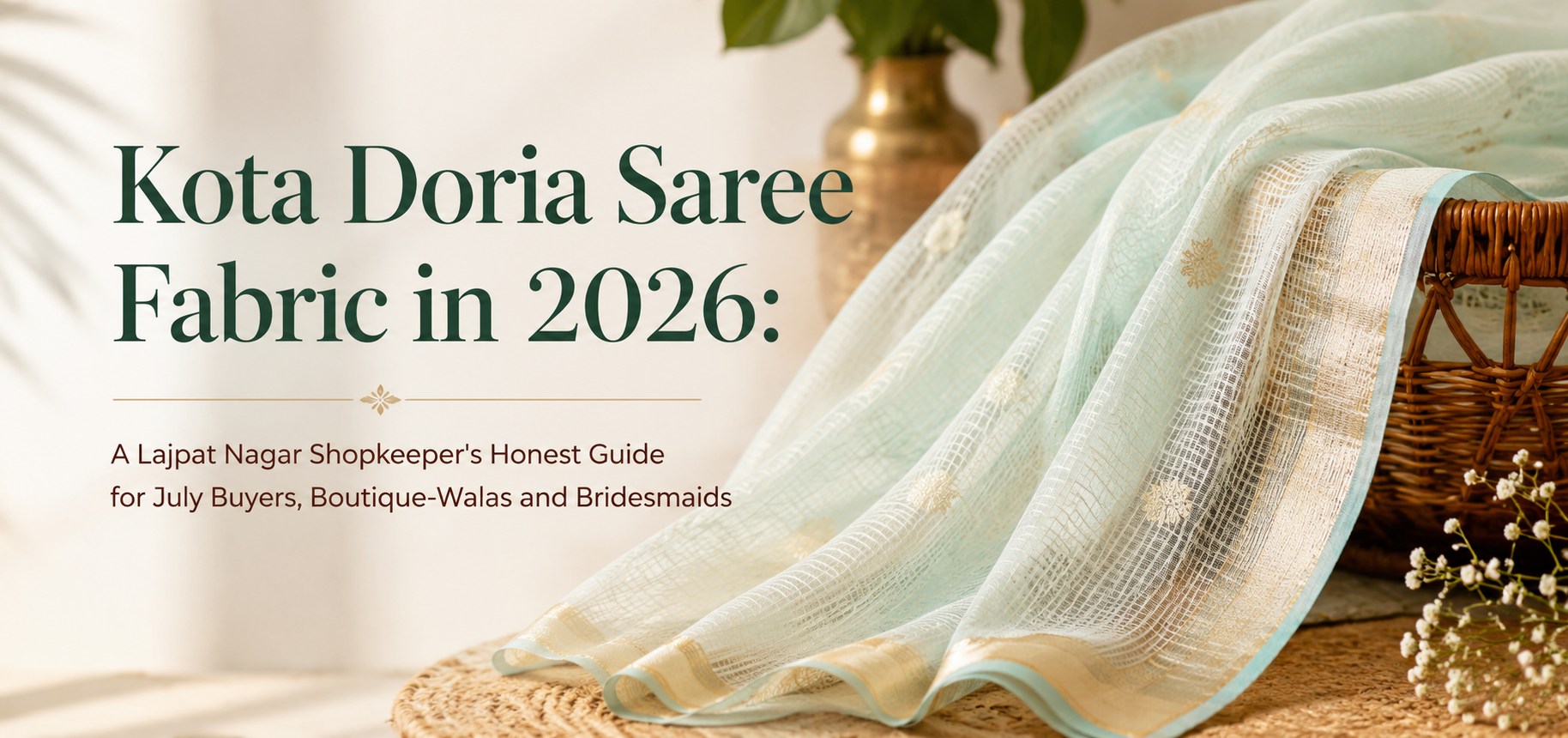
Kota doria is a hand-woven cotton-silk fabric from Kota in Rajasthan, recognised by its tiny square check called khat. The cotton gives breathability for summer, the silk gives shine, and the open weave keeps the saree light in July heat. Real Kota doria carries a Geographical Indication tag from 2005.
Twelve years now I am sitting at this counter in Lajpat Nagar. Every July a customer walks in saying she wants a Kota doria saree for office wear, for a relative's haldi, for daily July use because Delhi summer has finished her cotton wardrobe. And every July I have the same five-minute talk with her about what is real Kota and what is a polyester pretender. So I thought, let me just write it down once.
This is not a marketing piece. This is the same chat I have over chai with new buyers who come asking for Kota doria. If you are a boutique-wala stocking summer sarees for the July-August demand spike, this is also for you.
Sit, take chai, and read.
Kota doria saree fabric is a handloom weave from Kota in Rajasthan that mixes cotton warp with silk weft in a small square checked pattern locally called khat. It is light, breathable and semi-transparent, which makes it the most worn summer and monsoon saree fabric across North India, particularly between April and September.
What Kota doria actually is
The fabric is named after Kota district in Rajasthan. The weave itself comes from Kaithoon village, ten kilometres outside Kota city. The bunkar uses a cotton warp and a silk weft. They cross in a small square pattern. Each square is called one khat. A genuine Kota doria saree has roughly 300 khats across the body width. That number is the easiest single check for authenticity at the shop counter.
The cloth feels almost like air. It is semi-transparent because the open weave allows light through the squares. The silk gives a faint shine that no synthetic dupe can match for the price. Cotton gives breathability. The combination is what makes Kota doria the go-to summer saree fabric in cities where temperatures sit above 38 degrees from May to September.
People also confuse Kota doria with Mulmul cotton. These are totally different. Mulmul is a plain weave Bengal cotton with no silk content. Kota doria is a checked cotton-silk handloom with a recognisable khat pattern. The hand-feel, fall, drape, even the price band is different.
How to spot real Kota doria at the shop counter
The market is full of polyester Kota look-alikes. Surat mills run them on power-loom for forty rupees per metre wholesale and they end up retailing at 1,200 rupees as fake "Kota silk." This is what I tell every customer who comes in.
Count the squares across one inch of fabric. Real handloom Kota has roughly 14 to 16 khats per inch. Power-loom polyester has 20 plus and the squares look too perfect, almost printed.
Pull a single thread from the warp. Cotton warp tears with a slight fluff. Polyester warp pulls out as a smooth shiny filament. This one test alone catches 80 percent of fakes.
Look at the back of the saree pallu. Real Kota has tiny knots where the bunkar joined the silk weft. Power-loom fabric has no knots. The reverse looks identical to the front.
Hold the saree against window light. Genuine Kota has a slight unevenness in the square spacing. The cloth breathes. Polyester fakes have geometric perfection that feels almost printed.
Check for the GI mark. From 2005 Kota doria has had a Geographical Indication tag. The Kaithoon weaver cooperatives stamp real handloom rolls. Boutique-walas should ask for it.
July price bands in Lajpat Nagar wholesale
Real handloom Kota doria saree, plain dye with self khat. 1,800 to 2,400 rupees wholesale.
Real handloom Kota doria with zari border. 2,400 to 3,400 rupees.
Real handloom Kota doria with hand block print. 2,200 to 2,900 rupees.
Real handloom Kota doria with embroidery (chikankari, gota or aari). 2,800 to 4,500 rupees.
Power-loom cotton-mix Kota lookalike. 600 to 950 rupees. Useful for resellers who want volume but should not be sold as real Kota.
Pure polyester Kota print. 240 to 380 rupees. Stay away. Returns are heavy because the customer feels the heat retention within one wear.
Boutique retail will sit 1.8 to 2.4 times higher on the real handloom bands. The Sept festive demand pushes prices up by another 8 to 12 percent, so July is genuinely the smart sourcing window for boutique-walas.
Blouse and dupatta styling for Kota doria
This is where most buyers go wrong. Kota is a sheer body. The blouse choice will make or break the saree.
For office wear, a plain cotton blouse in the same dye tone works. Tight-fit lining inside. Three-quarter sleeves. Done.
For haldi or mehendi function, contrast hand-embroidered blouse. Mirror work, gota patti or aari work on raw silk base. The shine of the silk weft inside Kota pairs nicely with metallic embroidery on the blouse.
For evening receptions where the bride wants Kota for the cocktail look, go with a velvet blouse in a deep jewel tone. The weight contrast between the airy Kota and the body of the velvet blouse photographs beautifully under indoor lighting.
Do not pair Kota with a satin polyester blouse. The silk of Kota and the gloss of polyester satin clash. Customer complaint guaranteed.
For dupattas, Kota doria works as a second-day sangeet dupatta over a heavier suit. Many of my boutique customers in Jaipur and Lucknow stock Kota dupattas in light cream and lemon to pair with hand-block printed kurta sets.
Monsoon care that nobody tells you
A real Kota doria saree needs proper monsoon handling. Delhi humidity ruins the silk weft inside the weave if you store it folded.
Roll, do not fold. Wrap in a clean cotton cloth. Store flat in the cupboard.
For the first wash, gentle cold hand-wash with Ezee on the diluted side. Never use Surf Excel or any strong detergent on Kota. The silk threads will break within two washes.
Air-dry in shade. Direct July sun will fade the cotton warp and stiffen the silk weft.
Iron on medium heat with a thin cotton sheet on top. Never iron the bare cloth. The silk patches will scorch.
Once a season, send to a known karigar for re-pressing. Not a regular dry-cleaner. Most dry-cleaners in Karol Bagh and Lajpat Nagar do not know how to handle handloom Kota and the customer ends up with a stiff, dead saree.
Who Kota doria is genuinely for in 2026
Working women who want one summer saree they can rotate twice a week from May to September.
Mother-of-bride buyers who want a daytime haldi saree that does not make them sweat in 38 degree weather.
Boutique-walas stocking for the July to September wedding daytime function bracket. The demand spike begins around July 8 and runs till mid-September.
Resellers in Tier 2 cities who want a handloom story to tell their Instagram audience without going into expensive Banarasi or Kanjivaram bands.
Brides who want a relaxed pre-wedding lunch or pooja saree that photographs well in natural light.
FAQ
Is Kota doria saree fabric good for July and August in Delhi? Yes. Kota is the single most heat-friendly saree fabric for North Indian summer because of the open square weave. Customers who switch from chiffon and georgette in May usually settle on Kota for the rest of summer.
What is the price of a real Kota doria saree in 2026? At Lajpat Nagar wholesale right now, plain real Kota runs 1,800 to 2,400 rupees, Kota with zari border 2,400 to 3,400, embroidered Kota 2,800 to 4,500. Boutique retail sits 1.8 to 2.4 times higher.
How can a buyer tell real Kota from polyester Kota online? Count the squares per inch in zoomed images. Real handloom Kota has 14 to 16 khats per inch with slight unevenness. Polyester prints look too perfect. Always ask the seller for a GI tag or weaver cooperative stamp.
Can Kota doria be worn for evening weddings? Mostly daytime functions. For evening receptions a heavier blouse and a Kota with zari border can work, but the cloth itself is too sheer for late-night winter weddings. Switch to chanderi or tussar for evening events.
How do I wash a Kota doria saree at home? Cold hand-wash with Ezee for the first wash. Roll in a clean cotton cloth, do not wring. Air-dry in shade. From the third wash onward, dry-clean with a karigar who knows handloom care.
Which Kota doria is best for boutique resale? For volume resale, plain real Kota in pastel tones and Kota with hand block print move fastest in July to August. For premium retail, Kota with chikankari or aari embroidery gives the strongest margin in the Sept festive window. Stock both if your customer base is mixed.
CTA
If you are sourcing Kota doria for your July to September stock or for a personal summer saree wardrobe, talk to me on WhatsApp before you decide tone and border type. Same-day swatches go to most North Indian cities. Browse the live ranges on Designer Fabrics, Festive Celebration and Silk Fabric, or use the Fabric Estimator before placing a bulk order.