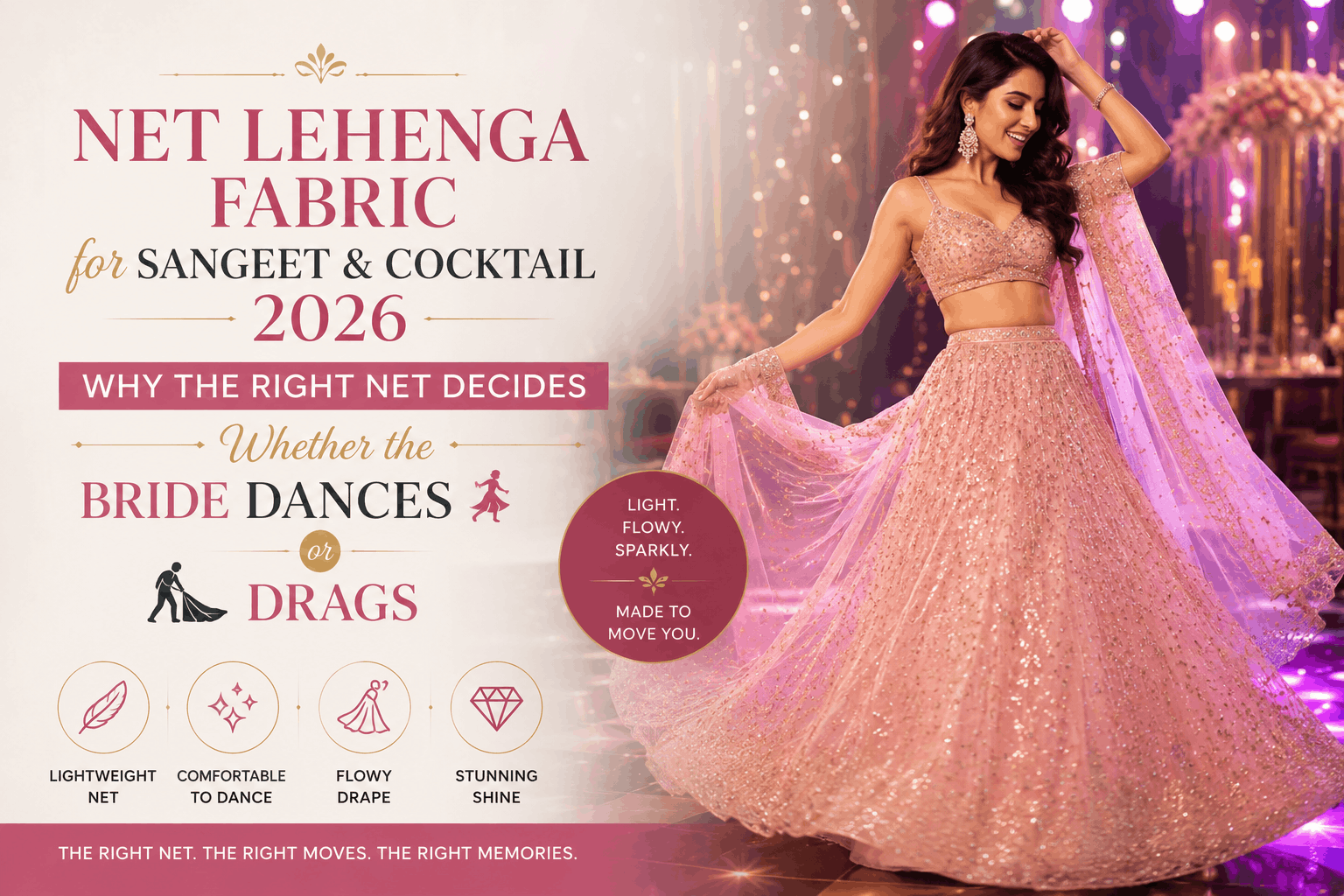
Net Lehenga Fabric for Sangeet and Cocktail 2026: Why the Right Net Decides Whether the Bride Dances or Drags
Net Lehenga Fabric for Sangeet and Cocktail 2026: Why the Right Net Decides Whether the Bride Dances or Drags
Net lehenga fabric is a lightweight mesh cloth used as a base for sangeet, cocktail and reception lehengas. The two main families are soft net for fluid drape and hard net for structured flares. The right net choice decides how the bride moves, how the cloth photographs, and how comfortable she stays.
Last Sunday a Lajpat Nagar bhabhi walked into my counter with her daughter plus three Pinterest screenshots in hand. All three reference images showed heavy net lehengas with full embroidery coverage. She kept asking me the same question through the whole consultation. Bhaiya can my daughter dance in this.
That is exactly the right question every mother plus every bride should be asking before paying for a net lehenga.
Here is what most boutique-walas will not tell you upfront. The wrong net turns the sangeet into a struggle. The right net lets the same bride photograph beautifully then still dance till the dhol stops. This guide is the one I wish someone had handed me ten years back when I started cutting bridal net pieces. Pull up the stool and read carefully.

Net lehenga fabric is a knitted mesh cloth, usually polyester or nylon, used as a transparent base for embroidered or sequinned lehengas. Soft net flows softly and works for sangeet and walking-friendly looks. Hard net holds a structured A-line or fish-cut silhouette and works for cocktail entry shots. Both need lining underneath for modesty.
What net fabric actually is
Net is a knitted or warp-knitted mesh cloth where the yarn loops to create open holes between thread points across the cloth surface. The hole size, hole shape, plus yarn thickness together decide everything about how the net behaves on the body during wear. Most Indian wedding net is polyester or nylon based at the source mill. Some heavier French net uses a stiffer nylon yarn for structural support. Korean soft net uses a finer softer yarn that drapes more like georgette than like traditional net.
Worth knowing that net is not the same as tulle even though buyers use the terms interchangeably at most counters. Tulle is a much finer mesh used mostly for veils plus lighter dupatta construction. Wedding net for lehengas runs significantly heavier plus more structured than tulle. Buyers who mix up the two end up confused at the shop when shown actual samples side by side. Browse current net options in our net fabric collection where each variety carries yarn-type attribution per bolt.
The net families I keep stocked at this counter
Picking the wrong family is the most common mistake first-time bridal buyers make at any fabric shop. Each family has a specific function which the cloth was designed for at the mill level.
Soft net in the standard polyester light variety is the fluid one in the family. Drapes like a heavier chiffon falling off the cutting table. Best application is sangeet lehengas where the bride wants to dance without effort across long evenings. Counter pricing runs Rs 240 to 360 per metre. Needs lining of crepe or silk-mix underneath for modesty.
The Korean soft variety runs at finer yarn count which gives even softer drape than standard soft net, at a slightly higher cost per metre. The 2026 trend for sangeet construction is moving strongly towards this option because the cloth catches reel-camera light beautifully across different lighting setups. Counter pricing comes in at Rs 380 to 540 per metre at the Lajpat counter right now.
Hard net in the nylon structured variety holds a fish-cut or full A-line silhouette without needing canvas backing underneath. Best application is cocktail entry shots and reception construction where the silhouette has to read on camera from a distance across large venues. Pricing comes in at Rs 220 to 340 per metre wholesale. Lining choice should be silk-cotton or shantung for structural support.
Embroidered net comes pre-embroidered with sequin, sitara, thread, or zardozi work already applied to the base. Sold ready-embroidered by the metre at the counter. Wholesale pricing starts around Rs 580 per metre for sequin filler work and climbs to roughly Rs 4,800 per metre for hand-zardozi embroidered net at the heaviest end. Browse the embroidered range in our bridal bliss collection where occasion-suitable pieces are sorted by embroidery density.
Honeycomb net rounds out the family I keep stocked. Larger hole pattern with a very 1990s structured silhouette character. Recently coming back into fashion for couture sherwanis plus groom-side accessories like dupattas and stoles. Pricing at the counter is Rs 280 to 440 per metre wholesale.
Soft net or hard net: how to decide
That question is the one every bride asks at the counter. The answer comes from the function the lehenga has to perform plus the silhouette intended for the photographs.
A sangeet where dance is the primary focus needs soft net specifically. Korean soft net works even better if the budget allows the slight extra cost. What the bride actually needs at the hem is movement that flows with dance steps rather than fighting them.
For a cocktail entry where the bride walks down a staircase or makes a grand entrance, hard net is the right choice instead. The structured flare reads beautifully on camera from a distance, which is exactly what entrance shots need to capture.
Reception construction usually pairs an embroidered net on a soft net base for the skirt plus a silk-cotton lining underneath the whole structure. This combination photographs heavily under stage lighting but stays comfortable across the hours of greeting guests plus posing for family photographs.
When the sangeet bride is also opening the dance routine, soft net for the ghera section plus a fitted velvet or silk choli on top works best. Soft bottom plus structured top gives the best of both worlds for this specific scenario.
Embroidery density on net: what the camera wants
The cloth itself is inherently transparent. So the embroidery is what the eye sees in the final photograph, not the cloth underneath. Get the density right and the lehenga reads as bridal-grade across all lighting conditions. Get it wrong and the same lehenga looks empty even in good light.
Sangeet net lehenga construction calls for 50 to 60 percent embroidery coverage on the skirt with the rest filled in scattered booti or small sequin filler work. The hem should carry a defined border running 4 to 6 inches deep around the entire lehenga circumference.
Cocktail net lehengas need slightly heavier coverage at 60 to 70 percent embroidery on the skirt with a hem border running 6 to 8 inches deep. The front panels should carry heavier embroidery than the back because the photograph focus typically captures the front angles more often during cocktail events.
Reception lehengas push to 70 to 80 percent embroidery coverage with a hem border running 10 to 12 inches deep around the lehenga edge. The matching dupatta should have scattered booti plus a thicker border treatment to coordinate with the heavier lehenga work. Coordinated zari border options work well for adding finishing details that match the main embroidery weight.
Anything below 40 percent embroidery coverage on a net base makes the lehenga read as thin in photographs. The cloth holes show too much skin underneath even with proper lining in place. Buyers complain about this consistently when boutiques cut corners on embroidery density at the construction stage.
Lining: the part nobody really talks about
A net lehenga lives or dies by the lining choice underneath. The wrong lining ruins what would otherwise be a perfect cloth construction. This is the area where boutique buyers cut corners most often because customers cannot see the lining at the showroom display.
For soft net sangeet lehengas, the lining should be crepe or silk-mix in a colour matched to the lehenga top layer. Crepe gives natural flow that complements the soft net movement. Silk-mix adds slight body without taking away the flow character that made the bride pick soft net in the first place.
For hard net cocktail lehengas, the lining choice should be shantung silk or silk-cotton. Shantung holds the structured A-line shape from inside the construction without crushing the outer cloth or restricting silhouette during movement.
Embroidered net reception lehengas need double-lining specifically. One layer of mulmul cotton sits against the bride's skin for comfort across long hours. The second layer of silk-mix provides body plus modesty underneath the embroidered outer panel.
Always brief your tailor to attach the lining 1 cm inside the net hem line so the lining does not peek out when the bride walks during ceremony movements. This small detail separates boutique-finish work from tailor-finish work visibly across the wear.
Colour and motif trends for 2026
The directions moving fastest right now at my counter follow specific patterns worth knowing.
Ivory net lehengas with pastel pink or pastel sage embroidery for sangeet construction are the safest combination this season. The contrast keeps the look photogenic across both indoor venue plus outdoor sangeet lighting without reading childish on camera.
Bottle green or deep wine soft net with antique gold zardozi for cocktail events is the next direction worth stocking. The deep base reads sophisticated on Instagram reel content. The gold catches venue lighting beautifully across different photograph settings.
Powder blue Korean soft net with silver plus pearl work for engagement function dressing has been selling fast through the September-October order slot. Stock this specific combination if your customer base includes engagement parties at the boutique-tier price point. Browse coordinated bridal options in our lehenga fabric collection sorted by function type plus colour family.
Pastel demand is slowing visibly compared to 2024. Earth tones, bottle green, wine, plum, plus powder blue are the colours my Surat suppliers are pushing for the autumn cycle. Stock accordingly across both retail plus boutique segments.
How much net to order for each lehenga construction
Metreages I send out from the counter follow specific patterns based on silhouette intent.
A flowing A-line sangeet lehenga in soft net needs 8 to 10 metres of net for the skirt depending on the ghera flare you want, plus 2 metres of lining cloth, plus 2.5 metres of dupatta cloth in matching tone.
Fish-cut cocktail lehenga construction in hard net takes 6 to 8 metres of hard net for the structured panels plus an additional 1.5 metres for the trumpet flare section at the bottom.
A full ghera reception lehenga in embroidered net runs 9 to 12 metres depending on the kali count plus ghera flare requirement. Add 0.5 metres extra specifically for kali pattern matching across panels.
Choli construction rarely uses net as the main blouse cloth. Most cholis are built from silk dupion or velvet with net only used for the sleeves or back panel detailing where transparency works visually.
Common mistakes worth warning customers about
The lehenga that looks gorgeous on the Surat thaan does not always look the same way on the actual bride. Tell your customer these specific things before they commit to the order.
These lehengas weigh significantly more than buyers expect when they see the cloth at the shop. Dry weight of a fully embroidered net lehenga can run 4 to 6 kg across the full construction. Tell the bride this number before she commits, not after the first fitting when adjustments become difficult.
Net catches on jewellery plus shoe buckles during normal movement at functions. Tape the inner hem of the lehenga before sangeet so the bride does not accidentally rip the cloth mid-dance which then requires emergency repair.
Net cloth ages in storage if folded incorrectly between functions. Always store rolled on a wide cardboard tube rather than folded flat, with butter paper layered between the embroidery and the net layers to prevent indentation marks from setting in permanently.
FAQ
What is the difference between soft net and hard net?
The soft variety uses a finer softer yarn that drapes fluidly with body movement. Hard net uses a stiffer nylon yarn that holds structured A-line and fish-cut shapes without canvas backing. Pick soft for movement plus dance. Pick hard for silhouette plus entry shots where the structure matters more than the flow.
How much net fabric do I need for a lehenga?
The sangeet A-line in soft net needs 8 to 10 metres for the skirt section. Cocktail fish-cut construction in hard net needs 6 to 8 metres. Full reception ghera in embroidered net runs 9 to 12 metres depending on kali count. Always add 0.5 metres extra to accommodate kali pattern matching across the panels during cutting.
What is the price of net fabric per metre in 2026?
Current Lajpat Nagar wholesale pricing covers soft net at Rs 240 to 360 per metre, Korean soft net at Rs 380 to 540, hard net at Rs 220 to 340, embroidered net starts at Rs 580 plus climbs up to Rs 4,800 per metre for hand-zardozi work. Boutique retail pricing typically doubles these wholesale numbers depending on margin policy at individual shops.
Can a net lehenga be worn for the wedding pheras?
The main pheras traditionally call for a heavier silk or raw silk lehenga construction rather than net. Net lehengas work best at sangeet, cocktail, engagement, plus reception functions where movement plus camera glamour matter more than ceremonial weight requirements. Mixing the wrong cloth with the wrong function is a common bridal-planning mistake.
How do I wash a net lehenga at home?
A net lehenga should never be washed at home regardless of how careful you intend to be. Always dry-clean with a specialised bridal dry-cleaner who handles embellished work routinely. Home washing distorts the mesh shape across the cloth plus damages the embroidery within a single wash cycle even with cold water plus mild detergent.
Which net base works best with zardozi embroidery?
The hard variety is the right base for full-coverage zardozi because the structure holds the metallic weight without sagging at the embroidery line. The softer variety works for scattered zardozi where the look should remain fluid plus dance-friendly. Pick Korean soft for sangeet zardozi specifically where comfort plus reel-camera read both matter equally.
Final word from the counter
This category is the bridal cloth that gets the photograph credit but causes the most planning confusion at the counter. A wrong choice means the bride struggles through her own sangeet. The right one means she dances through the night plus photographs beautifully in every frame.
The bhabhi who came in last Sunday eventually picked Korean soft net for her daughter's sangeet lehenga in ivory with pastel pink embroidery, plus hard net for the cocktail event in bottle green with antique gold zardozi work. Two different cloths. Two different functions. One bride dancing comfortably through both. That kind of staged buying is exactly what makes net work as a bridal category.
CTA
If you are booking your sangeet plus cocktail collection for the September through November delivery cycle, message me directly on WhatsApp this week before karigar slots tighten by mid-July. Browse the live ranges across net plus sequins plus bridal categories at the Lajpat Nagar counter. Boutique buyers planning larger volume orders should request bulk quotes through our bulk order page before committing to specific colour plus weight combinations. Direct sourcing from Surat plus Korean import channels. Honest grading. No runaround on net authenticity questions.