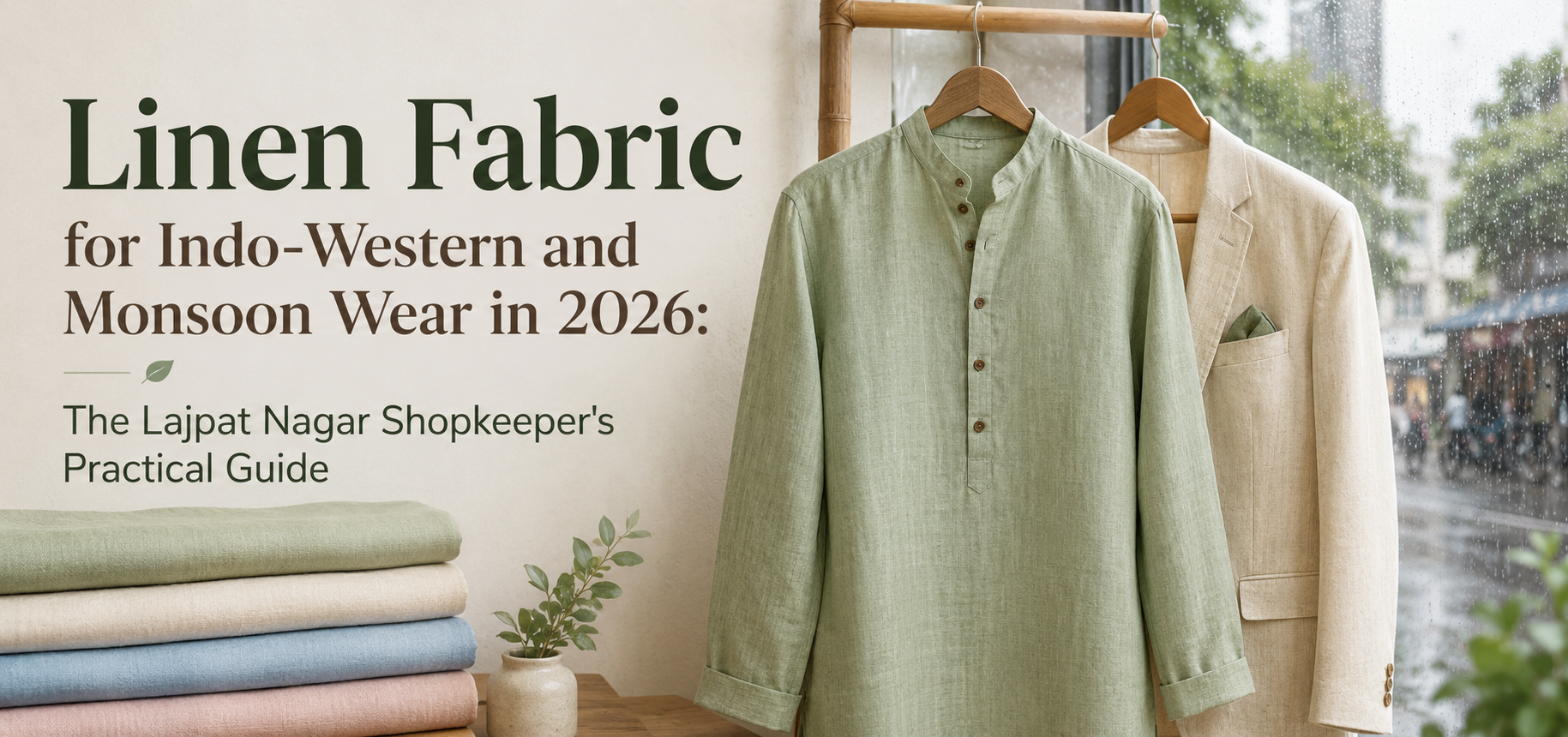
Linen Fabric for Indo-Western and Monsoon Wear in 2026: The Lajpat Nagar Shopkeeper's Practical Guide
Linen Fabric for Indo-Western and Monsoon Wear in 2026: The Lajpat Nagar Shopkeeper's Practical Guide
Last Saturday around 4 PM the rain hit Lajpat Nagar without warning. By six in the evening three boutique customers were standing inside my shop. Wet, frustrated, all asking the same exact thing. What can their brides and bridesmaids wear during Delhi monsoon without ending up looking like they had slept in their kurtas?
I pulled out the linen rolls. We sat down. That conversation, stretched across two hours of chai, became this blog.
Linen in India is a confused market though. Honestly. Half the stock being sold as linen across markets is actually a polyester-cotton blend dressed up with a slubby surface. The genuine cloth sits in a wide price band, anywhere from cheap khadi-linen at 220 rupees a metre right up to real European flax linen at 1,400 rupees. This guide will help you cut through that mess.
Pull up a stool. Take a chai. Let me walk you through the linen rolls actually sitting on my shelf right now.
What Real Linen Actually Is (and Why So Much Sold as Linen Is Not)
Linen comes from the flax plant. Specifically from the stem fibre, never from the leaf or seed. Europe is the historical home of fine flax cultivation. Belgium, France, Ireland still produce the highest count linen yarns globally. India also grows flax in pockets of Andhra Pradesh and Bihar. Mills in Surat and Ahmedabad weave a lot of Indian flax linen specifically for the domestic boutique market.
Spotting genuine linen is easier than people think. The flax fibre is naturally uneven, unlike cotton. Authentic cloth carries a slubby texture, occasional thicker knots in the weave, plus a matte natural lustre that is never glossy. It also creases very easily. A crisp linen kurta that wrinkles within one hour of wear is the real thing. A linen kurta that stays smooth all day is almost certainly blended with polyester.
People constantly confuse linen with cotton-slub. Or with khadi cotton. Or with chambray. These are completely different fibres or weaves. Khadi is hand-spun hand-woven cotton, totally different process. Chambray is a cotton weave that just happens to look denim-ish. Linen alone comes from flax. The hand-feel of each cloth is distinct once you know what to feel for.
For boutiques exploring the lighter ethnic side, our kurti fabric collection includes several linen and cotton-linen options worth pulling for swatches.
The Five Linen Families I Keep on My Shelf in 2026
These map to specific use cases. Stock the wrong family against the wrong customer and they come back unhappy within two wears.
European Flax Linen (180 to 240 GSM)
Highest count, finest weave, softest hand from day one. The cloth you sell to boutique kurta-pyjama buyers and customers ordering tailored Indo-Western suits. Wholesale rates sit at 950 to 1,400 rupees per metre depending on weight.
Indian Flax Linen (160 to 220 GSM)
Mill-made in Surat and Ahmedabad mostly. Slightly coarser slub than European but breathes equally well in Delhi heat. My workhorse for designer boutique suits and unisex shirts. Rate band runs 480 to 720 per metre at wholesale.
Cotton-Linen Blend (60-40 or 70-30 Cotton-Linen, 180 to 220 GSM)
More forgiving for daily wear customers. Wrinkles less. Feels softer to start. My default recommendation for office-wear suit pieces and bridesmaid Indo-Western co-ord sets. Around 320 to 520 a metre.
Linen-Viscose Blend (50-50, 160 to 200 GSM)
Drapes more, slubs less. What saree retailers should pick because the cloth falls cleaner in pleats. Wholesale band sits at 360 to 540 per metre.
Polyester-Linen Blend (Sold Deceptively as Linen-Look)
80 percent polyester, 20 percent linen at best. Honest advice? Stay away from this completely. Buyer feels the heat retention after one Delhi summer wear and the shop loses the customer permanently. Wholesale 180 to 260 rupees per metre.
Boutique resellers looking at the full linen-friendly range can browse our saree fabric collection and printed fabric collection for matching base cloths.
How to Spot Real Linen at the Counter Without Getting Cheated
Five honest tests. Use any two or three together before paying.
Thread pull. Tug one thread from the warp gently. Genuine flax pulls out with slubby unevenness plus a slight golden-grey natural shade at the core. Polyester comes out as a perfectly smooth shiny filament that almost glints. Walk out if you see the second one.
Crumple in fist. Squeeze a corner inside your closed fist for thirty seconds, then let go. Genuine linen holds a deep visible crease. A polyester-linen blend springs back smooth, almost mocking you. This one test alone catches most fakes in our market.
Light hold. Lift the cloth against bright daylight or shop tube-light. Authentic flax reveals tiny irregular flecks scattered across the surface from natural fibre variation. Blended fakes look uniform. Too uniform.
Hand-feel. Genuine cloth has a slight crispness when new which softens with each wash. A cotton-linen mix feels softer right from the bolt. Polyester variants feel almost plastic against the palm if you slow down and focus.
Burn test (if seller permits). This is the gold standard test. A pure flax thread smells exactly like burning paper or burning leaves when authentic. Polyester smells like burning plastic. No other check comes close to this for reliability.
Lajpat Nagar Wholesale Price Bands This Monsoon
Quick reference for boutique buyers planning July stock.
European linen in plain dye sits at 950 to 1,400 rupees a metre. Indian flax linen, same dye level, runs 480 to 720 instead. Blended cotton-linen drops to the 320 to 520 band. Viscose-linen mixes hold around 360 to 540 because of viscose content stabilising the fall.
Hand-embroidered linen with chikankari, kantha or aari adds 380 to 720 rupees on top of base price depending on motif density. Block-printed real linen pushes 180 to 320 on top of plain.
Boutique retail typically sits 1.8 to 2.4 times above these wholesale bands. The July-August monsoon demand spike is honestly the smartest window to source linen for your boutique floor before September festive prices begin climbing.
Stitching and Styling for Indo-Western Outfits
Where boutique-walas mess up. Underestimating metreage and pairing linen with wrong embroidery.
For an Indo-Western kurta set, plan 2.5 metres of Indian flax linen on the kurta plus 1.2 metres on the pant. Lining the kurta is optional because linen itself has enough body to skip the inner layer.
A boutique Indo-Western trouser suit needs 3 metres of cotton-linen blend to get a clean office-ready cut without skimping at the hem.
Linen saree calls for 5.5 metres of linen-viscose blend plus 0.8 metres extra on the matching blouse piece. Always advise the customer to get her blouse stitched in contrast cotton-satin so the saree pleats sit cleanly without slipping.
A tailored linen sherwani uses 3.5 metres of real linen paired with a cotton-satin lining inside the body shell.
Pair linen with embroidery very carefully. Hand-block printing pairs naturally with the slub. Chikankari pairs beautifully on the lighter European linen weight. Heavy zari plus sequins are a flat no because the linen body cannot hold the metallic weight without sagging at the seams within five wears.
Not sure how much fabric your design actually needs? Use our fabric estimator tool before placing the cutting order.
Monsoon Care That Nobody at the Shop Tells You
Linen is the most monsoon-friendly fabric in the entire ethnic wardrobe. But the cloth needs slightly different care than cotton, which trips up most first-time buyers.
Wash separately in cold water for the first three cycles. Natural dye on real linen can bleed slightly during this period. Ezee works well. So does any mild liquid detergent. Surf Excel? Never use it on linen, the enzymes break down the slub yarn faster.
Roll the wet kurta inside a clean cotton towel to absorb extra water before hanging. Wringing linen kills the fabric. Slub yarn snaps under twist pressure.
Hang to dry in shade only. Direct July sun fades real linen colour within five wears, which kills the resale value if your customer is a reseller herself.
Iron on high heat with a damp cotton cloth placed on top. This is one of the rare ethnic fabrics that handles high iron temperature beautifully. The damp cloth prevents surface glazing.
Once per season, send the piece to a dry-cleaner who specifically understands linen care. Most local dry-cleaners over-press linen and the cloth ends up shiny and lifeless within two visits.
When Linen Is the Wrong Choice (Honest Talk)
Daytime wedding events where photographs need a crisp no-wrinkle outfit are a problem. Linen wrinkles within two hours of being worn. Switch your customer to cotton-silk or chanderi instead, both will photograph cleaner.
Heavy embroidered bridal lehengas should never use linen as base. The natural body cannot carry zardozi plus dabka weight without seam sagging.
Mother-of-bride formal sarees being stitched for late-night winter weddings? Skip linen entirely. Pivot to silk or banglori silk instead, both photograph better under indoor wedding lighting.
Outfits being shipped to humid coastal destinations and stored in plastic bags are also a poor match. Linen needs cotton bag storage plus air circulation to stay fresh.
For winter wedding-season alternatives, our silk lehenga fabric range covers the gap linen cannot fill.
What Is Trending in 2026 Linen at My Counter
Three honest trends moving fast right now.
Self-tonal block-printed linen kurta sets in mustard, terracotta and indigo are going viral on Instagram reels as the new monsoon office-wear staple. Younger customers especially.
Tailored Indo-Western co-ord sets cut in Indian flax linen, sleeveless kurta paired with straight pants, are emerging as boutique daily-wear bestsellers. Photographs beautifully on Reels.
Sarees cut in cotton-linen blend with kantha embroidery borders are pulling mother-of-bride customers in their early forties away from chiffon for daytime functions. This shift has been visible since April 2026 at my counter and shows no sign of slowing.
For deeper seasonal fabric strategy, read our companion piece on the top breathable lehenga fabrics for summer weddings 2026.
Q: Is linen fabric good for Delhi monsoon and what makes it different from cotton?
Honestly the single best ethnic fabric for the Delhi June-September monsoon, linen dries within two hours and resists mildew far better than cotton. Made from flax plant stem fibres, this cloth has a naturally slubby texture and a matte lustre that does not retain humidity. Authentic linen wrinkles easily, which is the simplest way to tell it apart from polyester-blended fakes sold as linen.
Overview
For Indo-Western and monsoon wear in 2026, linen fabric comes in five practical families. European flax linen (180-240 GSM, Rs 950-1,400/m), Indian flax linen (160-220 GSM, Rs 480-720/m), cotton-linen blend (180-220 GSM, Rs 320-520/m), linen-viscose blend (160-200 GSM, Rs 360-540/m). Polyester-linen at Rs 180-260/m should be avoided because heat retention is high. Identification relies on the burn test (smells like burning paper, not plastic) plus the crumple test (holds deep crease). For Indo-Western kurta sets plan 2.5 metres of Indian flax linen plus 1.2 metres of matching pant fabric. This cloth is unsuitable for heavy bridal lehengas, formal evening winter weddings, or daytime functions where crisp wrinkle-free photos are needed.
FAQ Section
Is linen fabric good for Delhi monsoon?
Yes, very much so. Honestly the single best ethnic fabric for the June to September Delhi monsoon because it dries within roughly two hours and resists mildew. Customers who switch from cotton in July usually settle on linen for the rest of the season at my counter.
What is the price of linen fabric per metre in 2026?
At Lajpat Nagar wholesale rates currently, European linen runs 950 to 1,400 rupees, Indian flax linen 480 to 720, cotton-linen blend 320 to 520, linen-viscose blend 360 to 540. Boutique retail sits 1.8 to 2.4 times higher than these numbers.
How can I tell real linen from polyester linen?
Crumple a corner inside your fist for thirty seconds. Genuine cloth holds a deep crease. A polyester-linen blend springs back smooth. Burn test is the most reliable single check. Pure flax smells like burning leaves or burning paper. Polyester smells like burning plastic. No exception.
Does linen shrink after washing?
Pure linen shrinks roughly 4 to 6 percent during the first wash cycle. Pre-wash the cloth before stitching every single time. Buy 0.3 metres extra to account for shrinkage. Blends with cotton shrink less, around 2 to 3 percent.
Can linen be worn for evening weddings?
Mostly daytime functions, honestly. For evening events a hand-embroidered linen kurta paired with a contrast silk dupatta can work in shoulder seasons. The cloth itself is too matte for late-night winter weddings though. Switch to silk or banglori for that segment.
Which linen is best for boutique resale?
For volume resale, cotton-linen blend in pastel shades moves fastest from July through September. Pure Indian flax linen with kantha or block-print work gives stronger margin per piece for higher-ticket retail. Stock both if your customer base is mixed.
Final Word from the Counter
Twelve years selling linen across Delhi monsoons has taught me one thing very clearly. The buyers who win at linen are the ones who refuse to compromise on the burn test. Everyone else buys a confused blend and writes off the loss two months later.
If you are sourcing linen for July-September monsoon stock or stitching a personal Indo-Western set, message me directly on WhatsApp before locking weight and weave. Same-day swatches go out to most North Indian cities.
Browse the live linen-compatible ranges across our saree fabric collection and kurti fabric collection. For larger production needs, the wholesale fabric order desk handles boutique requirements directly. Use the fabric estimator tool before placing the cutting order.
Questions? Drop them in the comments. I read every single one.