Phulkari Fabric for Punjabi Suits in 2026: A Shopkeeper's Karva Chauth Sourcing Guide From Lajpat Nagar
Phulkari Fabric for Punjabi Suits in 2026: A Shopkeeper's Karva Chauth Sourcing Guide From Lajpat Nagar
Last Friday a boutique-wala from Patiala drove down to Lajpat Nagar with a real problem. His Karva Chauth pre-orders were already locked. Twenty-two brides waiting. But his usual karigar in Amritsar had broken his wrist mid-July, leaving three real-hand phulkari dupattas unfinished with the festival just nine weeks away. He wanted to see what I could pull from my shelves to bail him out.
We spent two full hours going through rolls. Drank three rounds of chai. That conversation became this blog.
Phulkari sourcing in India confuses even seasoned buyers because the gap between a real hand-embroidered piece and a Surat machine-phulkari being sold as the same thing is six times in price. Six times. The hand-feel completely changes. The story you tell your customer completely changes. And during Karva Chauth-Diwali-Lohri season, the difference shows up sharply in your shop's reputation.
Pull up a stool. Take a chai. Let me walk you through what is actually on my counter right now.
What Phulkari Really Is (and Why People Get It Wrong)
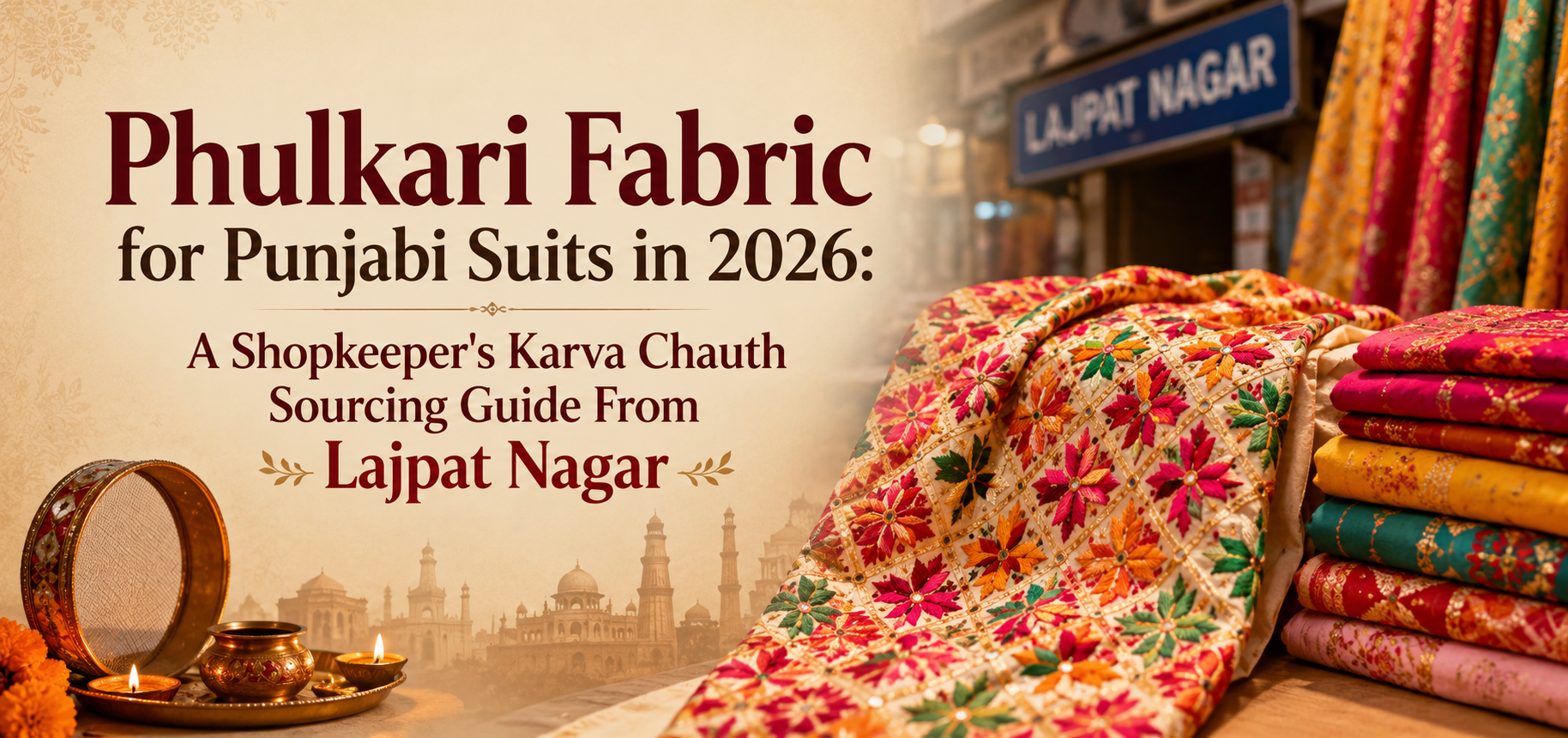
Phulkari is not the cloth itself. It is an embroidery technique, a critical distinction most first-time buyers miss. The base cloth is usually a khaddar cotton (the traditional weave from Patiala) or a soft georgette or chinon for the modern boutique versions. On top of this base, untwisted silk floss called pat gets hand-darned through the cloth in dense floral patterns.
What makes real phulkari so striking is that the embroidery gets worked from the reverse side of the cloth. The bunkar counts warp threads by hand. He pushes the floss through the back so that the front shows long satin-stitch flowers while the back reveals the counting structure. This reverse-embroidery method is what makes phulkari uniquely Punjabi.
A Geographical Indication tag was awarded to the fabric in 2010, covering Punjab and Haryana. That GI tag is your legal proof of authenticity when buying higher-end hand phulkari pieces.
People constantly mix up phulkari with bagh. Or with kantha. Or with chikankari. These are completely separate embroidery families. Bagh is a denser variant of phulkari where the work covers the entire base cloth. Kantha is a running-stitch tradition from Bengal, very different. Chikankari is fine white-on-white shadow work from Lucknow. Thread, stitch, base cloth, region, all different.
For boutiques exploring matching base cloths, our georgette fabric collection covers most modern phulkari foundations.
The Five Phulkari Families I Stock Through the Festive Window
These map directly to budget and occasion. Pick wrong and both the boutique-wala and the wearer end up disappointed.
Real Hand Phulkari on Khaddar Cotton
The original cloth. Sourced from cooperative workshops in Patiala and Amritsar. Dense floral work with that slight unevenness in stitch length, exactly because human hands made it. Wholesale rate sits at 4,800 to 9,500 rupees per dupatta depending on motif density.
Real Hand Phulkari on Chinon or Georgette Base
Lighter base cloth, faster for the karigar to embroider, still entirely hand-done by Punjabi craftsmen. My most popular SKU among boutique brides who want phulkari for sangeet without the weight of full khaddar. Around 2,800 to 5,400 rupees per dupatta wholesale.
Machine Phulkari on Georgette
Made in Surat power-looms and computer embroidery units mostly. Motifs look almost right at first glance. The stitch gives it away though, too uniform across the cloth. Wholesale 480 to 980 rupees per dupatta.
Machine Phulkari Suit Sets (3-Piece)
Three-piece kurta, salwar, dupatta with machine phulkari work throughout. The volume seller for resellers across Tier 2 cities. Rate band runs 1,400 to 2,400 rupees per complete set.
Bagh Phulkari
The denser variant where embroidery covers the entire dupatta from edge to edge. Almost always hand-done because the work is too intricate for machine production economics. Wholesale 8,500 to 18,000 rupees per dupatta.
For boutique buyers planning festive stock, browse our festive celebration collection alongside the phulkari rolls.
How to Spot Real Phulkari at the Shop Counter
Five practical tests. Run any three together before paying.
Flip the dupatta over. Real hand phulkari shows long count stitches visible on the back, revealing the warp-counting pattern clearly. The factory-made cloth has a uniform back with cut threads and a thin gauze look that screams machine output.
Count motifs per linear foot. Authentic embroidery carries 7 to 11 floral motifs per foot, no more. Factory versions pack 14 plus motifs per foot and the placement looks geometrically identical, almost robotic.
Touch the embroidery thread. Authentic phulkari uses untwisted silk floss called pat. The thread feels smooth, slightly shiny, with a soft silk hand. Machine versions use polyester rayon that has a plastic feel under your fingertip.
Examine the colour palette closely. Traditional hand phulkari uses 5 to 7 colours per dupatta, typically mustard, deep red, magenta, leaf green plus golden yellow. Machine work often uses 10 plus shades because the computer manages that easily. The result ends up looking busy or confused.
Pull a single embroidery thread gently. Pat will fluff slightly because of the silk content. Polyester rayon pulls out perfectly smooth. This is the quickest single test.
July Sourcing Prices in Lajpat Nagar Wholesale
Quick reference for boutique buyers planning August-September stock.
Hand phulkari on khaddar sits at 4,800 to 9,500 rupees per dupatta at wholesale. The same hand work on chinon or georgette base drops to 2,800 to 5,400 instead. Bagh phulkari, being the densest variant, holds at 8,500 to 18,000 a piece.
Machine phulkari dupatta on georgette runs 480 to 980 rupees, a fraction of hand-done rates. A complete 3-piece machine phulkari suit set sits between 1,400 and 2,400. Hand-done 3-piece sets exist but are rare and made strictly to order, with rates between 8,500 and 16,000 per set.
Boutique retail typically sits 1.8 to 2.4 times above these wholesale bands on the hand-done pieces. September Karva Chauth and October Diwali demand peaks push real hand phulkari prices by another 12 to 18 percent at the karigar level, which is why July remains the genuine sourcing window for boutique-walas.
Styling for Karva Chauth, Lohri and Teej
Karva Chauth is by far the biggest occasion for phulkari sales across Delhi and Punjab. The brand-new bride traditionally wears a phulkari dupatta on this day. Older buyers also stick to phulkari for the ritual photographs at the rooftop.
For Karva Chauth specifically, my standing recommendation is a real hand phulkari dupatta in deep red or magenta on a chinon base, paired with a plain red or maroon kurta plus a contrast lehenga salwar. The dupatta is the hero of the look. Everything else stays quiet.
Lohri (mid-January) calls for bagh phulkari on khaddar instead. The denser embroidery photographs beautifully in low winter sunlight. Cotton base keeps the wearer warm during the bonfire ritual.
Teej in August needs the lighter chinon phulkari because Delhi heat is still strong. Pair with a pista green or mustard kurta to catch the seasonal palette.
Pair phulkari with a simple gold jhumka plus matching bangles. Never overload phulkari with heavy kundan jewellery. Embroidery itself is the showpiece, jewellery only frames it.
For boutiques curating matching kurtas, our kurti fabric collection and saree fabric collection cover the supporting pieces.
Phulkari Care That Customers Always Ask About
Genuine hand-embroidered phulkari needs careful handling because the untwisted silk floss is delicate.
Skip the washing machine entirely. Spot-clean with cold water plus a soft cotton cloth instead. Once a year, send to a karigar-trained dry-cleaner who actually knows what phulkari is, not your local laundry corner.
Fold the dupatta loosely and store inside a soft cotton bag. Plastic bags are a disaster, since humid air gets trapped, dulls the silk floss, sometimes causes the dye to bleed.
Drop a small muslin pouch of dried neem leaves inside the storage bag. Phulkari attracts silverfish badly during Delhi humidity season.
When ironing, never touch the embroidered side directly with the iron. Place a clean cotton cloth on top. Iron the reverse side on medium heat only.
Every two seasons or so, take the dupatta out, hang it in shade for two hours, then re-fold. This little trick keeps the silk floss from going stiff over years of storage.
What Is Trending in 2026 Phulkari
Three honest movements I am seeing weekly at my counter right now.
Self-tonal phulkari is taking over Karva Chauth photographs. Same-colour pat embroidery worked on a same-colour base cloth, looking rich without screaming for attention. Going viral on Instagram reels among brand-new brides especially.
Phulkari dupatta thrown over a plain banglori silk salwar suit is the other trend gaining ground. Contrast between the matte hand-embroidery and the synthetic gloss of banglori photographs beautifully under indoor lighting. Mother-of-bride buyers are picking up this combination heavily.
Hand-embroidered phulkari being stitched into full kurta panels (not just dupattas) is the third big move. Boutiques across Patiala and Chandigarh are retailing phulkari kurta sets at 18,000 to 28,000 rupees. Pieces are walking off the rack within a week.
For more on seasonal styling shifts, read our companion piece on the versatility of silk and how to style silk fabrics for different occasions.
Q: What is phulkari and what makes real hand phulkari different from machine phulkari?
Phulkari is a Punjabi reverse-embroidery technique, not a fabric itself, where untwisted silk floss called pat is hand-darned from the back of a khaddar cotton or chinon base into dense floral patterns on the front. Authentic hand-done work shows long count stitches on the reverse side plus has 7 to 11 motifs per linear foot. Factory-made pieces show a uniform gauze-like back, pack 14 plus motifs per foot, use polyester rayon thread that feels plastic instead of silk.
Overview
For Karva Chauth and Punjabi suit sourcing in 2026, phulkari comes in five practical families. Real hand phulkari on khaddar (Rs 4,800-9,500 per dupatta wholesale), real hand phulkari on chinon or georgette (Rs 2,800-5,400), machine phulkari on georgette (Rs 480-980), machine phulkari 3-piece suit sets (Rs 1,400-2,400), plus bagh phulkari (Rs 8,500-18,000). Authenticity is confirmed by flipping the dupatta to check long count stitches on the reverse, counting 7 to 11 motifs per foot, plus feeling the silk pat thread which fluffs when pulled. July is the genuine sourcing window because Karva Chauth and Diwali demand pushes hand phulkari prices up 12 to 18 percent by September. For brand-new brides at Karva Chauth, hand phulkari dupatta in deep red or magenta on chinon base is the standing recommendation.
FAQ Section
Is phulkari fabric only for dupattas?
Traditionally yes, but the modern story has changed. Boutique designers also use phulkari on kurta yokes, lehenga panels, even sarees today. The base cloth shifts from khaddar to chinon or georgette for these newer uses to keep the outfit easier to drape and lighter to wear.
What is the price of real hand phulkari in 2026?
At Lajpat Nagar wholesale, hand phulkari dupatta on khaddar runs 4,800 to 9,500 rupees, on chinon 2,800 to 5,400, bagh phulkari 8,500 to 18,000. Machine phulkari runs much lower at 480 to 980. Boutique retail typically sits 1.8 to 2.4 times higher than these numbers.
How can I tell real hand phulkari from machine phulkari?
Flip the dupatta over first. Authentic embroidery shows long count stitches on the back, machine work has uniform cut threads. Touch the embroidery next. Pure phulkari uses smooth silk floss called pat, factory versions use plastic-feeling polyester rayon. Count motifs too, hand work has 7 to 11 per foot, machine packs 14 plus.
Can phulkari be washed at home?
Spot-clean only with cold water. For a full clean, send to a karigar-trained dry-cleaner who knows phulkari specifically. Never machine-wash. Never use Surf Excel either, the enzymes break the untwisted silk floss within two cycles.
Which phulkari is best for a brand-new bride at Karva Chauth?
Hand-embroidered phulkari dupatta in deep red or magenta on a chinon base, paired with a plain kurta in maroon or red. Let the dupatta carry the entire look. Everything else stays quiet to support the embroidery.
Which phulkari is best for boutique resale?
3-piece machine phulkari suit sets in deep red, magenta, mustard move fastest in volume from August to October. Hand phulkari dupattas on chinon give the strongest margin per piece for higher-ticket retail during the Karva Chauth window itself.
Final Word from the Counter
Twelve years at this counter has taught me one clear lesson about phulkari. The boutique-walas who win this segment are the ones who refuse to sell machine work as hand work. Honesty about the embroidery technique builds the customer trust that brings the next ten Karva Chauth orders.
If you are sourcing phulkari for the September Karva Chauth window or shopping a personal dupatta, message me directly on WhatsApp before locking embroidery density and base cloth. Same-day swatches go out to most North Indian cities.
Browse the live ranges across our festive celebration collection and kurti fabric collection. For larger production needs or boutique-grade volumes, the wholesale fabric order desk handles requirements directly. Use the fabric estimator tool before placing your cutting order.
Questions about phulkari? Drop them in the comments. I read every single one.