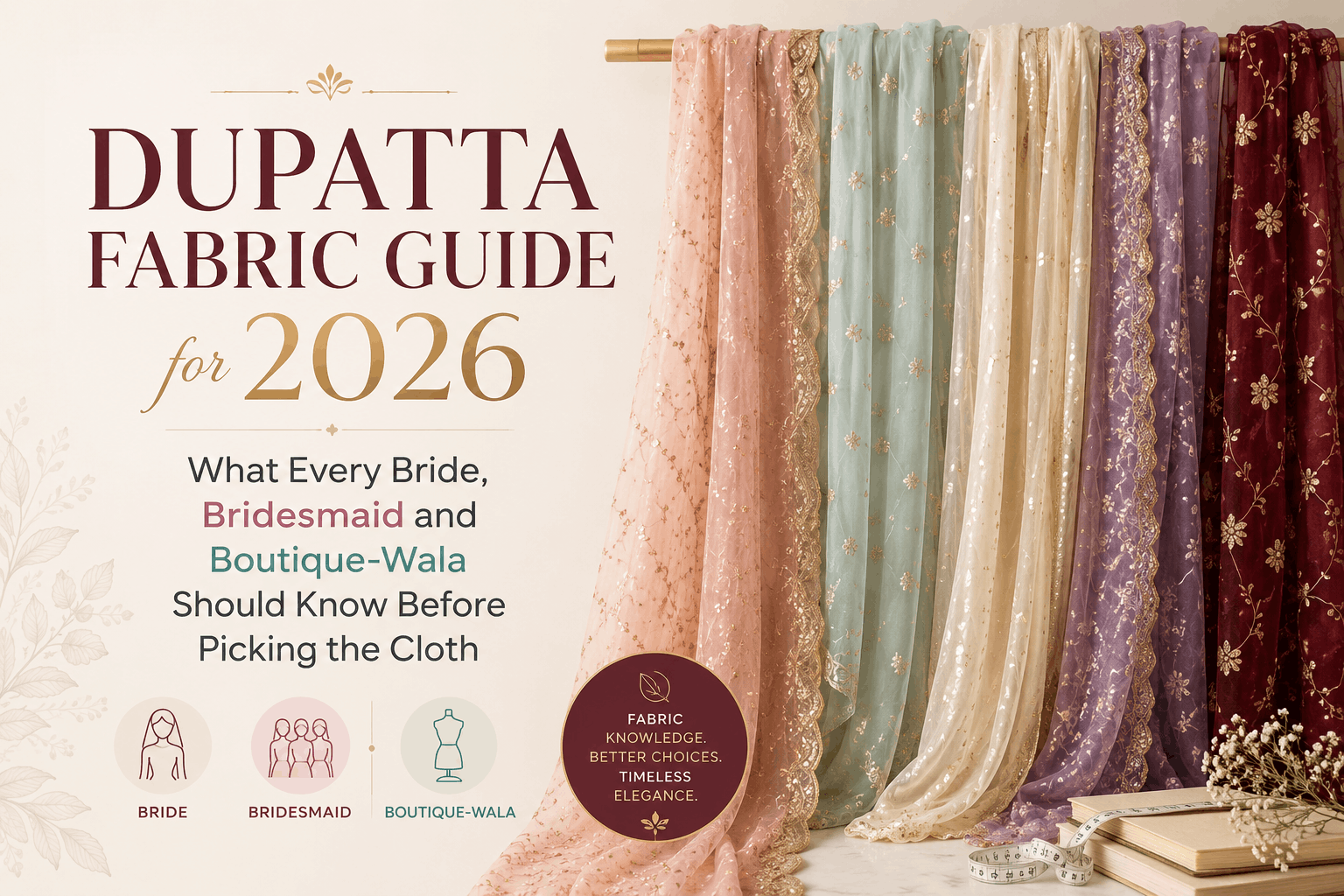
Dupatta Fabric Guide for 2026: What Every Bride, Bridesmaid and Boutique-Wala Should Know Before Picking the Cloth
Dupatta Fabric Guide for 2026: What Every Bride, Bridesmaid and Boutique-Wala Should Know Before Picking the Cloth
The right dupatta fabric depends on the weight of your suit or lehenga, not on what looks pretty in the seller's photo. Organza, net, georgette and chiffon are the four most-used dupatta fabrics in 2026. Each one drapes differently across the shoulder and behaves differently under camera flash and ceiling lights.
A regular customer walked up to my counter last Wednesday asking for "the right dupatta" to go with her beige Chanderi suit for her sister-in-law's Karva Chauth function. She had already been to four shops. Each shop had pushed her toward a different fabric. By the time she reached me she was confused, frustrated, slightly upset at the time wasted.
This kind of confusion is constant at the dupatta section of my Lajpat Nagar counter.
The actual problem is that most customers treat the dupatta as a backup cloth. Three weeks of careful thought go into picking the kurta or the lehenga. Then three minutes go into picking the dupatta. That choice ratio is backwards.
The dupatta is roughly sixty percent of how your outfit photographs at any function. You can wear a plain kurta plus the right dupatta will lift the whole look upward. You can wear an expensive lehenga plus the wrong dupatta will sink it visually. So here is the dupatta knowledge I share with every customer who asks me to help them choose properly.

For a heavy lehenga, pick a lighter dupatta in organza, net or chiffon so the cloth does not pull you down. For a chiffon or georgette suit, a slightly heavier dupatta in viscose or jacquard adds body. The dupatta fabric should always be one weight band lighter or heavier than your kurta or lehenga.
The dupatta fabric families worth knowing
Not every fabric makes a good dupatta. Some are too stiff. Some too heavy. Some go transparent in the wrong way under indoor function lighting. The fabrics I keep stocked at this counter are the ones that actually work across the range of festive plus wedding events Indian buyers attend.
Organza is the workhorse for festive functions. Crisp hand. Airy drape. Holds shape on the shoulder without falling flat against the body. Works beautifully paired with georgette suits or chiffon lehengas where the lehenga itself drapes soft. Photographs especially well because light passes through the cloth and gives that subtle backlit effect bridal photographers love. Through 2026 the gold-foil printed organza dupatta has been moving fastest off my counter for cocktail and sangeet events. Wholesale pricing Rs 280 to 420 per metre with 2.4 metres needed for standard cut. Browse current options in our organza collection where colour ranges plus border styles are listed by piece.
Net dupatta is the lightweight glamorous option. See-through quality plus minimal weight. Best for sangeet, reception, cocktail functions where the lehenga underneath is already carrying heavy embroidery and you want visual air on top of the silhouette. Net stretches slightly so the karigar must roll the edges with overlock thread rather than hem the cloth flat which causes puckering. Current wholesale runs Rs 220 to 380 per metre. Browse the net dupatta range which lists current sequinned plus plain options.
For office-festive plus daytime functions, chiffon dupatta drapes like water around the shoulder. Soft fall. Does not crease across an eight-hour event. Does not bulk up the silhouette of the outfit underneath. Photographs naturally in candid shots which is exactly what mother-of-bride looks usually need. Counter price runs Rs 240 to 360 per metre at wholesale.
Georgette dupatta sits one weight up from chiffon. Slightly more body which means it holds zari work plus sequin borders better without sagging at the embroidery line. Best application is when your suit underneath is plain crepe or solid colour, plus you want the dupatta itself to be the visual focus of the outfit. Wholesale Rs 280 to 420 per metre.
Banarasi silk dupatta is the heritage piece in this family. Pairs naturally with plain silk suits, plain Chanderi suits, minimalist lehengas where the silk does the visual work. Heavy by construction so do not pair it with another heavy outfit underneath. Banarasi silk is the wedding-jewellery photographer's favourite specifically because the silk catches every flash without losing texture detail. Browse current Banarasi options in our silk fabric collection. Pricing runs Rs 1,200 to 2,800 per metre at wholesale depending on weave complexity.
Tissue dupatta gives you featherweight shimmer that hits a different note from net. Best for haldi function, mehendi function, smaller intimate gatherings where you do not want to look over-styled but still want a subtle shimmer effect in photographs. Pricing comes in at Rs 380 to 580 per metre at the wholesale counter.
Viscose jacquard dupatta has self-motif woven on a viscose base which holds shape, drapes well, needs no embroidery additions to look complete. Excellent for festive kurta sets where you want a no-embellishment look that still reads as occasion-appropriate. Pricing at the counter is Rs 360 to 520 per metre.
Cotton mulmul dupatta rounds out the family. Soft hand. Breathable through summer heat. Casual festive positioning. Pairs with handloom suits, block-print suits, regular daywear pieces. Mulmul is the boutique-wala's quick-sale piece because the price point stays friendly. Counter pricing runs Rs 180 to 280 per metre.
How to match dupatta weight to your outfit
This is the rule that nobody actually tells you at most fabric counters. Weight balance is what makes outfits work visually.
If your lehenga is heavy with sequin work plus zari, your dupatta must be light. Organza or net or chiffon. Never silk or jacquard on top of an already-heavy lehenga base.
If your suit is plain crepe or solid georgette, you can carry a medium-weight dupatta on top. Viscose jacquard or embroidered net handles this combination well because the dupatta then becomes the visual interest of the outfit.
With a silk Banarasi suit, the contrast dupatta approach works best. Chiffon or organza dupatta in a contrast colour with a thin zari border running along the edges. That look is what every Lajpat Nagar bhabhi has been asking me about through 2026 across both Karva Chauth and Diwali events.
Cotton or mulmul daywear suits need a soft dupatta to keep the silhouette clean. Cotton mulmul dupatta or block-print chiffon are the right choices here. Anything heavier over-styles the daywear look immediately.
Colour and contrast for 2026
The colour preference has shifted noticeably this year compared to even 2024 patterns. Pastels are still moving steadily but earth tones are catching up fast across boutique orders. Terracotta. Sage. Dusty rose. Mustard. Ivory. Bottle green. All earth-and-muted territory rather than the bright primary colours that ran the market two years back.
Bright fuchsia plus electric blue dupattas, which sold heavily through 2022 and 2023, have slowed visibly at wholesale level. The retail demand has cooled and inventory is sitting.
The bridesmaid sangeet outfit works best with an ivory net dupatta paired against a pastel pink lehenga. Karva Chauth function dressing is dominated by the Banarasi silk dupatta in dusty rose paired with a beige Chanderi suit, which is the most-requested combination at my counter through October.
For resellers planning inventory, the practical advice is to not over-stock fuchsia or rani pink dupattas right now. Hold them light at wholesale. Stock more sage, ivory, plus dusty terracotta which are moving faster across all customer segments.
Length, width, plus metreage that actually works
Too short and the dupatta looks like a scarf when worn. Too long and it gets dragged across the floor or pinned awkwardly. Standard cuts that I send out from this counter follow specific dimensions.
Kurta set cuts come at 2.25 metres in length plus 0.95 to 1.05 metres in width. This gives enough cloth for a clean shoulder fall plus a draped chest section.
Lehenga outfits need 2.5 metres in length plus 1.15 to 1.25 metres in width. The longer length allows the dupatta to be pinned over the head during ceremonies while still draping across the body comfortably during the rest of the event.
A sherwani drape needs 2.7 metres in length plus 1.0 metre in width, draped over one shoulder traditionally.
Always tell your supplier whether you want a finished hemmed dupatta or unhemmed metre-length cloth. Many sellers ship unhemmed cloth expecting the buyer's karigar to finish the edges. Customers then complain later that the dimensions are off after finishing. Use the fabric estimator tool for exact yardage calculations on custom dupatta projects.
Quality checks before paying for any dupatta
The assessment routine I run on every dupatta before letting it leave the counter covers several specific points.
Start with edge work along the pico finish. The pico edge should lie flat against the cloth without curling upward or downward. If the edge curls in the shop itself before any wash, it will curl ten times worse after the first dry-clean cycle. Walk away from any piece showing edge curl at the point of purchase.
Border alignment matters significantly for embellished pieces. Hold the dupatta flat across both hands and look at the zari or sequin border line. The border should run straight across without waving or undulating along its length. A wavy border line means the cloth was cut off-grain at the mill which cannot be corrected during finishing.
Sheen direction tells you about dye consistency. Stand under tube light first, then under sunlight from a window. The cloth should not look like two completely different colours under the different light sources. If it does look different, the dye lot was mixed at the mill which means colour matching across multiple pieces will fail for boutique buyers planning sets.
Hand feel is the final check. Crumple a corner of the cloth in your fist for ten seconds before releasing. Quality cloth springs back without holding a crease, which indicates proper weave density. Weak cloth stays crumpled with visible creases that will not hold up across many wears.
Care and storage of dupattas across the season
Dupattas suffer significantly more wear than the kurta or lehenga underneath because they get handled, pinned, folded, repositioned the most across any function. The care routine matters specifically for this reason.
For organza plus tissue dupattas, fold flat between butter paper sheets. Never hang on a metal hanger because the wire leaves visible shoulder marks within weeks of storage. For net plus chiffon variants, hang on a padded hanger so the shoulder area does not stretch under the cloth's own weight over months. For silk Banarasi pieces, fold lengthwise once carefully then store in a muslin cloth pouch with a small camphor cube tucked alongside to deter insects from the silk fibre.
Dry-clean is safer than home washing for any embellished or pure silk dupatta. For plain chiffon plus georgette dupattas without embellishment, cold hand-wash with Ezee or Liquid Genteel works fine for the first few wash cycles before switching to dry-clean for longer-term care.
FAQ
Which dupatta fabric is best for a heavy lehenga?
Organza, net, or chiffon are the right options for heavy lehenga pairing. Your dupatta choice must run lighter than the lehenga itself so it drapes without weighing down your shoulder across long events. Avoid Banarasi silk or jacquard variants on top of an already-heavy lehenga because the combination becomes physically tiring to carry plus visually unbalanced in photographs.
What is the standard length of a dupatta?
Kurta set dupattas come at 2.25 metres which is the standard length used in the trade. The lehenga outfit needs 2.5 metres for proper draping. A sherwani drape needs 2.7 metres. Width varies between 0.95 and 1.25 metres depending on the outfit type plus the draping style intended for the event.
Which dupatta fabric works best for summer functions in Delhi?
Cotton mulmul, chiffon, plus light organza are the three best summer choices because all three breathe well and do not trap heat against the skin. Avoid silk Banarasi or heavy jacquard variants during May or June outdoor functions specifically because the weight becomes uncomfortable in direct heat.
Can I match a printed dupatta with an embroidered suit?
Yes when the embroidery on the suit is small-scale and tonal. With heavy sequin or zari work though, choose a solid-colour dupatta instead so the viewer's eye has somewhere visually quiet to rest. Too many busy patterns competing against each other reads as overdone in photographs.
How much does a good dupatta cost in 2026?
Current Lajpat Nagar wholesale pricing covers organza dupattas at Rs 280 to 420, chiffon at Rs 240 to 360, net at Rs 220 to 380, georgette at Rs 280 to 420, viscose jacquard at Rs 360 to 520, tissue at Rs 380 to 580, cotton mulmul at Rs 180 to 280, plus Banarasi silk at Rs 1,200 to 2,800 per metre. Retail boutique pricing usually doubles these wholesale numbers depending on margin policy.
Should I buy a hemmed dupatta or unhemmed metres?
For ready-to-wear use cases, buy a hemmed and pico-finished piece directly. For boutique tailoring projects where you want a custom border or fringe added during finishing, buy unhemmed metre-length cloth instead and let your karigar finish the edges to specification. Always confirm hemming status with the supplier before placing the order to avoid disappointment.
Final word from the counter
This piece is the cloth that gets remembered in photographs more than any other part of the outfit. The kurta might fade into background. The lehenga gets photographed only in select angles. Dupattas stay visible across every shoulder shot, every ceremony pin, every group photograph from start to finish of the event.
The customer from last Wednesday eventually picked a Banarasi silk dupatta in dusty rose to pair with her beige Chanderi suit. She came back three days later to confirm the family was happy with the outfit at the function. That is the kind of decision the dupatta deserves. Not three minutes after three weeks on the kurta. Equal time on both pieces always pays off in the final photographs.
Your Next Step...
If you are stocking dupattas for the September through November festive cycle, message me on WhatsApp and I will send swatches of the dupatta families on the same day. Browse the live ranges across organza, net, plus designer categories at the Lajpat Nagar counter. Boutique buyers planning larger volume orders should request bulk quotes through our bulk order page before committing to specific colour and weight combinations. Direct sourcing from Surat plus Banaras weaving clusters. Honest grading. No runaround on dupatta quality specifications.