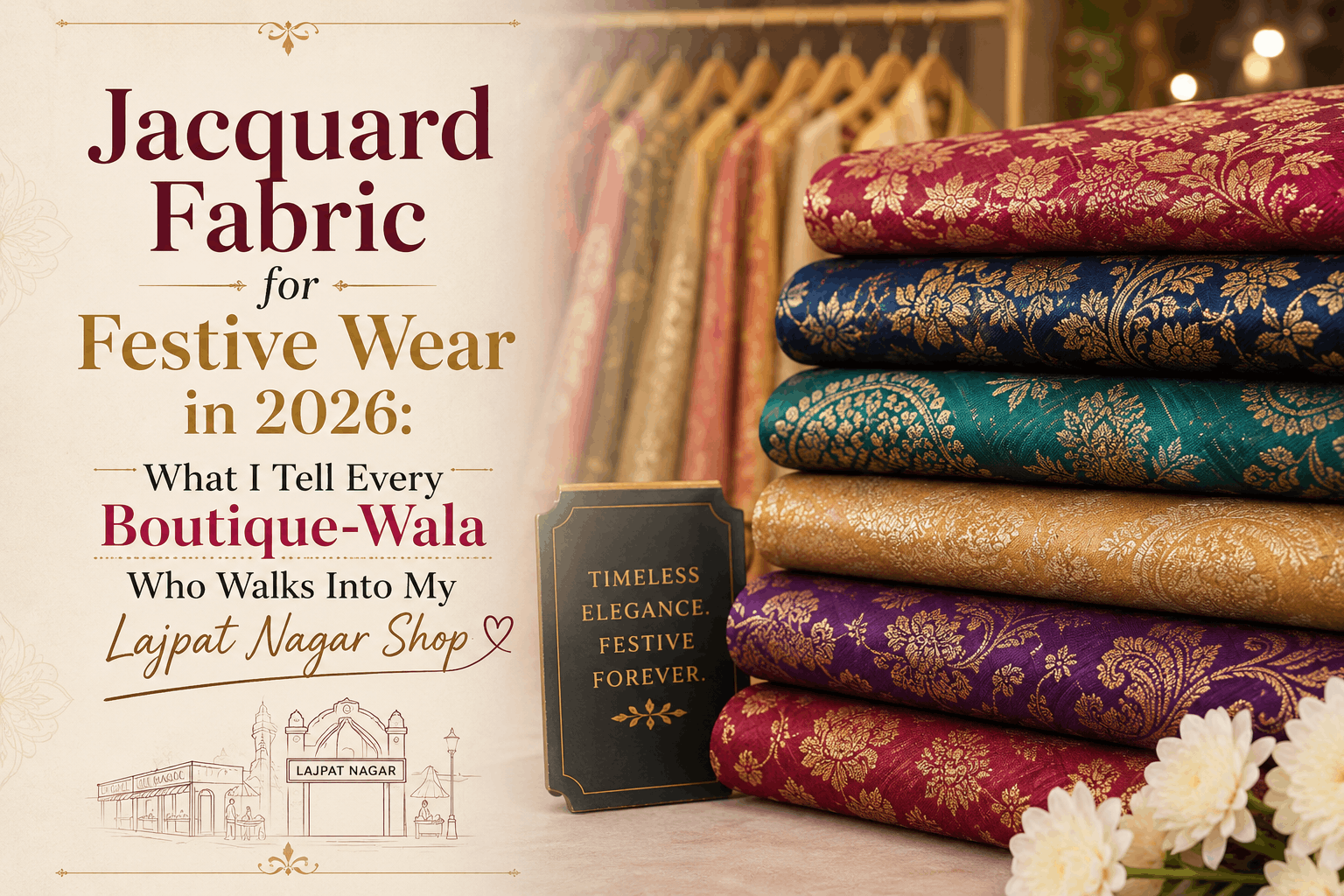
Jacquard Fabric for Festive Wear in 2026: What I Tell Every Boutique-Wala Who Walks Into My Lajpat Nagar Shop
Jacquard Fabric for Festive Wear in 2026: What I Tell Every Boutique-Wala Who Walks Into My Lajpat Nagar Shop
Jacquard fabric is a woven cloth where the pattern is built into the loom itself, not printed on top. The motif and the base share the same thread structure, so the design stays sharp even after stitching, dry-cleaning and storage. For Indian festive wear, jacquard sits between brocade and georgette in weight.
Last Friday a customer walked up to my counter asking for "kimkhab" for her daughter's mehendi outfit. What she actually wanted was a 180 GSM viscose jacquard piece priced around Rs 500 per metre. Two completely different fabrics.
This kind of confusion runs through the jacquard section every single week.
Boutique-walas asking for "brocade" when they mean light viscose jacquard. Retail customers asking for "silk" when they want the silk-viscose blend. Wedding shoppers convinced that all jacquard is heavy when half the family is genuinely featherweight.
So this guide is what I tell every boutique buyer who walks up asking which jacquard to stock for the festive cycle. No marketing fluff. Just what eleven hundred plus jacquard runs across suits, lehengas, dupattas have taught me about this fabric family.

Jacquard fabric is a loom-woven cloth made on a Jacquard mechanism that lifts each warp thread separately, building the motif into the cloth body itself. In Indian festive wear, jacquard is used for suits, lehengas, sherwanis and dupattas because it holds shape better than chiffon, drapes better than brocade, and the pattern never fades or peels.
What jacquard actually is
Jacquard is not a fibre type. It is a weaving technique. The cloth itself can be polyester or viscose or silk or cotton or even tissue jacquard depending on what base fibre runs through the loom. Motifs get formed inside the loom because of how the Jacquard head selects individual warp threads during weaving.
Here is the actual difference between jacquard and printed fabric. With a print you can scrape the design off with a fingernail in five years of wear. With jacquard the design IS the cloth itself rather than something applied on top.
People also confuse jacquard with brocade constantly. Brocade is technically a sub-type of jacquard where heavy zari or silk floats sit on top of the base weave. Banarasi brocade, kimkhab, imperial brocade. All of these are jacquards within the technical definition. But not every jacquard piece qualifies as brocade. The lighter viscose jacquards I sell most often for Teej or Janmashtami suits are nowhere close to brocade weight. Browse brocade-tier options in our imperial brocade collection where weights run 280 to 450 GSM with weaver attribution per piece.
The jacquard families I keep stocked
Pick the wrong family and your tailor will curse you. Pick the right one and the same cloth outlasts your client's wedding album. Working through the families I stock regularly.
Light viscose jacquard runs at the 160 to 200 GSM range. Soft handle. Fluid drape. Falls like a heavy georgette but with a built-in self motif structure throughout. Most Delhi boutiques pick this variety for Teej kurtas, Karva Chauth suits, daytime festive wear pieces. Stitches easily on standard machines. Does not need lining underneath for basic kurta construction. Wholesale pricing at the Lajpat counter runs Rs 380 to 560 per metre right now.
The polyester variant sits at 200 to 260 GSM weight. Crisper hand. Structured drape. Costs less than viscose at the same weight. Holds a sharp pleat which matters for kalidar construction work. Resellers needing volume usually pick this one because of margin maths. The downside is breathability which becomes a real issue in June Delhi heat where my regular customers refuse it for daywear. For sangeet plus reception lehengas in air-conditioned venues though, polyester jacquard photographs beautifully under stage lighting. Pricing Rs 240 to 380 per metre wholesale.
For boutique-walas building festive lehenga collections, silk jacquard at 220 to 320 GSM weight is the sweet spot category. Real silk warp with viscose or art-silk weft and the jacquard motif woven on top. Drapes like a dream falling off the cutting table. Takes hand-embroidery additions without puckering at the stitch points. Most boutique-walas in Lajpat Nagar quietly mark this grade up two to two-and-a-half times for retail pricing. Wholesale at Rs 720 to 1,150 per metre. Browse current silk jacquard options in our silk fabric collection.
Cotton jacquard is the underrated category in this whole family. Self-motif on a cotton base cloth at 180 to 240 GSM weight. Brilliant for haldi function kurtas, baby shower outfits, summer festive pieces. Breathes properly through humid weather. Washes well after the initial dry-clean step. Pricing Rs 360 to 540 per metre.
Featherweight tissue jacquard at 140 to 180 GSM rounds out the family I keep stocked. The metallic warp gives a shimmer effect that you genuinely cannot reproduce in any printed cloth at the same price band. Best application is dupatta construction with a heavier blouse piece, or for second-day reception outfits where you want light shimmer without the body weight of full brocade. Wholesale Rs 480 to 720 per metre.
How to actually check jacquard quality before paying
Every Tuesday a fresh consignment lands at my counter from the Surat trade. The quality assessment routine I run on every piece is the same one I tell boutique buyers to run before they hand over their money.
Start with the back of the cloth. A genuine jacquard shows clean floating threads on the reverse side. If the back is fuzzy or has cut threads scattered everywhere, the cloth has been thanked through too many washes already, or it is a low-grade production run from a sub-standard mill.
Next, fold a corner sharply and hold for ten seconds before releasing. If the crease stays sitting like an iron fold, the cloth has been over-starched at the mill before shipping. First wash will kill that artificial body completely. Springing back instantly when released means the weave density is genuinely good.
Try pulling a warp thread gently from the cut edge. A single thread coming out with no resistance means the loom tension was weak during weaving. That cloth will pucker at the side seams within two stitches of construction. Walk away.
Rub the motif surface with a dry cotton cloth. Any colour transfer onto your test cloth means you are looking at a hybrid printed-jacquard rather than a true loom-woven motif piece. Real jacquard does not transfer colour because the colour comes from the actual threads, not from surface dye sitting on top.
The selvedge edge tells the final story. A clean jacquard selvedge carries the mill name or production run number printed at regular intervals. Blank selvedge or paper-printed selvedge usually means a job-lot production with no quality guarantee from the source mill.
How jacquard stitches up versus how it photographs
This is where online buyers get burned most consistently. The fabric looks gorgeous on the seller's Instagram reel. The cloth arrives at the tailor. The kalis do not match across panels. Final photographs come back with the lehenga looking patchy because the motif placement is inconsistent across kalis.
The reality is that a repeating jacquard motif must be cut with motif alignment in mind. Your karigar needs an extra 30 to 40 cm of cloth so the motif sits centred on each lehenga kali, on each kurta yoke piece. Order tight metreage and the side panels end up looking chopped after stitching. I tell every customer to add 0.4 metres extra over the standard size requirement specifically when buying jacquard cloth.
For a kurta construction, six metres of light jacquard plus a contrast solid bottom works cleanly. A standard lehenga needs seven to nine metres of silk jacquard depending on the ghera flare you want in the final piece. Sherwani construction takes three and a half metres of jacquard with a satin lining stitched inside the body. These are the metreages that come back zero-complaint to my counter after stitching completes. Use the fabric estimator tool for exact yardage calculations on specific jacquard projects.
Festive trends running in 2026
The current jacquard order book shows a couple of directions dominating through this season.
Self-tonal jacquard suits where the warp, weft, plus motif are all from the same colour family are going viral on reels right now. The look reads rich without being loud. Best results come in dusty rose, sage green, mustard, terracotta colour families. Boutique orders for self-tonal pieces have roughly doubled compared to last September.
Heavy jacquard lehenga construction paired with a chiffon dupatta is the second direction. The weight balance lets the bride dance at sangeet without dragging cloth across the floor. We are sending six to seven such combinations every week to North Indian boutiques across Punjab plus UP. Coordinated lehenga base options for this construction sit in our lehenga fabric collection.
For boutique buyers planning the festive cycle, the rule of thumb stays consistent. Stock light viscose jacquard for the bridesmaid plus sangeet shopper segment. Hold silk jacquard plus tissue jacquard on the top shelf for mother-of-bride buyers who pay for quality without negotiating much on price.
When jacquard is not the right answer
Jacquard goes genuinely wrong for several specific situations and I steer customers away from it actively in these cases.
Outdoor daytime weddings in July or August heat above 35 degrees are wrong territory for polyester jacquard specifically. Polyester makes your client sweat through the back panel within hours. Either switch to cotton jacquard, or skip the jacquard family entirely and go to chanderi instead for these events.
Tight body silhouettes like fish-cut gowns also do not work with this fabric. The repeating motif distorts visibly at body curves which kills the design intent at the very places photographs focus. Satin or crepe handles these silhouettes much better than any jacquard variant.
Beach destination weddings present another problem area. Salt air dulls the motif sheen within a few hours of wear which then shows up unflatteringly in photographs. Send organza or georgette options to these clients instead.
When a buyer is pushing for jacquard under Rs 200 per metre, walk away from the order entirely. There is no genuine jacquard production at that price point in the Indian market currently. What you will end up shipping is printed polyester pretending to be jacquard, which destroys your boutique reputation when customers eventually figure out the substitution after a few washes.
FAQ
Is jacquard fabric good for summer?
The cotton variant plus light viscose jacquard are comfortable up to 32 degrees inside air-conditioned function venues. For peak May or June outdoor weddings I still send my regular customers chanderi or mulmul instead because those breathe better under direct sun. Polyester jacquard is genuinely too warm for Delhi summer day events.
What is the price of jacquard fabric per metre in 2026?
Current Lajpat Nagar wholesale pricing covers polyester jacquard at Rs 240 to 380, viscose jacquard at Rs 380 to 560, cotton jacquard at Rs 360 to 540, silk jacquard at Rs 720 to 1,150, tissue jacquard at Rs 480 to 720 per metre. Boutique retail pricing sits 1.8 to 2.5 times higher than these wholesale numbers depending on margin policy.
How much jacquard do I need for a lehenga?
Seven to nine metres of silk jacquard depending on the ghera flare you want in the finished piece, plus an extra 0.4 metres for motif matching across kalis. For a slim A-line lehenga construction, six metres also works fine. Always tell your karigar before cutting begins so the motif lines up correctly across panels.
Can jacquard be dry-cleaned only or can I wash it at home?
Silk jacquard plus tissue jacquard should be dry-clean only across their entire wear life. The viscose variant tolerates gentle cold hand-wash with Ezee detergent for the first wash, then dry-clean afterwards. The cotton variety handles regular cold hand-wash with Surf Excel Gentle. Never wring jacquard regardless of which variant. Always shoulder-dry on a padded hanger to maintain shape.
Is jacquard the same as brocade?
No but the relationship between them goes one direction only. All brocade is technically jacquard, but not all jacquard qualifies as brocade. Brocade has heavy zari or silk floats sitting on top of the base weave plus carries much higher weight and a formal look. Light viscose or cotton jacquard is everyday festive cloth that runs much softer and more affordable than any brocade piece.
Which jacquard is best for boutique resale?
For volume resale through the festive cycle, light viscose jacquard at 180 GSM in pastel plus earth tones moves fastest in the September through November window. For higher-margin boutique sales, silk jacquard at 240 GSM in jewel tones gives the strongest profit per metre. Stock both grades if your customer base spans the price spectrum. Boutique buyers should request bulk quotes through our bulk order page before committing larger volumes.
Final word from the counter
This fabric is the festive cloth that boutiques keep coming back to season after season because the cloth genuinely earns its margin in resale. The motif holds across washes. The drape photographs cleanly under both stage and natural light. The price spectrum offers options for both volume retail plus higher-end boutique positioning.
What the kimkhab-asking customer from Friday actually needed was a basic viscose jacquard at Rs 500 per metre. Not brocade. Not silk jacquard. Just the right grade for her daughter's mehendi outfit. Match the grade to the use case and the cloth almost always works. Mismatch the grade and you will be re-cutting the outfit before the wedding date arrives.
Your Next Step...
If you are stocking for the August through October festive cycle, talk to me directly on WhatsApp before deciding your colour plus weight mix. Same-day swatches go out to most North Indian cities. Browse the live jacquard ranges across festive plus lehenga categories at the Lajpat Nagar counter. Direct sourcing from Surat plus Banaras weaving clusters. Honest grading. No runaround on jacquard quality specifications.