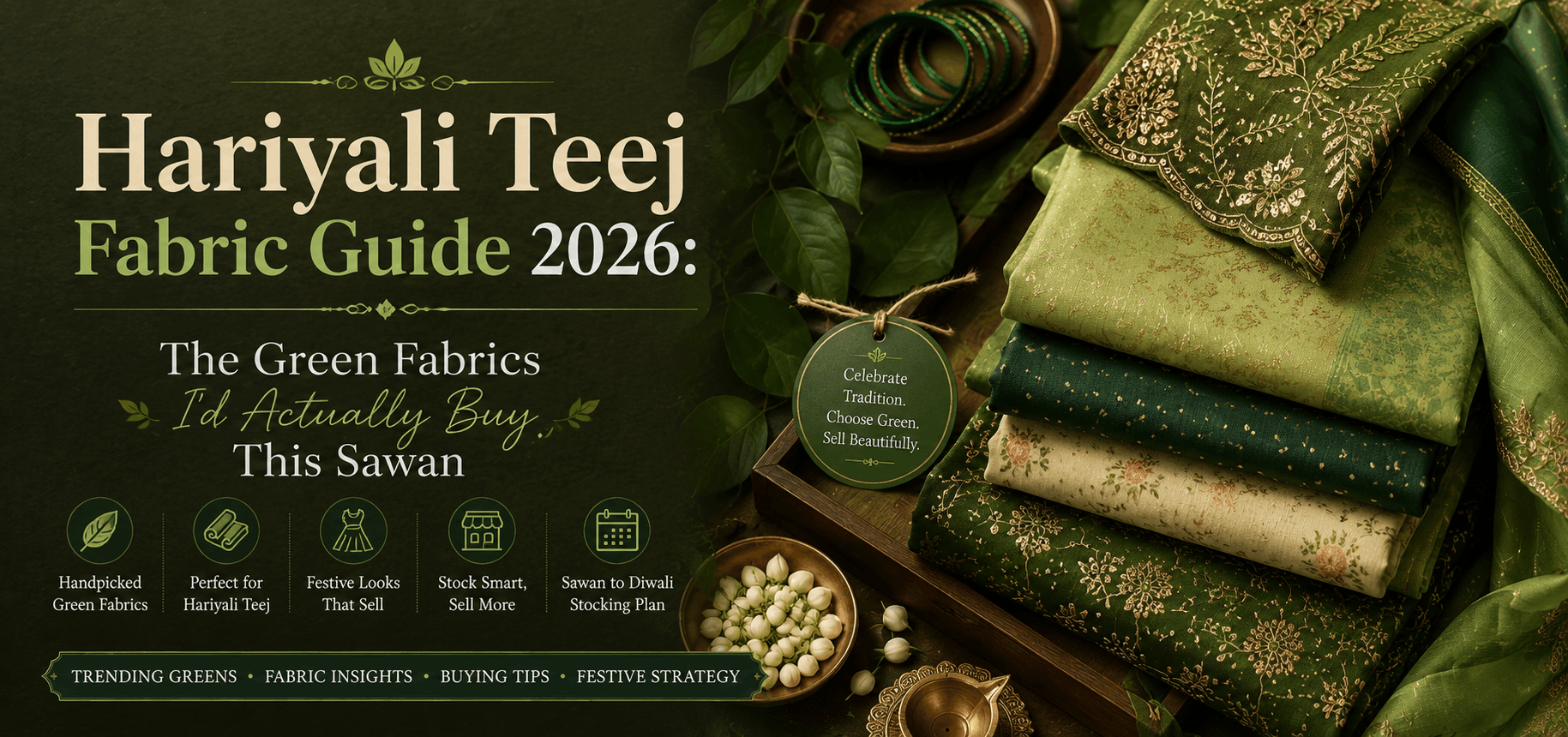
Hariyali Teej Fabric Guide 2026: The Green Fabrics I'd Actually Buy This Sawan
Every year around the last week of June my WhatsApp starts vibrating with the same question. "Bhaiya, koi achha green mila hai for Teej?" This year Hariyali Teej falls on 27 July 2026. Which means Sawan mehendi and jhoolan photos are barely three and a half weeks away.
Now, "green" sounds simple till you actually stand in front of a stack of thaans in Lajpat Nagar. Bottle, mehendi, parrot, sea green, olive, minty pastel, dark forest. Each of them behaves differently once you drape it.
Some greens photograph beautifully under a mandap light but look flat in daylight jhoolan pictures. Some look great in the shop but bleed a shade or two once stitched with a full lining. So this year I sat down and made a proper list. Not the internet's top-10 list. The one I would send to my own sister if she asked me for Teej fabric right now.
Quick answer: For Hariyali Teej 2026, the safest green fabric picks are mehendi-green organza for suits and dupattas, bottle-green Banarasi silk for sarees, pastel sea-green georgette for daytime jhoolan plus olive-green satin with light zari work for evening pooja. Buy 6.5 metres for a suit set. Buy 6 metres for a saree with blouse. Always check the dye against natural window light before you cut.
Why green matters at Teej (beyond the pictures)
Green during Sawan is not just about looking good in pictures. In North India, Hariyali Teej is tied to the monsoon returning. Mehendi drying dark. Jhoolas hanging in courtyards. Married women wearing solah shringar. The colour is part of the ritual, not just the outfit.
Which is why fabric choice matters more than most people realise. A cheap plastic-y green polyester in a courtyard swing under humid Delhi sky? Sweat patches by 11 am. A heavy zari brocade for a small home pooja? You will stop enjoying the day by lunchtime.
Match the fabric to the actual event, not to what the WhatsApp reel showed you.
The 8 green fabrics I recommend this Teej
1. Mehendi green organza (my top pick for suits)
Organza has quietly become the Teej favourite in the last three seasons. It has that crisp fall that makes an Anarkali or a straight-cut kurta stand up beautifully. Mehendi-green organza with a small buti or scattered zari photographs beautifully in jhoolan pictures without going overboard.
Push for a pure organza rather than the "organza satin" mix, because pure organza breathes better in Delhi's July humidity. We have a wide dyeable and pre-embroidered range in our organza fabric collection.
Best for: Straight suits, Anarkalis, dupatta-heavy sets. Metres: 6.5m for a full suit set.
2. Bottle green Banarasi silk (my top pick for sarees)
Bottle green with gold zari is the saree you see on aunties and cousins alike. Honestly there is a reason. Bottle green forgives everything. Every skin tone. Every jewellery finish. Every light. Photographs like a dream.
Buy a proper Banarasi silk with meenakari border if your budget allows. Banarasi carries a Geographical Indication tag so authenticity is protected by law. Otherwise a soft silk in bottle green with a running gold border works well too.
Best for: Kirtan, big family Teej, mata ki chowki. Metres: 5.5m saree plus 0.8m blouse.
3. Pastel sea-green georgette
If you don't want to look like every other cousin in the courtyard, go pastel. Sea green georgette flows like water. Catches the wind on a jhoola. Photographs incredibly well against the reddish henna on your palms.
Georgette is also a genuinely comfortable option for humid Delhi July. Dries fast. Doesn't cling like satin. Doesn't crush like cotton silk.
4. Olive green silk blend
Olive is what I recommend to slightly older customers who want to look festive without looking bridal. Reads mature. Sits well. With a light zari or gota border, it becomes a beautiful evening Teej option.
5. Parrot green chinon (for the young cousin set)
Parrot green is loud and I know that. But it is the shade the college girls ask for every year for jhoolan photos. Honestly it does look beautiful when the light hits it. Go for chinon or a soft flowy georgette so the loudness of the colour is softened by the fabric fall.
6. Mint green cotton silk (day pooja only)
For small home poojas in the day, mint cotton silk keeps you cool. Doesn't wrinkle terribly. Looks fresh in every photo. Not the shade I would recommend for evening events though. It dulls under yellow light.
7. Dark forest green velvet (for evening Teej dinner)
Some families in Delhi now do an evening dressy Teej dinner. Forest green velvet with light thread work reads modern. Holds shape beautifully. Photographs like a designer piece.
8. Fern green net with sequins (for Teej sangeet)
If you have a Teej sangeet in the family, fern net with light sequin scatter gives you shine without being bridal-heavy. Pair it with pastel green inners for a two-tone effect.
In short: Mehendi green organza and bottle green Banarasi silk are the two safest Teej picks for a Delhi Hariyali celebration. Pastel sea-green georgette works for daytime jhoolan. Skip full polyester greens, heavy zari brocade or thick kanjivaram for the morning slot entirely.
How to check a green fabric before you cut it
Many years at this counter have taught me one thing about greens. Every shopkeeper's light makes a bad green look wearable. Always do these four checks before you finalise.
Test 1. Window check. Ask them to unroll about a metre and hold it up against a natural window. Shop lights lie. Sunlight tells the truth.
Test 2. Palm rub. Rub the fabric between your palms for ten seconds. If your palms come off green, the dye will bleed at the first press.
Test 3. Crush-release. Crush a corner tight for five seconds, then release. If it takes forever to smooth out, that fabric will look tired by 2 pm on your Teej day.
Test 4. Composition question. Ask the shopkeeper what the composition is. If they hesitate, the fabric is probably a poly-viscose blend even if the tag says silk.
Delhi wholesale prices, real numbers
I get asked this every day so let me be direct. For Hariyali Teej 2026 in Delhi Lajpat Nagar Central Market range.
- Mehendi organza plain. Rs 240 to Rs 380 per metre. Embroidered mehendi organza Rs 650 to Rs 2,200 for heavy work.
- Bottle green Banarasi soft silk saree. Rs 1,800 to Rs 8,500 for proper meenakari.
- Pastel georgette. Rs 220 to Rs 480 per metre.
- Mint cotton silk. Rs 180 to Rs 320 per metre.
- Forest green velvet with thread work. Rs 850 to Rs 2,400 per metre.
Prices vary a little week to week in Sawan because demand jumps sharply. Book early, ji.
For boutique buyers picking up ten metres or more per shade, our wholesale page handles pricing directly.
Things ladies ask me at the counter
What colour is best for Hariyali Teej 2026?
Traditional deep green (bottle or mehendi) if you are a married woman doing full solah shringar. Pastel sea green or mint if you want a softer look for daytime jhoolan.
Can I wear a saree instead of a suit for Teej?
Yes. A green Banarasi silk saree is one of the most classic Teej choices in North India.
How much fabric do I need for a Teej suit?
6.5 metres covers kurta, salwar or sharara plus dupatta comfortably for most sizes.
Is organza too hot for July in Delhi?
Pure organza breathes surprisingly well. Organza satin blends get warm. Stick to pure organza for Sawan.
Where can I buy Teej fabric online with pan-India delivery?
Parasgalleryfabrics.com ships across India from our Lajpat Nagar hub, usually within 3 to 6 working days.
Ready to pick your Teej green?
Shopping for your own Hariyali Teej suit? Or picking sarees for bhabhi, mummy-ji, chachi together? WhatsApp me for same-day swatch courier across Delhi NCR, Mumbai, Bengaluru, Hyderabad, Chennai, Kolkata, Ahmedabad. Come by the shop if you want to check the green against natural light before committing.