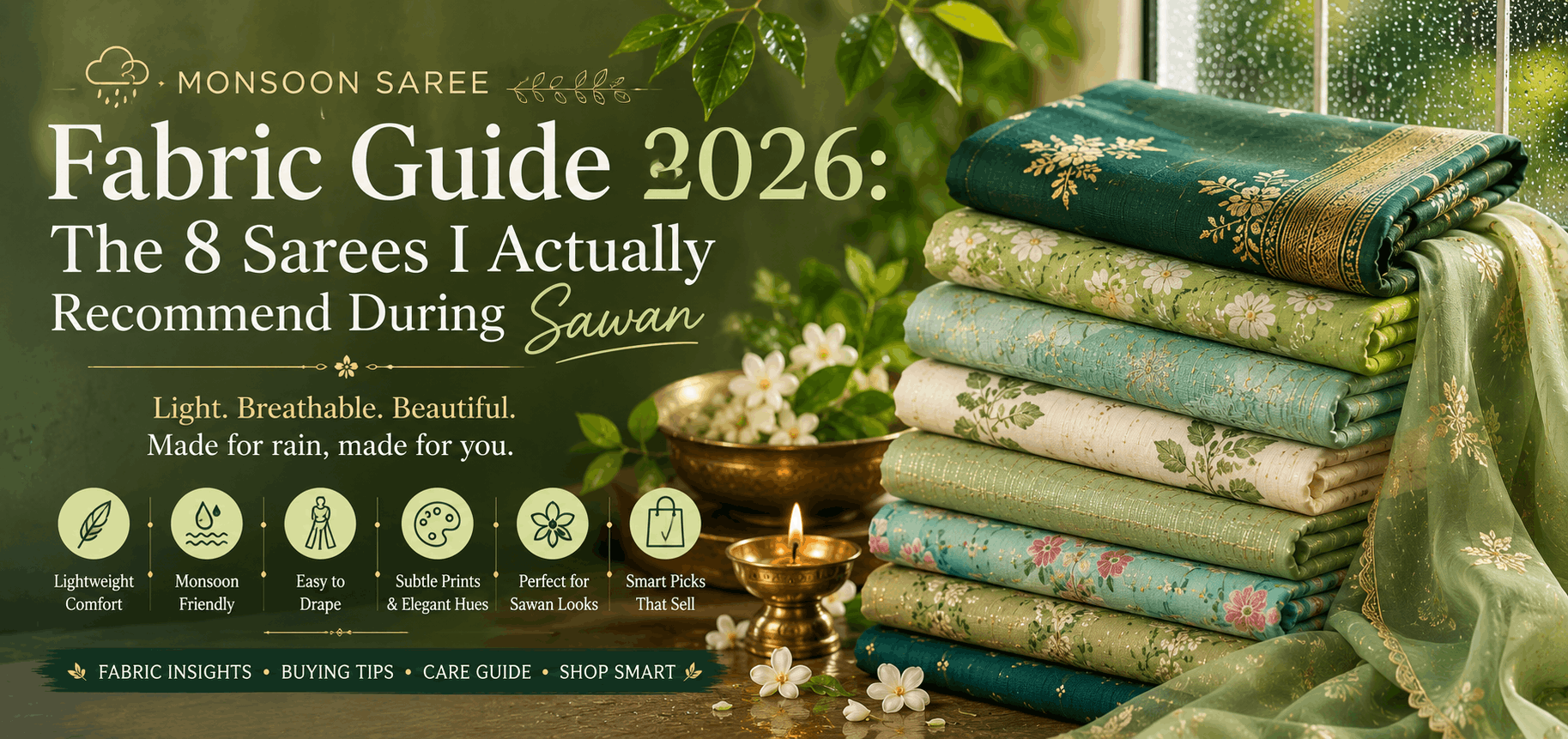
Monsoon Saree Fabric Guide 2026: The 8 Sarees I Actually Recommend During Sawan
Dressing for a Delhi monsoon is its own small puzzle. Clear sky one evening, then you wake up and the humidity has climbed to 82 percent. By lunch your pallu is glued to your neck. Around this time every year the same question walks into the shop. "Bhaiya, kaunsa saree fabric monsoon ke liye theek rahega?"
Honestly? There isn't one answer. It depends whether you are off to a small kirtan, a Sawan get-together at someone's house, a Teej party, or just an office day where you want to wear a saree and not regret it by 3 pm.
So this is the list I keep in my own head when someone asks. Eight fabrics, ranked the way I would actually rank them. Awkward parts left in.
Quick answer: For a Delhi monsoon the safest saree fabrics are chiffon, georgette, chinon, soft crepe, cotton silk, khadi, mulmul plus a lightly starched Kota Doria. Skip heavy Banarasi, kanjivaram tissue, thick brocade or full satin. Buy 5.5 to 6 metres for the saree plus 0.8 metre for the blouse. Ask whether the fabric is colour-fast before you let anyone cut it.
What actually makes a saree "monsoon-safe"
Weight is the first thing I check. A heavy saree in 80 percent humidity feels like a wet blanket by evening. Light drapes hang better. Dry faster. They don't cling to you on the metro.
Then there is how the colour behaves. Deep reds and inks bleed when the fabric isn't dyed properly. Rain leaves little dots all over the pallu. Mid-tones and pastels take Delhi rain far better than a saturated dark in cheap dye.
The blouse is the part people forget. Your saree can be perfect. But a sticky poly-satin lining plus a humid afternoon and you'll be miserable by noon. Match a breathable blouse to the saree or the whole outfit falls apart on you.
The 8 monsoon saree fabrics I recommend
1. Chiffon (my top pick)
Chiffon flows. Dries almost instantly if a drizzle catches it. It also photographs beautifully under that grey Delhi sky. Pastel chiffons, printed chiffons, both work.
One catch: it needs a proper fall stitched in. Tell your tailor to add a satin fall so it doesn't ride up at the ankles the second there is wind. Good for family gatherings, small kirtans, Teej brunches. Take 5.5m plus 0.8m for the blouse.
2. Georgette (the workhorse)
A little more body than chiffon. Easier to drape if you are new to it. Won't crush at the waist by evening. Plain or shimmer, take your pick.
Plenty of drape-friendly options in our georgette collection if you want to see the range.
3. Chinon
Think of chinon as chiffon's younger sister with a slightly firmer hand and a friendlier price. Behaves well in Delhi humidity because it doesn't hold sweat.
A printed chinon with a small border is lovely for a rainy-day pooja. Packs down to almost nothing if you are travelling.
4. Soft crepe (for office weeks)
My pick for working women wearing a saree through monsoon office weeks. Crepe sits close without clinging. Holds a pinned pleat neatly. Doesn't wrinkle at the drape either, so you can get through a full-day meeting without looking like you slept in it.
5. Cotton silk
Want something dressier for daytime? Cotton silk gives you a silk-like drape without the heat, because the cotton keeps it breathable.
Just watch for cheap "art cotton silks" that are really all polyester wearing a nice label. Rub a corner between your fingers. Real cotton silk breathes. Plastic doesn't.
6. Khadi (underrated, genuinely)
For a small pooja or a quiet Teej lunch, handwoven khadi absorbs sweat instead of trapping it. Exactly what Delhi humidity demands. Real khadi comes through KVIC-registered weavers, worth remembering when someone quotes you a suspiciously low rate.
Pair it with silver oxidised jewellery and you are done.
7. Mulmul cotton
If any fabric was made for Delhi Sawan, it is mulmul. Feather-light. Dry in minutes. Looks soft and pretty in small block prints too.
The one rule with mulmul: starch it very lightly. Overdo the starch and it goes limp on you by afternoon.
8. Kota Doria (lightly starched)
Kota has that open grid weave that lets air move through it. A lightly starched Kota Doria in a pastel with light zari carries you from a morning kirtan to a small evening pooja without a change of saree. Not many fabrics do both.
In short: Chiffon and georgette are the two safest monsoon saree picks for Delhi. Mulmul and Kota Doria are best for daytime pujas. Soft crepe is the office-day workhorse. Heavy Banarasi katan, thick kanjivaram, uncured chanderi and full satin all belong in the winter cupboard, not the monsoon one.
What NOT to wear in a Delhi monsoon
Let me spare you the regret. Heavy Banarasi katan silk, no. Full satin, no. Dense kanjivaram zari, no. Velvet, no.
Uncured chanderi can go a bit mildewy if it has been stored damp. Cheap art-silk prints where the design sits on top will lift off with one raindrop. All of it best left in the cupboard till winter.
Already own a heavy Banarasi with a monsoon wedding coming? Keep it for the indoor mandap under AC. Please don't wear it in an open jhoola courtyard and expect to survive the evening.
Blouse and fall advice
This is where monsoon outfits usually go wrong. Poly-satin lining plus 80 percent humidity turns your blouse into a plastic bag by the time the pooja ends.
Ask for cotton lining in monsoon blouses. Always. Cotton pulls the sweat away instead of sealing it in. Elbow-length sleeves? Cotton lawn inside. Sleeveless? Cotton cambric.
For the fall: light satin on chiffon and georgette. Cotton on cotton silk. A soft micro-satin on chinon. Small detail. But it is the thing that decides whether you are comfortable by evening.
Real Delhi prices, July 2026
Straight rates from the Lajpat Nagar Central Market range, no drama.
- Plain chiffon. Starts near Rs 220 a metre. Printed chiffon Rs 320 to Rs 650.
- Plain georgette. Rs 180 to Rs 380. Shimmer georgette Rs 380 to Rs 720.
- Chinon. Roughly Rs 160 to Rs 290.
- Crepe. Rs 220 to Rs 480.
- Cotton silk. Rs 280 to Rs 620.
- Handwoven khadi. Rs 480 to Rs 1,400 depending on the weave.
- Mulmul. Rs 150 to Rs 320.
- Kota Doria. Rs 220 to Rs 480.
Rates move week to week, so treat these as a guide, not a promise. Picking several sarees for a boutique reorder? Our wholesale page works out slab pricing on quantity.
FAQ
Can I wear a silk saree in monsoon?
Soft silk or cotton silk, yes. Heavy Banarasi katan or thick kanjivaram are better kept for winter, when the humidity isn't fighting you.
What is the coolest saree fabric for July in Delhi?
Mulmul first, with chinon close behind. Chiffon and khadi come after that.
Do chiffon sarees get ruined in the rain?
A light drizzle won't hurt. Heavy rain can leave spots if the dye was cheap. So always check colour-fastness at the counter before buying.
How much fabric for a full saree with blouse?
5.5 metres for the saree. Another 0.8 to 1 metre for the blouse, depending on sleeve length.
Which colours suit the Sawan mood?
Pastels do beautifully in overcast light. Mint, sea green, ivory, powder pink, soft grey. All of them read well in photos on a grey day.
Wrapping up
If you remember nothing else, remember the two things monsoon punishes. Weight. Cheap dye.
Keep the fabric light. Keep the dye honest. Put a cotton-lined blouse under it. Do that and chiffon, georgette, mulmul or a soft crepe will carry you through the whole Sawan season without a single sticky afternoon.
Save the heavy Banarasi and the dense zari for the AC halls in winter, where they actually belong. Come by the shop if you are still unsure. Bring the occasion, not just the colour in your head. We will match a fabric to the day you are actually dressing for.