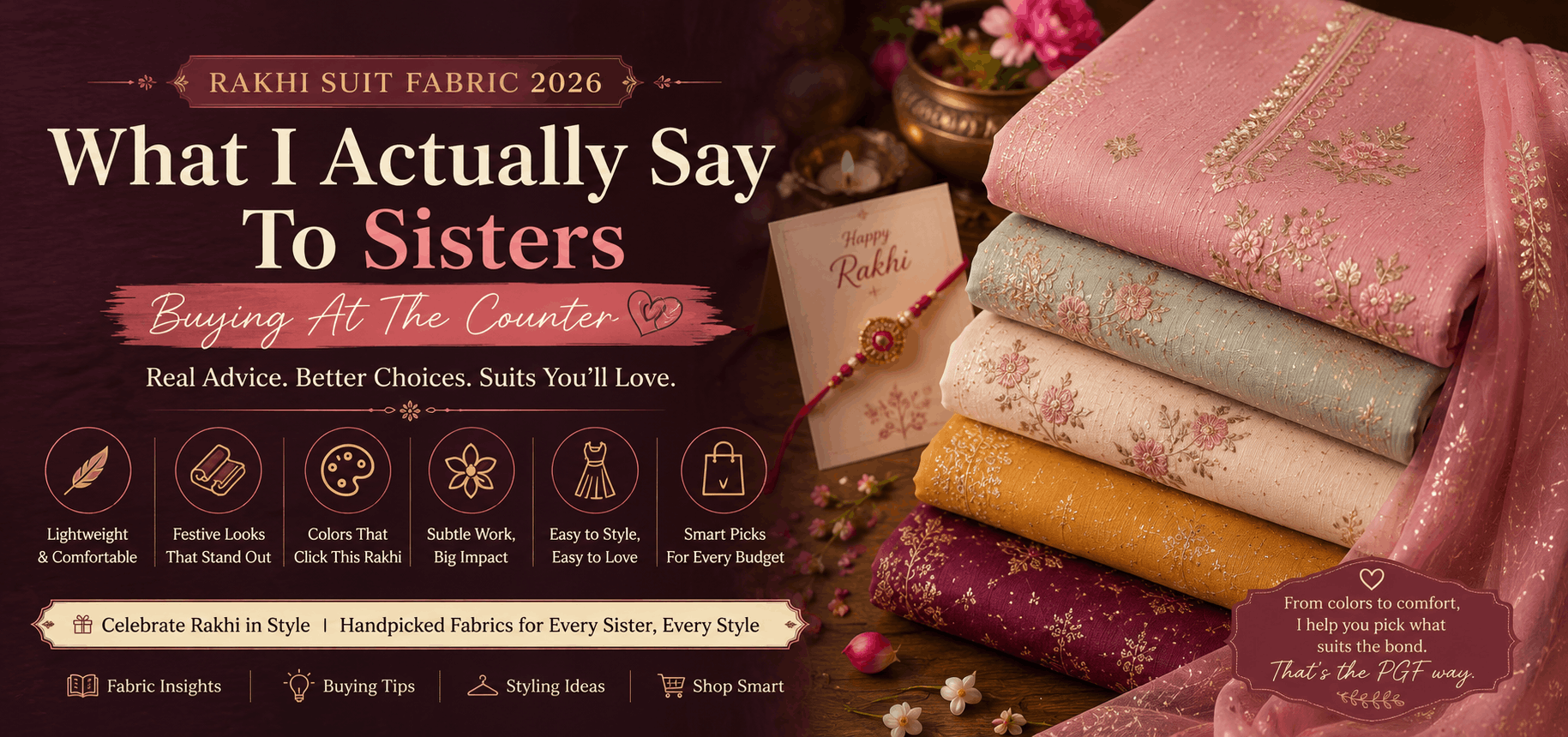
Rakhi Suit Fabric 2026: What I Actually Say To Sisters Buying At The Counter
So Rakhi is on 28 August this year. Every July around now the same conversation starts up at the counter. Sister of a bride. Cousins in from Bangalore for the weekend. One aunty last Tuesday sent a swatch to her daughter-in-law in Dubai by DHL just to get approval before letting the tailor cut anything. Delhi families do not take Rakhi shopping lightly.
Now. What most people get wrong is treating Rakhi like Diwali shopping. It is not. Diwali is evening, indoor, AC on if you are lucky. Rakhi is morning-to-afternoon, at your maayka or bhaiya's place, elders around. Delhi in August is 82 percent humidity. Different math entirely.
The fabric has to be festive. Not bridal. Has to breathe because you are on the floor for the puja. Has to photograph well in home tubelight, which is a whole separate problem in itself. Should not need three hours of ironing before you leave. Not every fabric handles all four.
Let me talk through what actually works.
Quick answer: For Rakhi 2026 (28 August), the safest Delhi fabric picks are pastel yellow chikankari cotton for morning puja, chinon with light gota for family lunches, pastel organza for the trendy cousin set, cotton silk for extended-family gatherings plus dyeable georgette when your family runs a colour theme. Order online by 25 July for pan-India delivery.
The 7 Rakhi fabrics I would send this year
1. Cotton chikankari (specifically pastel yellow)
Cotton chikankari has been strong for three seasons running now. Specifically pastel yellow, which is dominating this July.
My own bhabi wore an ivory chikankari kurta last year. By 2pm everyone was asking her where she had gotten it from, which turned into an aunty-group WhatsApp thread across three families comparing chikankari sources for weeks afterwards.
Very soft. Very morning-appropriate. Reads sweet without going anywhere near a wedding zone.
2. Chinon with light zari or gota
Chinon is one of those fabrics that drapes like chiffon but stitches like georgette. Which every tailor loves working with.
Slightly bigger Rakhi lunch coming? Chinon with light yoke work. Done.
3. Pastel organza (for the trendy cousin set)
Something in powder pink. Or mint. That whole aesthetic. Photographs like an Instagram reel waiting to happen.
Important thing though. Line the organza kurta with cotton, otherwise August humidity ruins the whole outfit inside an hour. Two hours max.
4. Cotton silk (softer alternative)
If the Rakhi lunch has extended relatives dropping in, cotton silk is the move. Takes a discreet zari border best. Ivory. Or a powder pink. Or soft peach.
Reads slightly dressier without being heavy. Sits in the silk family without pure banarasi money.
5. Muslin (for a small home-only Rakhi)
Home-only Rakhi with just siblings around? Muslin. My sister wore muslin last year. Complained afterwards that she should have bought two more sets in the same colour range because everyone at the aunty side of the family kept touching the fabric asking where it was from.
I now suspect she is going to send me a WhatsApp order this Sunday for exactly those two extra pieces before the rush hits later in July. Impossibly soft. Easy to sit in. Drapes like nothing else in home photographs.
6. Dyeable georgette (for the colour-themed families)
This one is for the specific-thaali-colour situation. Some families have a running colour theme every Rakhi. Your ready-made suit will never match exactly.
Dyeable georgette gets dyed to your exact shade, then stitched. Truly one-of-one look. The dyeable embroidery collection has base options that take pastel dye evenly, which matters because blotchy dye shows up in every single photograph.
7. Light satin (evening dinners only)
Only for evening Rakhi dinners with the sasural side family. A version with light zari embroidery holds through the evening without collapsing. Full heavy satin? Save it. Wrong energy for a home puja in the morning.
In short: Pastel yellow chikankari and mint chinon are the two safest picks for a Delhi morning Rakhi puja. Pastel organza works for the young cousin set. Dyeable georgette is for families running a colour theme. Skip velvet, brocade or heavy satin for the morning slot entirely.
Now the colour thing
Pastel yellow is having the biggest moment I have seen in years. Soft. Sunny. Photographs beautifully even under yellow home tubelight, which is not easy for most colours to pull off.
Mint sits second. Fresh in monsoon. Works with almost any gold jewellery finish, which matters when the older cousins are borrowing your mummy's earrings.
Powder pink just refuses to leave. Every year I think it will fade. Every year it holds on. Every skin tone. Every rakhi thaali across every family in Delhi.
Ivory with gold work if you want to look slightly dressier than the crowd. Magazine cover in indoor daylight, basically.
Dusty rose is the surprise this year. Older sisters plus bhabis in Delhi are picking dusty rose in chinon or cotton silk. Numbers I did not predict back in April. July numbers do not lie though.
Mistakes I watch happen every year
Look, let me save you these because I see them every single year at the counter.
Heavy net or velvet suit for morning Rakhi. Wrong energy. Too warm. Too dressy. Family puja is not a reception.
Pure polyester satin because it looks shiny under shop lights. By noon in August humidity it feels sticky on the arms. Every time.
Skipping the dupatta and settling for a stole. A proper dupatta anchors the whole outfit visually. Do not skip.
Bright red or maroon. Save it for Karva Chauth or Diwali. Rakhi mood is softer than that.
Getting the kurta stitched too fitted. Rakhi involves sitting on the floor. Bending for the aarti. Reaching across for the thaali to hand over the mithai. Tell the tailor to leave ease at the waist plus hip.
Prices, since you'll ask anyway
Straight numbers for July 2026 at Lajpat Nagar range.
- Chikankari cotton kurta piece. Rs 850 to Rs 2,400.
- Full chikankari suit set. Rs 1,900 to Rs 4,800.
- Chinon plain. Rs 220 per metre. Embroidered chinon Rs 480 to Rs 1,600.
- Pastel organza plain. Rs 240 to Rs 380. Pre-embroidered Rs 650 to Rs 2,200.
- Cotton silk plain. Rs 240 to Rs 520.
- Muslin. Rs 180 to Rs 360.
- Dyeable georgette. Rs 160 to Rs 260 before dye charges.
- Light satin. Rs 240 to Rs 480.
Ordering multiple sets for cousins plus bhabhis in one go? Ask for group pricing when you enquire.
Questions I have been asked this July already
What colour is trending for Rakhi 2026?
Pastel yellow, mint, powder pink, ivory plus dusty rose. Those five.
Is chikankari really okay for Raksha Bandhan?
Absolutely yes. One of the most popular Rakhi picks, especially for morning family pujas at home. Ivory or pastel yellow chikankari with a light gota-work dupatta is the classic answer.
Can I wear a saree instead?
Absolutely. A chiffon or cotton silk saree in a soft pastel works beautifully for Rakhi lunches.
Kitna fabric chahiye?
6.5 metres covers kurta, salwar or churidar plus dupatta. Add half a metre if you like a longer kurta or extra churidar volume.
Kab tak order karna hoga?
For 28 August Rakhi, order online by 25 July for pan-India delivery. If stitching with a local tailor who has bandwidth, 2 August is your final safe date.
Ready to order?
Shopping for your own Rakhi suit? Or picking pieces for cousins plus bhabhis together? WhatsApp me for same-day swatch courier across Delhi NCR, Mumbai, Bengaluru, Hyderabad, Chennai, Kolkata, Ahmedabad. The wholesale page has the bulk-order form for multi-sister orders.