Imperial Brocade Fabric in 2026: Why Boutiques Are Buying This Heavier Weave for Winter Wedding Lehengas
Imperial Brocade Fabric in 2026: Why Boutiques Are Buying This Heavier Weave for Winter Wedding Lehengas
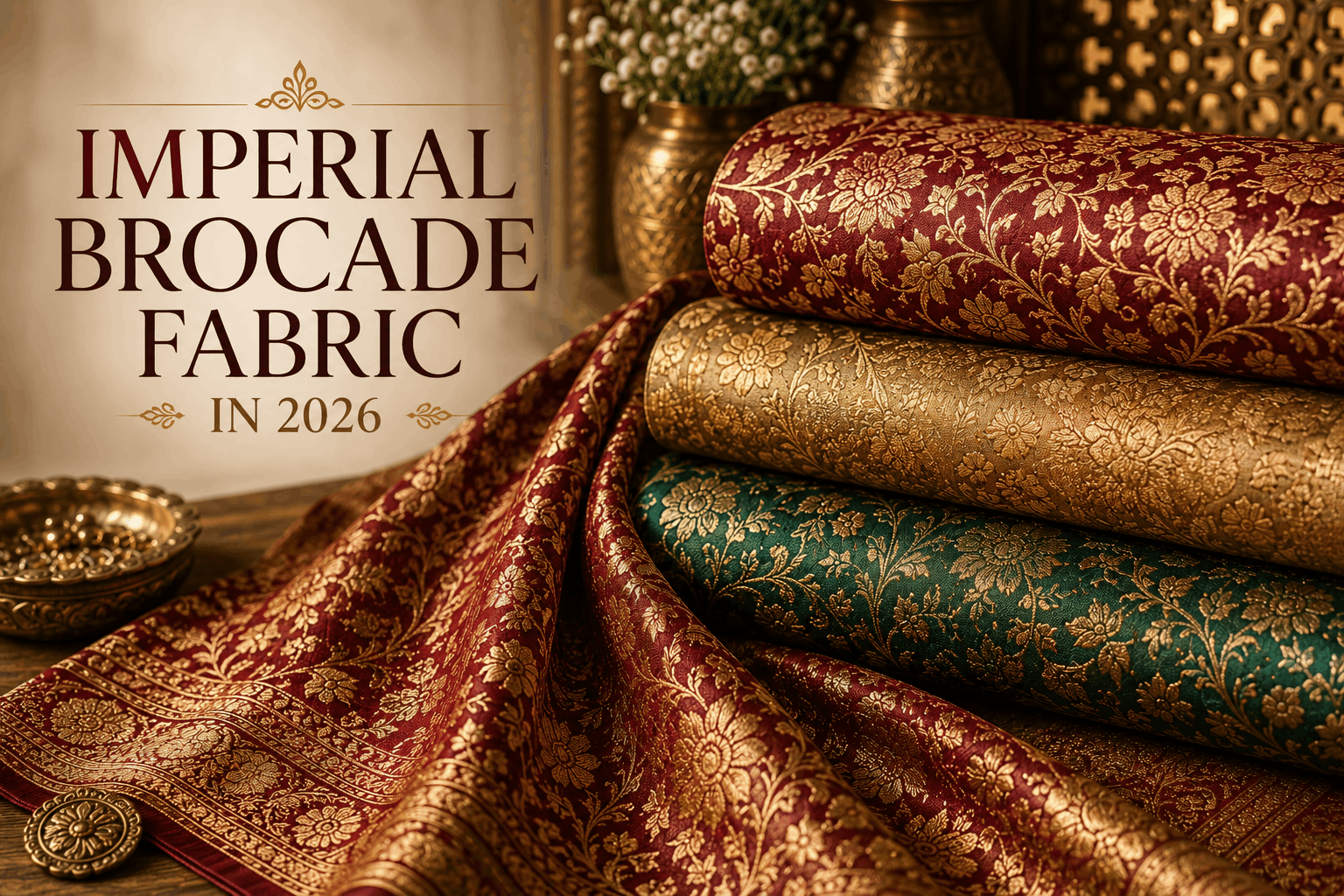
Imperial brocade fabric is a heavy zari woven cloth where gold or silver yarn is interlaced into a silk or art silk base to create raised metallic motifs. In 2026 it ranges from Rs 380 per metre for art zari brocade to Rs 2,800 per metre for pure tested zari kimkhab brocade.
For years brocade was the cloth every Lajpat Nagar dealer kept tucked behind the silks. Customers asked for Banarasi sarees, organza, georgette. Brocade was a niche cloth, used mostly for sherwani panels and dupatta borders. That shifted around 2023 when boutique designers in Hyderabad and Pune started pushing full-skirt brocade lehengas onto wedding shoppers. Today imperial brocade is one of the fastest moving heavy weaves for winter 2026 to 2027 commissions.
Last September a Pune boutique-wala called for half-fine zari quotes. Walked into a Karol Bagh wholesaler instead because quoted price was Rs 950 per metre. Sounded reasonable. Zari turned out art quality, not half-fine. Finished bridal lehenga tarnished by month four. Rs 30,000 of fabric lost plus client trust which hurts more.
This is the conversation I have with every boutique-wala calling ahead of the festive booking window. What grade of zari, what base cloth, what motif scale, what price actually corresponds to what cloth.

The best imperial brocade fabric in 2026 for a winter wedding depends on the function. Pick art zari brocade at Rs 380 to Rs 580 per metre for sangeet and reception sets. Choose half-fine zari brocade at Rs 850 to Rs 1,400 for boutique-finished bridal lehengas. Reserve pure tested zari kimkhab brocade above Rs 1,800 for designer commissions and heirloom sherwani sets.
What imperial brocade fabric actually is
Brocade is a jacquard-woven heavy cloth where supplementary weft yarns, usually metallic zari, are interlaced into a base weave to form raised decorative motifs. Base can be silk, art silk, cotton silk or polyester. Metallic yarn can be pure tested zari, half-fine zari, art zari or polyester metallic. Combination of base and zari decides everything about the finished cloth.
Quality swings on three things. Zari purity matters most. Pure tested zari uses silver wire coated with gold, which is why it never tarnishes. Half-fine zari uses silver wire with no gold coating. Art zari uses copper coated with imitation gold polish, which tarnishes within a year. Base cloth comes next. Pure silk drapes heavier and holds zari weight without sagging. Art silk and polyester bases feel lighter but slip at kali joins on heavy ghera. Motif scale and density last. Smaller buti patterns cut easily into a ghera. Larger panel motifs need careful kali planning otherwise the motif breaks at seams.
Browse our imperial brocade collection tagged with zari purity, base composition and motif description.
The four imperial brocade grades I stock for 2026
Art zari brocade
Polyester or art silk base with copper-imitation zari motifs. GSM 180 to 220. Price Rs 340 to Rs 580 per metre. Most accessible brocade. Photographs heavier on Instagram than it weighs in hand. Art zari tarnishes in 8 to 18 months. Cloth stays intact but gold motifs darken to dull copper. Best for one-season function wear Rs 4,000 to Rs 12,000 finished.
Half-fine zari brocade
Pure silk or cotton silk base with half-fine zari (silver wire without gold coating). GSM 220 to 280. Price Rs 750 to Rs 1,400 per metre. Most popular for boutique bridal lehengas Rs 35,000 to Rs 85,000. Half-fine zari stays bright for three to five years with proper care. Pure silk base holds zari weight without sagging, which makes this the right pick for full-skirt lehengas with brocade ghera panels.
Pure tested zari kimkhab brocade
Pure mulberry silk base with pure tested zari (gold-coated silver wire). GSM 280 to 360. Price Rs 1,800 to Rs 4,500 per metre. Heavyweight feel. Deep dye colours. Zari that never tarnishes. The brocade for designer bridal commissions over Rs 1,80,000 and heirloom sherwani sets. Tested zari is exactly why these hold their value for decades.
Banarasi brocade (Varanasi handloom)
Specific weave from Varanasi handloom traditions. Pure silk base with pure tested zari in classic shikargah, jaal, jangla or buti patterns. GSM 240 to 320. Price Rs 2,200 to Rs 6,800 per metre depending on motif complexity and bunkar attribution. Heritage brocade. Slower to produce, higher motif density, longer lifespan. The bridal bliss section carries Varanasi handloom pieces in limited bridal palettes.
How much imperial brocade fabric you actually need
Brocade is heavier and pricier per metre, which is why exact yardage matters. The fabric estimator tool handles motif matching allowances at kali joins.
|
Component |
Imperial brocade requirement |
|
Bridal lehenga ghera (6 kali) |
5.5 to 6 metres |
|
Bridal lehenga ghera (8 kali full flare) |
7 to 8 metres |
|
Sherwani full piece (mens) |
3.5 to 4 metres |
|
Choli blouse |
0.8 to 1 metre |
|
Brocade dupatta with border |
2.5 metres |
|
Brocade jacket layering |
2.5 metres |
|
Reception lehenga (lighter ghera) |
4.5 to 5 metres |
Tailor asking for more than 8 metres for a standard 6 kali ghera? Ask whether the extra metre accounts for matching motif placement across kali joins.
How to spot fake tested zari sold as pure zari
This is where the Pune boutique-wala got caught. Three checks help.
Magnet test first. Pure tested zari and half-fine are silver-based, not magnetic. Art zari uses copper alloys with mild magnetic response. Hold a strong neodymium magnet to a zari thread pulled from the selvedge. Mild attraction means art zari.
Burn test next. Pure tested zari burns to a tiny silver bead with a brief flash. Half-fine burns to silver-grey ash with no flash. Art zari burns to a darkened copper bead with a sharp acrid smell.
Price reality check last. Pure tested zari kimkhab cannot cost less than Rs 1,800 per metre because silver and gold raw materials alone account for over half the price. Seller offering pure tested zari at Rs 800? Zari is half-fine at best, more likely art zari with confident sales talk.
For verified tested zari with assay certification, the imported collection tags zari purity on every thaan.
How brocade choice changes the lehenga price
Two brocade lehengas that look similar in photos can land at completely different prices because of zari grade.
Art zari brocade lehenga with simple stitching lands Rs 12,000 to Rs 28,000 in fabric plus tailoring. Move to half-fine zari on silk, suddenly Rs 38,000 to Rs 75,000. Execute in pure tested zari kimkhab, Rs 1,40,000 to Rs 3,80,000 because tested zari is the most expensive single component. Varanasi handloom Banarasi can land Rs 2,50,000 to Rs 8,00,000.
Broader context in our piece on most popular bridal lehenga fabrics in India right now.
Brocade care and stitching tips for bridal commissions
Few rules brides and tailors keep getting wrong.
Store brocade folded inside soft muslin, never directly inside a plastic garment cover. Trapped moisture tarnishes half-fine and art zari faster than open-air exposure. Pure tested zari is more forgiving but still benefits from muslin storage.
Fine machine needle in size 80 or 90 for brocade. Heavier needles pull zari out of the base weave and leave visible loops along the seam.
Never iron brocade directly on the zari side. Iron from the reverse with a press cloth at medium heat. Direct iron contact flattens metallic threads permanently. Steam pressing is safer than dry iron for heavy brocades.
Frequently Asked Question
What is the difference between imperial brocade and Banarasi brocade?
Imperial brocade is a general term for heavy zari-woven cloth. Banarasi is the specific Varanasi handloom tradition with pure silk base and pure tested zari. All Banarasi is imperial brocade. Not all imperial brocade is Banarasi.
How much does imperial brocade fabric cost per metre in 2026?
Art zari Rs 340 to Rs 580. Half-fine zari Rs 750 to Rs 1,400. Pure tested zari kimkhab Rs 1,800 to Rs 4,500. Banarasi handloom Rs 2,200 to Rs 6,800 per metre.
How many metres of brocade for a bridal lehenga?
Standard 6 kali ghera needs 5.5 to 6 metres. An 8 kali full flare needs 7 to 8 metres. Add 1 metre for the choli and 2.5 metres for the dupatta. Sherwani needs 3.5 to 4 metres.
Does art zari brocade tarnish?
Yes, art zari uses copper-based imitation polish that tarnishes within 8 to 18 months. Cloth stays intact but motifs darken to dull copper. For lasting shine, choose half-fine or pure tested zari instead.
Can brocade be machine washed?
No, brocade should be dry cleaned only. Hand washing damages the zari coating and weakens the base weave. Metallic yarns bleed onto adjacent panels during washing.
Which brocade is best for a winter wedding lehenga in 2026?
Half-fine zari on pure silk for mid-range commissions Rs 35,000 to Rs 85,000. Pure tested zari kimkhab for designer commissions above Rs 1,80,000. Varanasi handloom Banarasi for heirloom-grade.
The honest takeaway from the shop counter
Brocade rewards investment proportional to the wedding occasion. Art zari brocade looks heavier than its price suggests but tells its own story by month twelve. Half-fine zari sits in the right place for most boutique-finished bridal lehengas. Pure tested zari and Banarasi handloom are heirloom investments holding value for decades.
For winter 2026 to 2027 lehengas, the booking window is July to September. Pure tested zari and Varanasi handloom need 8 to 12 weeks for weaving and motif customisation. Bulk pricing through the bulk order page from June onwards.
Your Next Step...
Walk through the live imperial brocade collection sorted by zari purity and base composition. Pair with matching zari border for dupatta edges or silk fabric for blouse coordination. WhatsApp for swatch dispatch before October lock-in. Honest grading on every thaan. One counter. One promise.