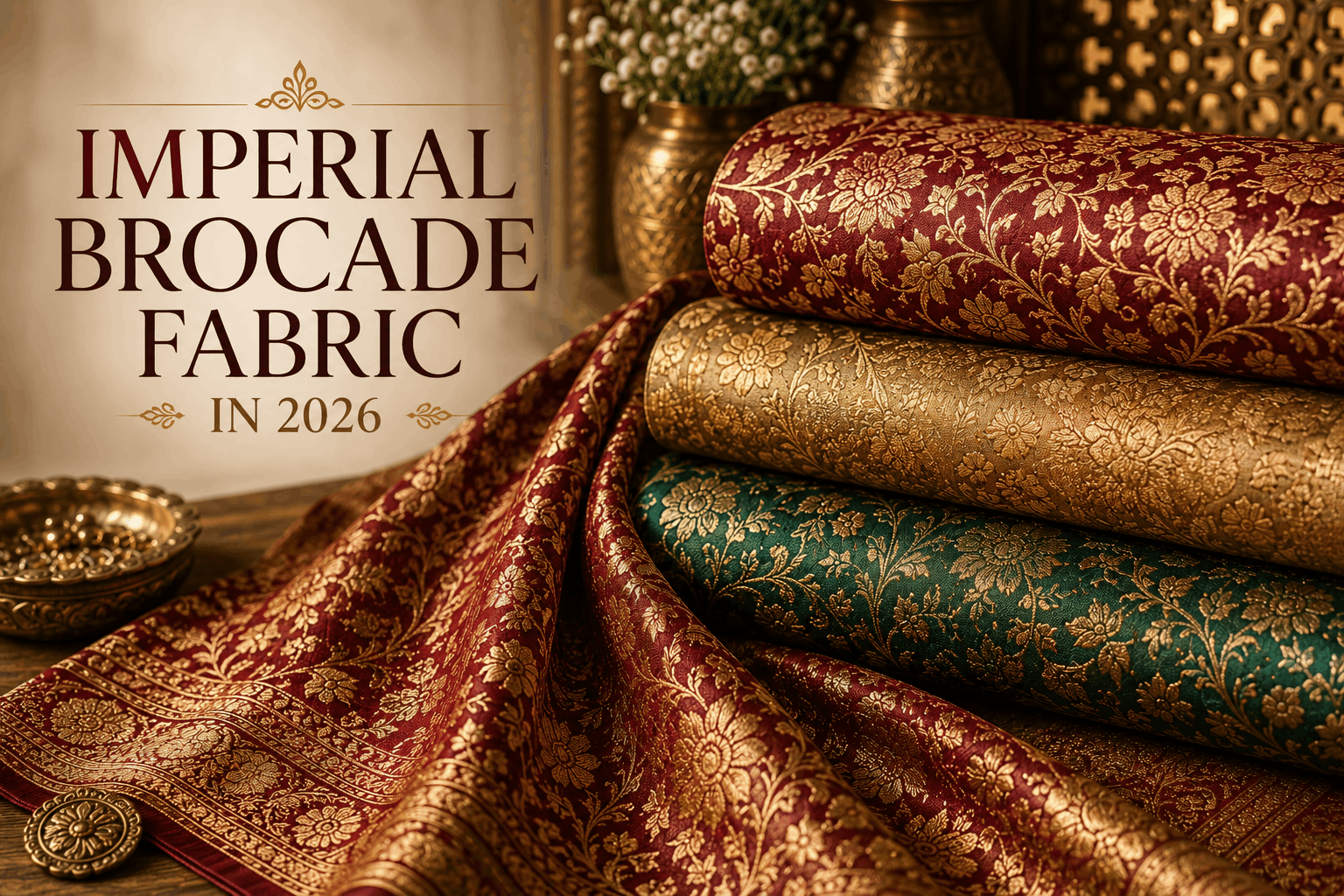
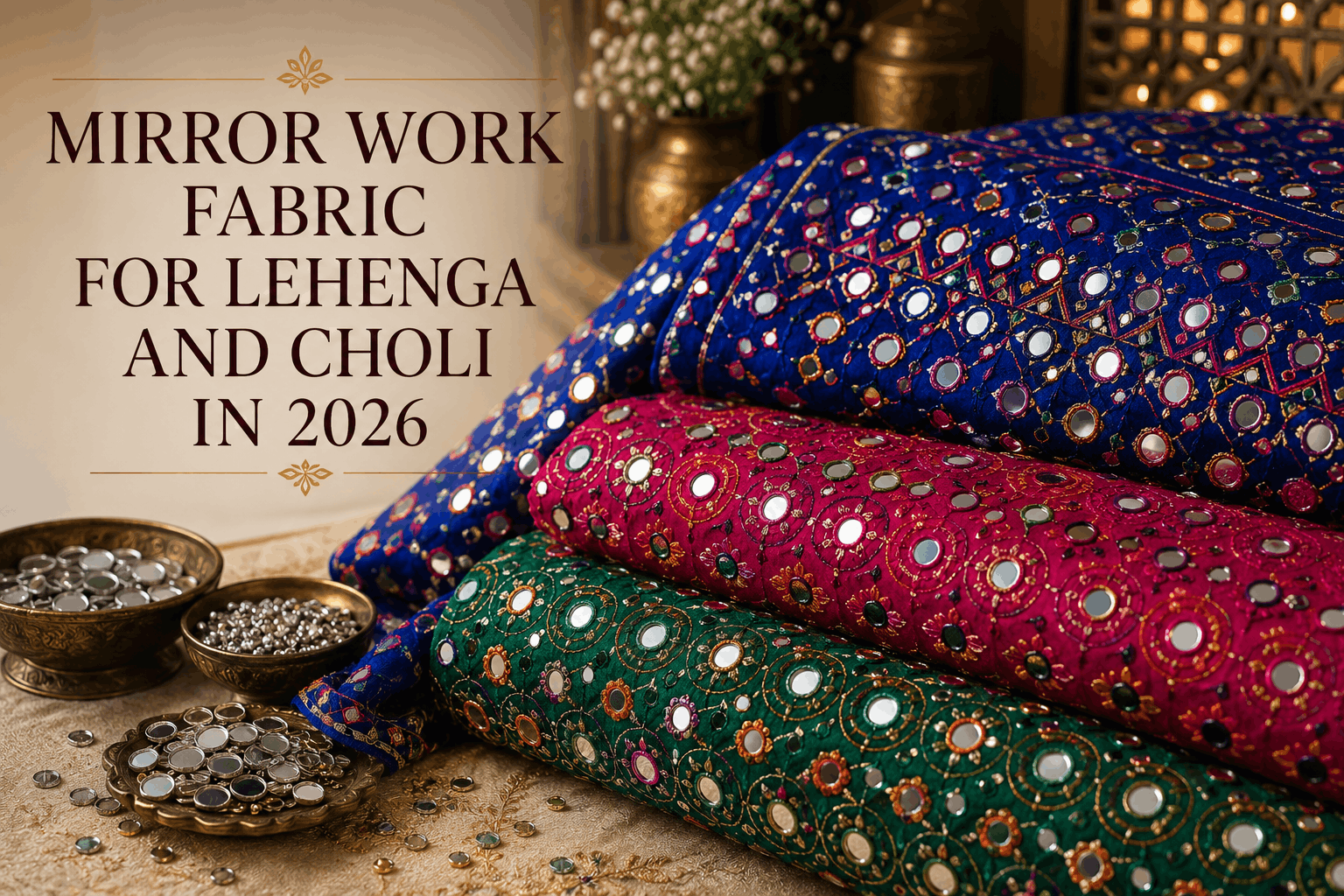
Mirror Work Fabric for Lehenga and Choli in 2026: A Lajpat Nagar Guide to Sheesha Kutchi and Foil Mirrors
Mirror Work Fabric for Lehenga and Choli in 2026: A Lajpat Nagar Guide to Sheesha Kutchi and Foil Mirrors
Mirror work fabric is an embroidered cloth where small reflective discs called sheesha are stitched onto a base fabric. In 2026 the four common grades are foil mirror polyester at Rs 280 per metre, plastic sheesha on georgette at Rs 480, glass sheesha on cotton at Rs 750, and hand Kutchi mirror at Rs 1,400 plus.
Every Navratri season my counter fills up the same way. Women looking for mirror work cloth. Some for chaniya choli for the dandiya nights. Some for a sangeet outfit. Some walk in with a Manish Malhotra reference photo asking for the same look at a tenth of the cost.
Reality is mirror work fabric in 2026 sits across four very different quality tiers. Most buyers do not realise the difference until mirrors start falling off after the second wear. Last September a Rajouri Garden customer came in with a Rs 4,200 chaniya choli ordered online for her daughter's college garba. By the third night, half the mirrors were gone. Foil-printed polyester, not real mirrors. Refund window closed.
This is the conversation I have with every first-time buyer. What kind of mirror, what base cloth, what stitching, what you are actually paying for.

The best mirror work fabric for a 2026 lehenga depends on use. Pick foil mirror polyester for budget sangeet sets. Choose plastic sheesha georgette for boutique choli pieces. Go for glass sheesha on cotton for festive durability. Choose handmade Kutchi mirror work for designer bridal or heirloom pieces. Glass mirrors hold their shine longer than foil and plastic.
What mirror work fabric actually is
Mirror work fabric is an umbrella term. Any cloth where small reflective discs, called sheesha in Hindi or aabhla in Gujarati, are attached to a base fabric. Discs can be glass, plastic or printed foil. Attachment can be hand or machine embroidery, sometimes heat-pressed adhesive. Base cloth can be cotton, georgette, net, silk or polyester.
Quality swings on three things. Mirror material matters most. Glass reflects deepest and lasts longest. Plastic weighs less but yellows after washing. Foil is just printed on the surface, shine wears off with friction. Stitch type next. Hand stitching locks the mirror firmly. Machine stitching is quicker but mirrors loosen earlier. Base cloth last. Cotton handles wear better. Net or georgette tears at attachment points faster.
Browse our dyeable embroidery collection tagged with mirror type, stitching method and base composition.
The four mirror work fabric grades I stock for 2026
Foil mirror polyester
Polyester base with printed reflective foil designs that look like mirrors from a distance. No actual disc on the cloth. GSM 80 to 110. Price Rs 240 to Rs 380 per metre. The most affordable mirror work cloth, sold heavily online during Navratri. Works for one-time garba. By the third or fourth wear, the foil scratches off and the pattern looks patchy.
Plastic sheesha on georgette
Plastic mirror discs stitched onto a georgette base with machine embroidery. GSM 90 to 110. Price Rs 440 to Rs 680 per metre. Most popular for boutique cholis and lehenga panels in the Rs 4,500 to Rs 9,000 bracket. Plastic holds shape longer than foil but yellows from detergents. Best for sangeet outfit fabric that is dry cleaned.
Glass sheesha on cotton
Real glass mirror discs stitched onto cotton with denser thread to lock the glass. GSM 100 to 130. Price Rs 700 to Rs 1,100 per metre. What I recommend for serious festival wardrobes. Glass holds shine for years. Cotton breathes through Navratri heat. Survives ten plus washes when dry cleaned. Used for boutique bridal sangeet Rs 18,000 to Rs 45,000.
Hand Kutchi mirror work
Traditional Gujarati hand embroidery with glass mirrors surrounded by colourful silk thread satin stitches. Base is pure cotton handloom or raw silk. GSM 110 to 140. Price Rs 1,400 to Rs 4,200 per metre depending on motif density. Heritage cloth. Designer commissions over Rs 80,000 use this grade. Sourced from Kutchi clusters in Bhuj and Anjar. For boutiques, the bridal bliss section carries hand Kutchi pieces.
How much mirror work fabric you actually need
Denser the work, higher the per-piece cost because embroidery limits where you can cut. For exact requirements with kali-join allowances, the fabric estimator tool handles it.
|
Component |
Mirror work fabric requirement |
|
Chaniya choli ghera (8 kali full flare) |
6.5 to 7.5 metres |
|
Sangeet lehenga ghera (6 kali) |
5.5 to 6 metres |
|
Choli blouse |
0.8 to 1 metre |
|
Dupatta with mirror border |
2.5 metres |
|
Mirror jacket layering piece |
2 to 2.5 metres |
|
Anarkali kurti with mirror panels |
4 to 4.5 metres |
Tailor asking for more than 8 metres for a standard 8 kali chaniya? Ask whether the extra metre is for motif placement at kali joins. Sometimes real, sometimes not.
How to spot fake glass mirrors sold as Kutchi work
The market sells plenty of machine-stitched plastic mirror work labelled as Kutchi. The Rajouri Garden customer fell for exactly this. Three checks help.
Back-of-cloth test first. Flip the cloth. Hand embroidery shows visible thread knots and irregularity. Machine embroidery shows a flat repeating pattern. The test most online sellers will not show in a video, which is itself the answer.
Tap-and-listen next. Tap a mirror gently with a fingernail. Real glass gives a clear high sound. Plastic gives a dull thunk.
Thread density last. Hand Kutchi surrounds every mirror with eight to twelve satin stitches in coloured silk. Machine work has two to four stitches in polyester with a slight plastic sheen.
For verified hand Kutchi with karigar attribution, the imported collection tags origin cluster and stitch type.
How mirror choice changes the lehenga price
Two chaniya cholis that look similar on Instagram can land at completely different prices because of the base mirror.
A foil polyester chaniya choli with basic stitching lands Rs 1,800 to Rs 3,800 in fabric plus tailoring. Move to plastic sheesha georgette, suddenly Rs 5,200 to Rs 11,000 because mirrors are real discs not prints. Execute in glass sheesha cotton with denser work, Rs 12,000 to Rs 32,000 because glass and cotton cost more. Hand Kutchi with full motif coverage lands Rs 45,000 to Rs 1,80,000 because silk thread handwork takes weeks per piece.
Broader bridal pricing in our piece on the most popular bridal lehenga fabrics in India right now.
Mirror work care and stitching tips
Few rules to get right. Otherwise the cloth tells on itself within a season.
Dry clean always. Hand washing loosens the surrounding embroidery thread, which is exactly what locks the mirrors in place. Once thread weakens, mirrors drop off one by one.
Fine machine needle in size 70 only for stitching mirror work. Heavier needles snag surrounding threads and pull mirror clusters loose.
Store mirror work hanging on a padded broad hanger inside a cotton garment cover. Folding creates pressure points where mirrors press against each other and crack the glass. Avoid plastic covers because trapped moisture yellows the thread.
Frequently Asked Questions
What is the difference between sheesha and Kutchi mirror work?
Sheesha is the general term for any mirror embroidery. Kutchi is specific Gujarati traditional embroidery where glass mirrors are surrounded by dense coloured silk thread satin stitches done by hand. All Kutchi work is sheesha. Not all sheesha is Kutchi.
How much does mirror work fabric cost per metre in 2026?
Foil mirror polyester Rs 240 to Rs 380. Plastic sheesha georgette Rs 440 to Rs 680. Glass sheesha cotton Rs 700 to Rs 1,100. Hand Kutchi Rs 1,400 to Rs 4,200 per metre.
How many metres of mirror work fabric for a chaniya choli?
An 8 kali full flare chaniya needs 6.5 to 7.5 metres. A 6 kali sangeet lehenga needs 5.5 to 6 metres. Add 1 metre for the choli blouse and 2.5 metres for the dupatta.
Can mirror work fabric be machine washed?
No, mirror work should only be dry cleaned. Hand or machine washing loosens the embroidery threads holding the mirrors in place. Mirrors fall off with every wash once stitches weaken.
Which mirror work is best for a bridal sangeet outfit?
Glass sheesha on cotton for mid-range bridal sangeet between Rs 25,000 and Rs 60,000 finished. Hand Kutchi for designer commissions above Rs 80,000.
How can I tell real Kutchi mirror work from a machine copy?
Three checks. Back of cloth shows knots and irregularity for handwork versus flat repeat for machine. Tap a mirror, glass gives a high clear sound, plastic gives a dull thunk. Thread density is 8 to 12 satin stitches for hand versus 2 to 4 for machine.
The honest takeaway from the shop counter
Mirror work is the cloth where you get what you pay for. Foil mirrors look great for one season. Plastic sheesha holds for three to five wears. Glass sheesha lasts a decade with dry cleaning. Hand Kutchi passes from mother to daughter when stored properly.
Pick foil mirror polyester for college festival or one-time garba. Plastic sheesha georgette for boutique sangeet cholis. Glass sheesha cotton for multi-year festive wardrobes. Hand Kutchi for bridal trousseaux. Bulk pricing through the bulk order page from June onwards.
Now your next step...
Walk through the live mirror work fabric collection sorted by mirror type and base composition. Pair with matching zari brocade for choli edges. WhatsApp for swatch dispatch before Navratri rush. Honest grading on every bolt. One counter. One promise.