Tussar Silk Fabric Buyer Guide : Bhagalpur, Ghicha, plus What You Should Pay Meta Title: Tussar Silk Fabric Guide
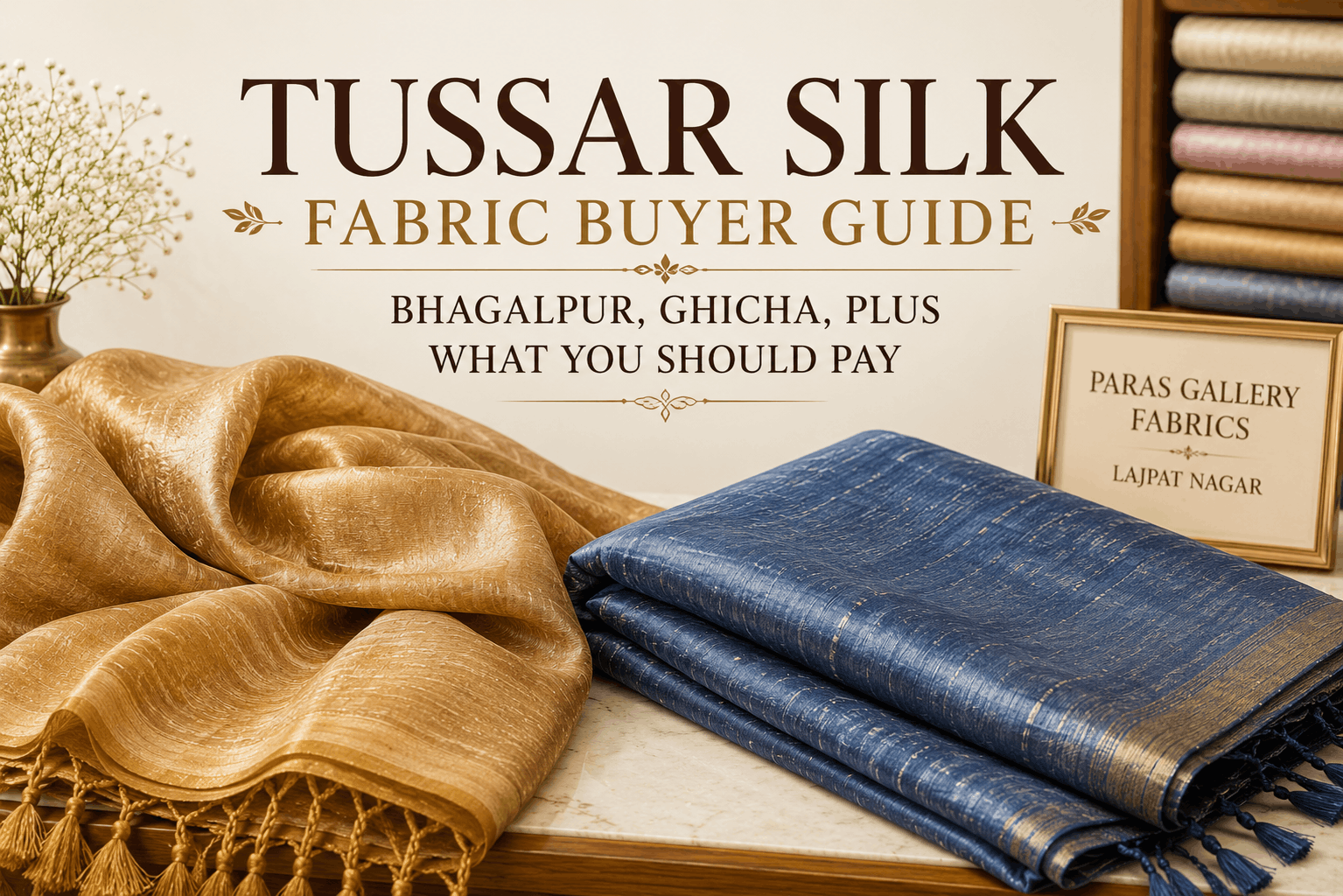
Tussar Silk Fabric Buyer Guide : Bhagalpur, Ghicha, plus What You Should Pay
Meta Title: Tussar Silk Fabric Guide
Tussar silk fabric is a wild silk woven from cocoons of the Antheraea moth, mostly farmed in Bhagalpur, Jharkhand, and Chhattisgarh. The yarn is uneven with natural slubs, giving the cloth a textured surface, a golden-honey sheen, and a coarser hand than mulberry silk. It breathes well and suits Indian monsoon humidity.
People walk into my shop and ask for tussar silk thinking it is one fabric. Not true.
Four working grades exist in the Indian market under the same name. Price gap between them runs three times. Look and drape behaviour is completely different across the four. The right grade for you depends entirely on what you are stitching plus how you intend to wear it.
Before someone spends Rs 5,000 on a tussar saree that might actually be polyester pretending, or pays Bhagalpur prices for what is really Katia grade, here is what I tell every customer who walks up to this counter asking about tussar silk.

Tussar silk fabric, also spelled tussore or tasar, ranges from Rs 480 to Rs 1,800 per metre depending on grade. Bhagalpur tussar is the most common at Rs 480 to 850. Katia tussar costs Rs 650 to 1,100. Ghicha tussar from raw silk waste sells around Rs 580 to 950. Pure dye-vat hand-block tussar from Madhya Pradesh runs higher.
What tussar silk actually is
Different moth. That is the foundational thing to understand.
Mulberry silk comes from Bombyx mori which is a farmed moth that feeds on cultivated mulberry leaves under controlled conditions. Tussar silk comes from the Antheraea family of moths which live wild in the forests of eastern India. Jharkhand leads tussar production by volume. Chhattisgarh follows closely behind. Odisha contributes a significant share too. West Bengal plus parts of Madhya Pradesh round out the source map for the trade.
Because the moths are wild rather than farmed, the cocoons that get harvested are harder than mulberry cocoons. The silk filament reeled from those cocoons is also uneven. That unevenness in the yarn is what the trade calls the slub. It is not a defect. The slub is the actual signature of tussar.
Raw colour straight off the reel is honey-gold or pale beige. This natural shade comes from the sericin protein in the silk fibre itself. Dyeing happens later in the production chain. High-quality tussar takes vegetable-based dyes considerably better than chemical dyes. That dye-type detail matters for what you eventually purchase. Browse current tussar options in our silk fabric collection where dye type is noted per piece.
The four tussar grades I stock at the counter
Bhagalpur is the mass-market backbone of the entire trade. Smooth slub texture. Even weave structure. Mild sheen across the surface. The Bhagalpur weaver clusters in Bihar have been producing this grade for over a hundred years now. Sarees, kurtas, dupattas come out of this category, which is what your average tussar customer ends up buying because the price keeps it accessible.
Katia is the longer-filament variant where reeling happens with extra care so the slubs come out smaller and the finished cloth feels softer in hand. Most boutique customers asking for "high-quality tussar" actually want Katia even when they cannot name the grade specifically. Pricing runs slightly above Bhagalpur but the drape difference is visible immediately on the cutting table.
There is also ghicha, which gets made from the waste silk left over after the main filament has been pulled from the cocoon. Rougher texture. More visible slubs. Bigger weave irregularity at every level. Designers love ghicha for jacket fabric or home furnishing applications because it offers the most visible craft surface of the four available grades.
Desi tussar from Madhya Pradesh plus Chhattisgarh forest weavers is the rarest category I stock. Hand-reeled. Hand-spun. Sometimes sold completely undyed in its natural honey-gold state. Eco-craft buyers pay top prices for this grade specifically because the hand-crafted origin documentation is genuine.
Current Lajpat Nagar wholesale pricing
These are June 2026 wholesale-counter prices from my direct sourcing.
|
Type |
Width |
Per metre |
|
Bhagalpur tussar plain |
44 inch |
Rs 480 to 850 |
|
Bhagalpur tussar handloom checks |
44 inch |
Rs 620 to 950 |
|
Katia tussar saree weight |
44 inch |
Rs 650 to 1,100 |
|
Ghicha tussar designer |
44 inch |
Rs 580 to 950 |
|
Desi forest tussar undyed |
36 to 44 inch |
Rs 1,200 to 1,800 |
|
Block-printed tussar (Bagh, Ajrakh) |
44 inch |
Rs 750 to 1,400 |
For a six-metre saree with blouse fabric included plan on 6.3 metres total requirement. Suit pieces typically need 2.5 to 3 metres for the kurta with 2 metres separately for lining cloth. Use the fabric estimator tool for exact yardage calculations on more complex tussar projects.
Why monsoon buyers should pick tussar over mulberry silk
This conversation happens twice a week at my counter through monsoon season. Customer wants silk for a July or August event. Reaches automatically for mulberry silk out of habit. I push them toward tussar instead for several practical reasons.
Porosity is the biggest one. The slub structure in tussar creates micro-channels between the woven threads which let air move through the cloth. In Mumbai or Hyderabad humidity that air circulation translates directly to less perspiration getting trapped against skin during a long event. Mulberry silk has none of this air movement built in.
Wrinkle tolerance is the next factor most customers actually care about. The natural slubs in tussar disguise crease lines that would be glaringly visible on smooth mulberry silk. A tussar saree worn for a four-hour office function followed by a two-hour metro ride still reads as intentionally textured rather than crumpled by the end of the day. Kanjivaram silk in the same scenario shows every fold line.
Drying speed matters too and people underestimate this one consistently. The looser tussar weave does not hold moisture the way tightly-woven mulberry silk does. A light rain spray on tussar is shake-off-and-keep-going. The same rain on Kanjivaram becomes a dry-cleaner emergency by evening.
How to spot real tussar from acid-dyed fake
Most online buyers never check this. They end up disappointed when the saree arrives looking nothing like the listing photos.
A burn test on a snipped yarn end pulled from the selvedge is the first authentication check. Real silk shrivels under flame and gives off a smell exactly like burnt hair. Polyester pretending to be tussar melts into a hard plastic bead and smells chemical instead. If you cannot do this test yourself before purchase, ask the seller to do it in front of you.
The touch test for slub authenticity is the next layer. Real tussar feels cool to the touch, slightly papery in texture, with irregular slubs that you can roll between thumb and finger. Fake tussar feels warm in hand, plasticky, plus the slubs feel suspiciously even because they were printed or embossed into the weave rather than naturally woven.
Water absorption tells you the same story from another angle. A drop of clean water placed on real tussar gets absorbed slowly and darkens the spot where it landed. The same water drop on acrylic fake beads up and runs off the surface. This works because natural silk takes moisture into the fibre structure while synthetic repels it.
About the chemical dye question, look carefully at the inside of the seam allowance after the first wash cycle finishes. Chemical dyes bleed into surrounding cloth in visible stripe patterns. Vegetable dyes bleed evenly and softly without creating any stripe effect. Reputable Bhagalpur tussar uses azo-free dyes mostly these days. Cheap market versions still use sulphur or naphthol dyes that the European Union banned many years back.
Outfit constructions worth knowing about
The classic Bengal-influenced look is tussar saree paired with kantha embroidery border work. Sells well to Kolkata buyers, Hyderabad buyers, also Bangalore buyers across the year not just during festive seasons. The kantha thread work pairs naturally with the honey-gold tussar base.
Bagh hand-block prints from Madhya Pradesh on tussar base is the next combination I recommend regularly. Madhya Pradesh craft mixed with East Indian silk fibre. Strong pooja and festive day choice. Particularly suits wearers aged thirty-five and above in my retail experience.
For corporate office wear, the tussar tunic in three metres of dusty pista or muted beige with a plain neckline cut into a slight A-line is what I am sending to professional-women customers across India this month. The cut handles monsoon humidity without the wrinkle issues that cotton blouses develop by the end of a working day.
A tussar suit set paired with a raw silk dupatta gives you two natural fibres playing off each other beautifully. The suit drapes structured because tussar holds shape inherently. The dupatta drapes soft because raw silk has more fall than tussar does. This pairing works well for sangeet functions where the sister-of-the-bride wants craft authenticity without the visual weight of mulberry silk pieces. Our bridal bliss collection carries coordinated tussar-and-raw-silk options sorted by wedding function.
Stitching notes worth giving your tailor
Tussar shifts on the cutting table because of the irregular slub structure built into the weave. Your tailor needs to mark pattern pieces with chalk in both directions and baste the major seams before final stitching. Cutting tussar without basting first leads to twisted seam lines that show up clearly after the first wash cycle.
Use cotton thread for tussar stitching rather than polyester. Polyester thread is harder than silk fibre and slowly cuts through the silk over months of regular wear. Cotton thread ages along with the fabric instead of degrading it.
Line a tussar kurta or blouse with soft cotton cambric only. Polyester lining traps body heat against the skin and defeats the breathability advantage you bought tussar for in the first place. The lining choice matters more for tussar than for mulberry silk because tussar's primary selling point IS breathability.
Care routine for three-season longevity
Dry clean for the first three washes after purchase regardless of how careful you intend to be. After those initial dry cleans, gentle hand wash with shikakai or any mild silk-friendly liquid detergent works for low-embroidery tussar pieces. Heavy zardosi work or hand-block printed tussar should stay dry-clean only across its entire usage life.
Never dry tussar in direct sun. The natural gold-honey base fades to a dull beige within weeks of regular summer sun drying which is mostly irreversible damage. Always shade dry in a ventilated space.
For storage, use neem leaves or dried lavender pouches rather than naphthalene mothballs. Tussar contains natural protein which attracts moths. Naphthalene chemistry is also harsh on the natural dyes used in good tussar pieces, which is the more important reason to avoid it.
When to buy for best stock selection
The tussar trade season ties directly to the wild moth cocoon harvest in the forest regions. Fresh inventory arrives at Lajpat Nagar wholesalers from late June through August every year. By September the most desirable colours, particularly the soft pastels plus indigo overdye varieties, start running short at wholesale level.
Boutique buyers wanting special-grade Katia tussar or block-printed Bagh tussar should place orders by mid-July to lock production capacity at the source weaver clusters before the festive demand spike begins.
For wholesale lots above twenty metres, direct Bhagalpur sourcing through markup-free Lajpat Nagar channels is available. Ask for it specifically because it is not the default offering. Pricing drops about 18 percent versus standard retail when this direct channel gets used. Boutique buyers should request bulk quotes through our bulk order page before committing to larger orders.
FAQ
Is tussar silk pure silk?
Yes. Tussar is a category of natural silk but produced from a different moth species than mulberry silk. The Antheraea moth produces a wilder, slubbed silk with different texture characteristics. It is still 100 percent natural protein fibre regardless of the visual difference from mulberry.
Which tussar silk grade is best for sarees?
For everyday wear and office sarees, Bhagalpur plain tussar offers the best balance of price plus durability across the four grades. For festive day sarees, Katia tussar or block-printed Bagh tussar gives more visible craft surface plus better overall drape. The right pick depends on how often the saree will get worn through the year.
How do I stop my tussar saree from creasing too much?
Steam the saree before wearing it. Avoid folding the same fabric along the same lines repeatedly across multiple storage cycles. Use a hanger only for short-term storage with a soft cotton cover over the saree. Never use bare wood or plastic hangers because both damage the silk at the shoulder grip points over months.
Can tussar silk handle Indian monsoon rain?
Tussar handles light rain better than mulberry silk because it dries faster after exposure. Avoid heavy downpours and immediately shake off water drops with a dry cotton cloth if caught in unexpected rain. Never wring tussar regardless of how wet it gets, because wringing damages the weave permanently in ways that cannot be ironed out afterwards.
Is tussar silk suitable for summer wear?
Yes very much so. The porous weave breathes well which makes tussar one of the best natural silk options for Indian summers, particularly in coastal cities where humidity stays high. Chennai, Kolkata, plus Mumbai customers buy tussar specifically for the breathability through summer months.
How can I tell genuine Bhagalpur tussar from a synthetic copy?
Run the burn test on a yarn end pulled from the selvedge. Real tussar has uneven natural slubs that vary across the cloth. The fabric absorbs water slowly when a drop is placed on it. The yarn burns with a hair-like smell when tested with flame. Synthetic copies show machine-uniform slubs, repel water on contact, plus melt rather than burn when tested. Browse authenticated tussar options in our lehenga fabric collection where Bhagalpur attribution is verified per piece.
Final word from the counter
Tussar is the silk most people end up loving once they switch to it from mulberry. The breathability advantage shows up immediately in humid weather. The craft authenticity is real rather than marketing claim. The price gap means you can buy three tussar sarees for what one quality mulberry silk piece costs.
The mistake to avoid is buying tussar without confirming which grade you are actually getting. Bhagalpur, Katia, ghicha, desi forest tussar. Four different categories priced differently for good production reasons. Knowing which one you are buying lets you make a sensible decision rather than feeling like you overpaid for the wrong cloth afterwards.
Your Next Step...
Real Bhagalpur and Katia tussar swatches go out by India Post on next-day dispatch. WhatsApp the shop for the running lot list with current colour availability. Browse the full tussar plus mulberry silk range at the Lajpat Nagar counter where every piece carries grade attribution per bolt. Direct Bhagalpur sourcing for boutique buyers. Honest grading. No runaround on tussar authenticity questions.