Where to Buy Lehenga & Embroidery Fabric Online
I've been in fabric sourcing for over 12 years now first with a wholesale house in Surat then with a boutique label in Delhi and now with Paras Gallery. The single most common conversation I have with new boutique owners and designers who come to us is this: they know what they want, they just don't know what to ask for.
They'll say, 'I want something bridal, heavy embroidery, good fall.' and I'll ask, 'What's the base fabric?' and they'll say, Whatever works. The problem starts from here.
So this is not a general guide to lehenga fabrics. You can find a hundred of those. This is what I'd actually tell a designer sitting across from me what each fabric does, where it gets used and what to watch for when buying online. Paras Gallery sells most of what I'm describing here, so I'll point you there when it's relevant.
Look at the base fabric first, not the embroidery
I know that sounds Surprising when you are buying embroidered fabric. But the embroidery is sitting on top of something and that something changes everything about how the final garment behaves.
I've seen beautiful katdana work on a thin, loosely woven base that completely lost its shape after the first fitting. And I've seen plain heavy georgette with modest sequin buti that made a lehenga hang exactly right for three hours of dancing. The base determines fall, weight, movement and how long the garment stays looking sharp through a long function.
Boutique buyers who've been around a few seasons get this. They don't think about base fabric and embroidery as separate choices. They think about the finished garment and work backwards. If you're new to ordering fabric by the meter, train yourself to ask: what is the base and what weight is it? That one habit will save you a lot of returned stock.
Georgette my default recommendation for 70% of lehengas
If someone asks me what to order for a sangeet outfit, I say georgette without thinking about it. It moves well, it photographs in any lighting and it holds sequin, resham and bead embroidery without becoming uncomfortably heavy. I've watched dancers wear georgette lehengas for four, five hours and still look the way they did when they walked in.
The crinkled texture is a real advantage indoors, by the way. Indoor wedding lighting usually warm overhead spots tends to flatten silk. Georgette catches it differently and looks richer on camera than you'd expect.
Where georgette falls short is ceremony. If you need that dense, heavy presence the kind that reads 'bridal' in a formal portrait georgette alone doesn't cut it. For the main function, I'll usually recommend a silk base or at least a heavier georgette blend.
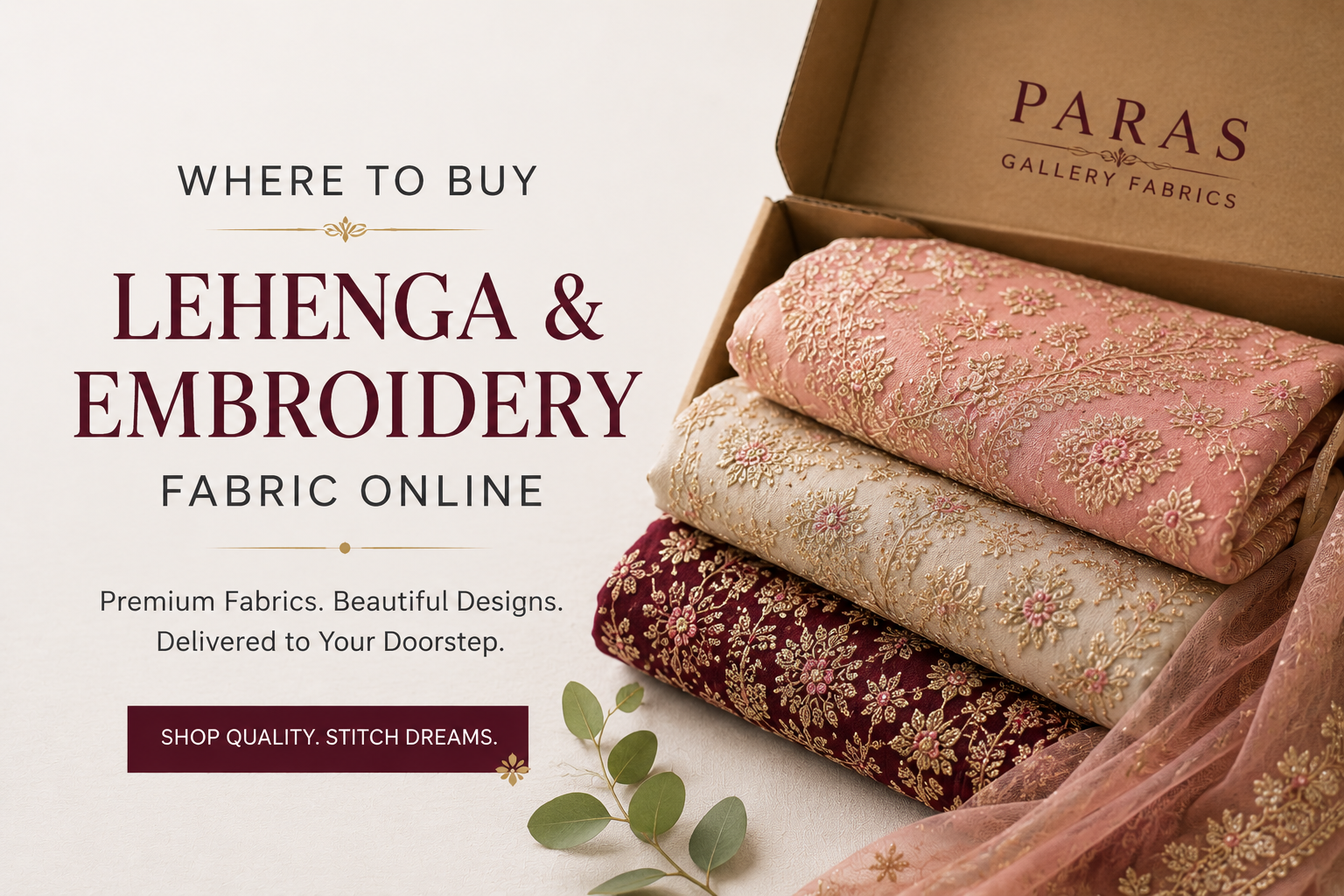
At Paras Gallery, we stock dyeable white georgette with katdana and sequin buti work. For boutiques that need the same design in four or five shades, this is the sensible way to handle it: buy one piece, dye to order.
Dola silk the workhorse for bridal ceremony fabric
Dola is a semisynthetic silk. It's not pure silk and I'd rather be upfront about that than let you find out after you've ordered. But it sits in a genuinely useful middle ground heavier than georgette, has a real sheen and takes zari and sequin embroidery better than most fabrics I've worked with. The weight gives the finished lehenga that structured fall that reads well in photos.
Where dola silk earns its place with boutique buyers is in the dyeable format. You order white dola silk with the embroidery already done the full work: zari, sequins, bead, katdana, whatever the design calls for. Your client picks a colour. You send it to the dyer. The base fabric absorbs the dye, the embroidery thread reacts differently and you get a natural twotone that looks intentional and expensive.
One dyeable dola silk purchase covers eight to ten colour options. I've spoken with boutique owners who were previously ordering six colour variants of the same design, holding stock of all of them, dealing with unsold pieces. Switching to dyeable stock cut that problem significantly. It's a simple change that most people resist until they've tried it once.
Organza And Net, Two Very Different Jobs
Organza is having a moment right now and I think it's earned. The stiffness of the fabric creates a silhouette that softer fabrics can't layered, voluminous skirts that hold their shape through a reception. It photographs with a crispness that I particularly appreciate in bridal editorial work.
But there's a distinction I want to make clearly, because I've had clients order the wrong thing: base organza and embroidered organza are not interchangeable. Base organza by the meter is for building layered underskirts and creating volume. Embroidered organza pieces with scalloped borders, sequin buti, katdana detailing is for outer panels where the embroidery is what you're paying for. Know which one you need before you call.
Net is a different story altogether. On its own, net doesn't do much visually. Its job is internal it creates structure from underneath. A good cancan or net inner skirt is what gives a lehenga that full, flared look without requiring the outer fabric to be stiff. If a lehenga you've stitched isn't falling right, nine times out of ten the net layering is where the fix needs to happen.
Zari and katdana people mix these up constantly
I get calls asking for 'zari fabric' when what the person actually wants is katdana. It happens regularly enough that I now always confirm which one before processing an order.
Zari is metallic thread gold or silver either woven into the fabric or embroidered onto it. The effect is flat and uniform: dense, consistent shimmer. Traditional handloom zari from Varanasi weavers looks different from machine zari on georgette or tissue the handloom version has slight irregularities that actually look better at close range. Any supplier worth dealing with will tell you which it is.
Katdana is cut beads metallic or crystal stitched onto the fabric by hand. It's dimensional. It catches light from multiple angles and shifts as the wearer moves, which is why bridal fabrics favour it for the outer panels. It's also meaningfully heavier than zari per square meter. I always tell clients to factor that in when they're planning a heavily embellished bridal piece the finished garment weight is not a small thing when someone's wearing it for six hours.
In practice, a lot of bridal fabric uses both together. Zari for the base pattern, katdana for the dimensional highlights. If you're looking at a fabric and you're not sure which embellishment you're looking at, ask for a closeup photo. Any serious supplier should be able to send one.
Dyeable fabric the inventory fix most boutiques don't know they need
I talked about this a bit in the dola silk section, but it goes beyond one fabric type.
Dyeable embroidery fabric white or offwhite base with the embroidery fully done is one of the most practical tools for any boutique doing custom bridal or festive work. Your client wants a specific colour. You order a dyeable piece in that design, send it for dyeing and deliver exactly what they wanted without holding colourwise stock.
The embroidery thread and the base fabric dye at different rates. The thread tends to take a shade or two lighter than the base, which gives you that subtle tonal depth. It's not a bug in the process it's actually why the finished result looks more expensive than a straightdyed fabric.
We stock dyeable options in georgette, organza and dola silk at Paras Gallery fabrics. If you're a boutique and you're currently ordering the same design in five separate colours and managing that inventory, come talk to us. There's a better way to do it.
How many meters you actually need with a real buffer
I get asked this a lot from people who are new to ordering fabric for stitching rather than buying readymade.
For a standard flared lehenga skirt with three to four panels, you're looking at six to eight meters depending on the circumference and how much flare you want. A heavily flared bridal piece with extra panels the kind that takes up a whole room when spread out can go up to twelve meters. Blouse: one to one and a quarter meters. Dupatta: two and a quarter to two and a half meters.
Here's what people consistently underestimate: if your embroidery has a directional pattern or a strong border, your tailor will need extra for matching at the seams. The pattern has to line up. I've had boutique owners call me in a panic two days before delivery because they ran half a meter short and couldn't find a matching piece. Add half a meter buffer when you order embroidered fabric. The cost is nothing. The alternative is a problem.
What 'fabric fall' means and why it matters when buying online
Fall is how the fabric hangs and moves when it's on a body. Georgette is soft and follows movement. Organza holds its position. Silk drops with weight and authority. Net moves with whatever inner structure it's sitting on top of.
When you're buying fabric in person, you can hold it up and feel the fall in about three seconds. Online, you can't. What you can do is check the fabric composition and the GSM (grams per square meter) if the seller lists it. Most don't and that's a red flag in my opinion. GSM tells you how heavy the fabric is; that, combined with the composition, gives you a reasonable picture of how it will fall.
My advice: if a seller doesn't describe GSM or fall in their listings, ask before you order. A boutique that receives fabric with the wrong fall either reworks the design or eats the return cost. Neither is a good outcome. I'd rather deal with a supplier who describes their fabric honestly and prices it fairly than one who is cheap per meter but leaves you guessing.
Questions I get asked most often
Answers from 12 years of working with boutiques, designers and fabric traders across India.
Which fabric is actually best for a bridal lehenga?
For the ceremony itself, dola silk or silk organza. The weight is necessary it's what makes a bridal piece look like a bridal piece in formal photos. For the sangeet or reception, where the bride needs to move freely for three or four hours, I'd switch to georgette or a softer organza blend. A lot of brides now do exactly this: heavy fabric for the ceremony, lighter fabric for the evening function. It makes more sense than trying to find one fabric that does both.
What is dyeable embroidery fabric and why should boutiques care?
It's fabric produced in white or off white, with the full embroidery already done. You dye it after purchase to whatever colour your client needs. The base absorbs the dye; the embroidery thread reacts at a slightly different rate, giving you natural tonal variation. The main reason boutiques should care: you stop holding colourwise inventory. One piece covers eight to ten colour options. If you're currently stocking five versions of the same design in different colours, this solves that problem.
What's the actual difference between zari and katdana?
Zari is metallic thread, either woven in or embroidered. Flat shimmer, consistent across the surface. Katdana is cut beads stitched by hand. Dimensional, catches light from different angles, shifts as you move. Both get used in the same piece often zari for the base pattern, katdana for the textural highlights. Practical difference to know when ordering: katdana adds more weight per square meter than zari. Factor that in if you're planning a heavy bridal piece.
How many meters do I order for a lehenga?
Standard flared skirt: six to eight meters. Heavily flared bridal with extra panels: up to twelve. Blouse: one to one and a quarter meters. Dupatta: two and a quarter to two and a half. Always add half a meter buffer on the skirt fabric if the embroidery has directional patterns or borders the tailor needs room to match seams. I've seen too many lastminute crises over half a meter of missing fabric.
Can I buy lehenga fabric by the meter from Paras Gallery?
Yes. We sell by the meter across the full range: georgette, dola silk, organza, net, tissue, all with embroidery combinations of zari, sequin, beadand katdana. Runninglength orders available for boutique production. Dyeable options in stock.
Georgette or organza for sangeet which one?
Georgette. I say that without hesitation. Organza is stiff enough that extended movement becomes uncomfortable and it's also less forgiving when you're dancing for hours. Georgette moves with you. For sangeet specifically, comfort over the full function matters more than silhouette stiffness.
Is organza fabric good for lehenga?
Yes, for the right occasion. Reception lehengas, contemporary bridal looks, anything where you want architectural volume and crisp photography organza works. Just don't put it on someone who needs to move freely for four hours straight. It's a fabric that looks better when you're standing still than when you're dancing.