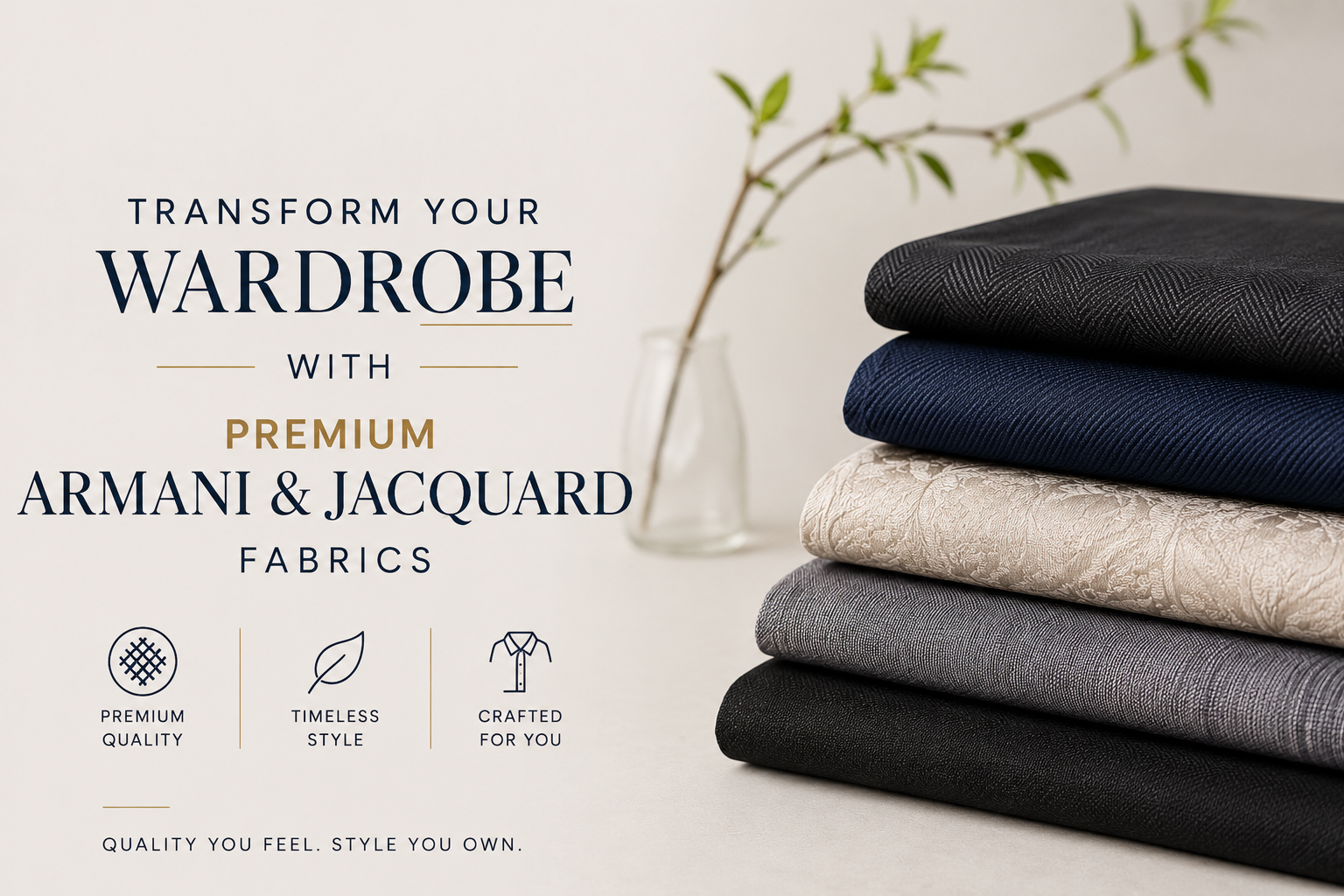
Transform Your Wardrobe with Premium Armani & Jacquard Fabrics
Two fabrics. Same five questions. Every wedding season for twelve years now.
Armani silk and jacquard. People walk in. Ask for them by name. Almost never know what they're actually buying. Both look expensive on the bolt. Both feel like they belong at a wedding. Then the tailor cuts the cloth and something is off. The armani silk you picked for a structured kurta isn't doing what you thought it would. Or the jacquard you bought for a flowy reception gown is just... sitting there. Like a curtain.
Which fine. Sometimes it actually is a curtain. We sell the same bolts to interior designers too. Whole separate thing. Not getting into it here.
Anyway. I work at our shop in Lajpat Nagar. Twelve years roughly. Give or take. You pick things up after a while. Which fabric survives a sangeet. Which one looks great in photos but feels miserable by hour three of a reception. Which ones the karigars complain about when they see them land on the cutting table. So this isn't a glossary post. It's what I'd actually tell you at the counter if you walked in tomorrow asking which one to pick for your sister's wedding.
If you're shopping for the 2026 season. Or even next month's family thing. Knowing where each one fits will save you money. Also the tailor's bad mood. Which honestly might be worth more than the money saved.
So what is armani silk really
The name has nothing to do with Giorgio Armani. Nothing at all. I get asked this every single week. People still don't believe me when I tell them.
What happened is this. Sometime in the early 2000s. 2002. 2003. Around there based on what older traders remember. A satin finish viscose blend started showing up on the Surat Delhi trade route. Somebody thought it looked like the inner lining of an Italian suit jacket. The name armani silk got slapped on. Twenty odd years later we're still calling it that. Can't undo a name once a market accepts it. We just sell it.
What it actually is. Viscose blended with polyester. Sometimes a small percentage of real silk thrown in too. Usually to justify a higher price tag at the retail end. Weave is satin. That's where the shine comes from. Most mills make it between 90 to 130 GSM. Which is a weight range that works for our weather. Doesn't stick to you in summer. Doesn't feel like cardboard in winter either.
The thing that sells it is the drape. Honestly. That's the whole pitch. Take a piece. Hold it up by one corner. Let it hang. Falls in a perfectly straight line down. No flutter. No bunching at the hem. Every other floor length anarkali at your cousin's wedding last year was probably made from this. Probably more than half of them.
Where it actually works
-
Floor length anarkalis. Main job
-
Reception gowns. Fitted bodice on top kind of cut
-
Sharara bottoms. Gharara bottoms. You want the flare to actually swing when you walk. This does that
-
Men's kurtas with light embellishment. Sits flat across the chest. Doesn't bunch at the shoulder
Jacquard is not really a fabric
This is the part that throws people off the most.
Jacquard is a method of weaving. Not a fabric. The pattern you see is woven straight into the cloth on a special loom. Named after the guy who invented the loom. Joseph Marie Jacquard. French. Early 1800s. (I only know this because a customer once corrected my pronunciation. Was very smug about it. Had to look it up afterwards. Embarrassing.)
So when you're holding a jacquard. The floral or geometric design you're looking at isn't printed on. Not embroidered on either. It's the cloth itself. Run your fingernail across it. You'll feel the raised pattern. That's the giveaway. Cheap copies trying to fake jacquard don't have that texture. They feel flat. Lifeless.
Because it's woven that way jacquard is heavier than it looks. It holds its own shape. Here's a quality check most people don't know about. Flip the piece over. A good jacquard looks more or less the same on the back. Just colours kind of flipped. A bad jacquard looks like a mess on the back. Floats everywhere. Loose threads visible. Always check the back. Always. People only check the front. Mistake.
Jacquard is what gets us through festive season at the shop. Karva Chauth. Navratri. Diwali. Eid. Boutique owners come in. Buy by the bolt for ready to wear sets. The actual reason (they'll admit this if you ask them directly) is that jacquard photographs well even when the studio lighting is mediocre. Which most boutique studio lighting genuinely is. Matters more for online sales than people realise.
Weight varies a lot. Cotton jacquards around 150 GSM. Fine for summer kurtis. Brocade style jacquards can go up to 400 GSM. Strictly winter and wedding. The pattern itself is basically indestructible. You can dry clean it. Stitch heavy zari on top. Iron it slightly too hot. It'll probably forgive you (don't push your luck though).
Where jacquard wins
-
Kurta sets. The woven pattern does the visual work. No extra embroidery needed
-
Lehenga blouses. Especially the ready to wear kind boutiques sell off the rack
-
Mother of the bride suits. When you want rich without shouty
-
Bandhgalas. Nehru jackets. Sherwani panels for grooms
-
Curtains. Cushion covers. Said this earlier. Still true. Sorry to break the romance
So which one do you actually buy
Simple version. Want movement. Buy armani silk. Want structure. Buy jacquard. That answers about 80% of the questions I get at the counter.
Detail version follows.
Armani silk flows. Jacquard sits. Your tailor will use a different needle for each. Armani silk needs a size 9 or 11 needle because the satin slips around. A thicker needle leaves tiny visible holes along the seam line. Permanent ones. Jacquard takes a standard 14 without any issue. Most tailors won't bother changing the needle between fabrics. A good one will. Worth checking before they start cutting.
Almost every armani silk outfit needs lining underneath it. The satin is faintly see through under camera flash. At every wedding now you've got what. Thirty phones pointed at you at any given moment. So plan for lining. Jacquard doesn't need lining. The base weave is thick enough on its own.
Both prefer dry cleaning. A light cotton jacquard might survive a gentle hand wash if the dye is good. You'll know within ten seconds whether the dye is good. Bad dye turns the water colourful immediately. Do not try this with armani silk. Do not. I've had three customers this year alone come back with water mark disasters because they "just rinsed it quickly". Three. This year alone. Stopped being surprised at this point.
Embroidery handling. Jacquard takes heavy zari and sequins much better than armani silk does. The thicker base doesn't pucker around thread tension. Armani silk puckers easily if your karigar isn't being careful. Once it's puckered the only fix is to unpick everything. Start over. Which costs more than the fabric did in the first place.
Three outfits boutiques are selling right now
The reception one
Wine coloured armani silk gown. Floor length. Fitted bodice. Flared from the waist. Pair it with a jacquard dupatta in the same wine. Or one shade darker if you can find it. That contrast between the soft drape on the body and the structured drape over the shoulder is doing the styling work for you. Keep jewellery minimal. One earring style. Maybe a small bangle stack. Don't crowd the look.
The festive family thing
Mustard jacquard kurta pyjama for the husband. Same mustard jacquard cut as a short kurti for the wife. Daughter in an armani silk anarkali in a contrast colour. Teal works. Maroon works. Bottle green works too. Coordinated but not matching. Which is what families actually want for festive photos these days. Boutique owners in Karol Bagh restock this exact combination twice in October. Sometimes three times. I've seen it happen.
The sangeet sharara
Powder blue armani silk sharara on the bottom. Get 4 metres minimum or the flare won't be wide enough to actually swing. Heavily embroidered jacquard short kurti on top. The sharara moves when you dance. The kurti holds the embroidery weight without sagging at the waist. Your blouse won't ride up during a thumka. Genuinely the most practical sangeet combination I've recommended. People keep coming back for it.
What the tailors want you to know
Called three tailors I work with regularly before writing this section. Here's the boiled down version of what they all said.
Don't pre wash. Either fabric. Both shrink. Neither shrinks predictably. You'll end up with sizing weirdness at the trial. If you really want to clean the fabric before stitching send it for dry cleaning. Otherwise just take it straight to the tailor. Don't be clever about it at home.
Buy extra fabric. Always. Armani silk frays badly at the cut edge. You'll lose roughly 200 grams just dealing with the fraying during stitching. Jacquard with a raised pattern needs pattern matching at the seams. Like wallpaper basically. That eats another 300 grams. Especially on blouses or kurtis where the front and back panels need to line up properly. People who skimp on the buffer always end up making a second trip to the shop. Irritated. Asking for the same fabric in the same dye lot. Which by then we sometimes don't have anymore.
Use fusible interfacing on jacquard collars. Also cuffs. Non negotiable. Without it the collar goes floppy after two wears. The whole kurta starts looking secondhand. Interfacing costs about 80 rupees a metre. Get it. Don't argue with your tailor on this one.
Grain direction matters most on armani silk. If the karigar cuts against the grain the garment will start twisting on your body within three or four wears. The front seam ends up sitting at your hip. I've personally seen a ₹40,000 anarkali ruined this exact way. The customer thought it was a manufacturing defect. It wasn't. It was just cut wrong. Always ask the tailor to confirm grain direction before they make the first cut.
How much fabric do you actually need
-
Floor length flared anarkali. 3.5 metres armani silk plus 2 metres lining
-
Sharara set. 4 metres armani silk for the sharara. 1.5 metres jacquard for the kurti. 2.5 metres net for the dupatta
-
Men's kurta pyjama. 2.5 metres jacquard for the kurta. 1.5 metres for the pyjama
-
Lehenga blouse. Under a metre of jacquard. People always overbuy here. Don't
If you want exact numbers based on your size and the design our fabric estimator tool does the math. Easier than guessing.
Stuff people keep asking me at the counter
The questions below come up so often I could probably set a timer by them. Easier to just answer them all here.
People constantly want to know whether armani silk is real silk. It's not. It's a viscose polyester blend mostly. Sometimes there's a small bit of real silk woven in for the premium versions but not always. Pure silk is a completely different fabric altogether. Heavier. More delicate. Much more expensive. If you want pure silk just ask for pure silk by name. Don't assume armani silk gives you that. It doesn't.
The summer jacquard question comes up a lot too especially around April. Short answer. Light cotton jacquards in the 150 to 180 GSM range are fine for summer. Anything above 300 GSM is wedding and winter only. You'll figure out which side you bought within ten minutes of stepping outside in May. Indian summers don't forgive heavy fabric.
Brides keep asking which is better for the actual lehenga skirt. Armani silk or jacquard. Honestly. Neither one really. Most proper bridal lehengas use raw silk or tissue paired with embroidered net or organza for the visual layers. Jacquard makes a gorgeous bridal blouse though. And armani silk works nicely as a lining inside the skirt to add fall without adding weight. For the actual skirt fabric our bridal fabric collection is where the real bridal options live. The ones I'd actually recommend.
Then there's the fading question. Does jacquard fade with washing. A properly dyed jacquard from a decent mill holds colour for years. Provided you stick to dry cleaning. Cheap jacquard from random suppliers bleeds colour in the first wash. Always ask for a colourfastness swatch test before any bulk order. Costs the seller nothing. Protects you completely from a disaster.
And the last one. How to tell real armani silk from cheap copies. Hold a fold up to natural light. Daylight specifically. Not shop light. Real armani silk shows a soft even sheen across the whole piece. Fake stuff looks slightly plastic. Especially in the brighter colours. Sometimes you can even see uneven weave lines on the fake versions if you look closely. Then rub it between your fingers. Real armani silk feels cool. Slips a little. Fake stuff feels warm. Sticky almost. Once you've felt the real thing once you genuinely cannot be fooled again. That's the only test that really works.