From Design to Delivery: How Paras Gallery Fabrics Streamlines the Wholesale Fabric Process
Most boutique owners we work with have never actually seen what happens between clicking "place order" and the courier arriving at their shop. Whole lot happens. Most of it invisible.
The wholesale fabric supply chain in India is messy. Opinionated. Full of small decisions that decide whether your fabric arrives in five days or five weeks. Most of those decisions get made by people you'll never meet. A quality inspector at a Surat mill. A dispatch guy in our Delhi warehouse. A courier supervisor who decides which truck your shipment goes on.
This article walks you through the seven step process we follow for every wholesale order. Not to look impressive. To help you understand what to expect. What questions to ask any supplier you work with. Why some shipments arrive smooth while others turn into a three week nightmare.
If you've been burned by a wholesale supplier before this is the kind of transparency you should be demanding. From every fabric partner. Not just us.
Step 1. Design discovery. Catalogue sharing.
Most wholesale relationships start with a conversation. A boutique owner messages us. "Planning a sangeet collection for August 2026. What's trending right now." We send back a curated catalogue. Not the full 4000 SKU dump that most portals will hit you with.
Curation is the actual value here. Our team looks at the boutique's existing style. Usually means scrolling through their Instagram. Checking what their bestsellers look like. Then we share 30 to 40 fabric options that genuinely fit their aesthetic. Not the entire stock list.
This saves the boutique owner roughly three hours of catalogue scrolling. Also helps us understand their price point. Their aesthetic. The kind of customer walking into their store. Most of these early conversations happen on WhatsApp or video call. Not formal email forms. People don't talk through forms anymore. They talk through chat.
Step 2. Swatch dispatch. Physical verification.
Nobody should commit to a wholesale order based on a phone photo. Phone cameras lie about colour. Studio lighting lies about texture. There's no substitute for actually feeling the fabric in your hand.
Once the catalogue is narrowed to 8 to 10 options we ship free swatches. The boutique owner gets to feel the fall. Check embroidery density. Test the colour under their boutique lighting. Even take a swatch to their tailor for a stitch test.
Most online fabric sellers skip this step entirely. Or charge for swatches like they're doing you a favour. We treat it as the cost of doing real wholesale. A boutique that doesn't physically check fabric before ordering will always be unhappy with the bulk shipment. Always. That unhappiness hurts the long term relationship more than the cost of shipping a few free swatches ever would.
Step 3. Quotation. MOQ discussion. Customisation locks.
After the swatch round we share a final quotation. It includes everything below.
-
Per metre price with quantity slabs (10 to 50m. 50 to 100m. 100m plus)
-
GST breakdown shown clearly. No hidden tax shocks at delivery
-
Shipping estimate based on delivery pincode
-
Customisation cost if any (custom dyeing. embroidery placement. anything else)
-
Delivery timeline. Realistic not optimistic
If the boutique wants colour customisation on dyeable embroidery we lock the dye lot at this stage. Custom dyeing adds 7 to 10 days to the timeline. But it ensures every metre delivered matches the same colour reference. Critical when you're stitching a 50 piece bridal collection where dye lot mismatches between pieces would be visible in photos.
Step 4. Production or stock pull.
Some orders ship from our Delhi warehouse stock. Others need fresh production from partner mills in Surat or Bareilly. Which path the order takes depends on volume. Also depends on customisation requests.
Stock orders ship within 48 to 72 hours of confirmation. Production orders take longer. 10 to 14 days for embroidery work. 5 to 7 days for plain dyeable fabrics. We share these timelines upfront before payment. No nasty surprises three weeks in.
During production our Surat based quality team physically visits the embroidery unit. Inspects work in progress. Sends WhatsApp updates back to our Delhi dispatch desk with photos. Sometimes video. If any roll doesn't meet our quality bar it gets rejected right at the mill. Not after it reaches our warehouse. Not after it reaches the customer. At the mill. Saves everyone time.
Step 5. Quality inspection. Delhi warehouse.
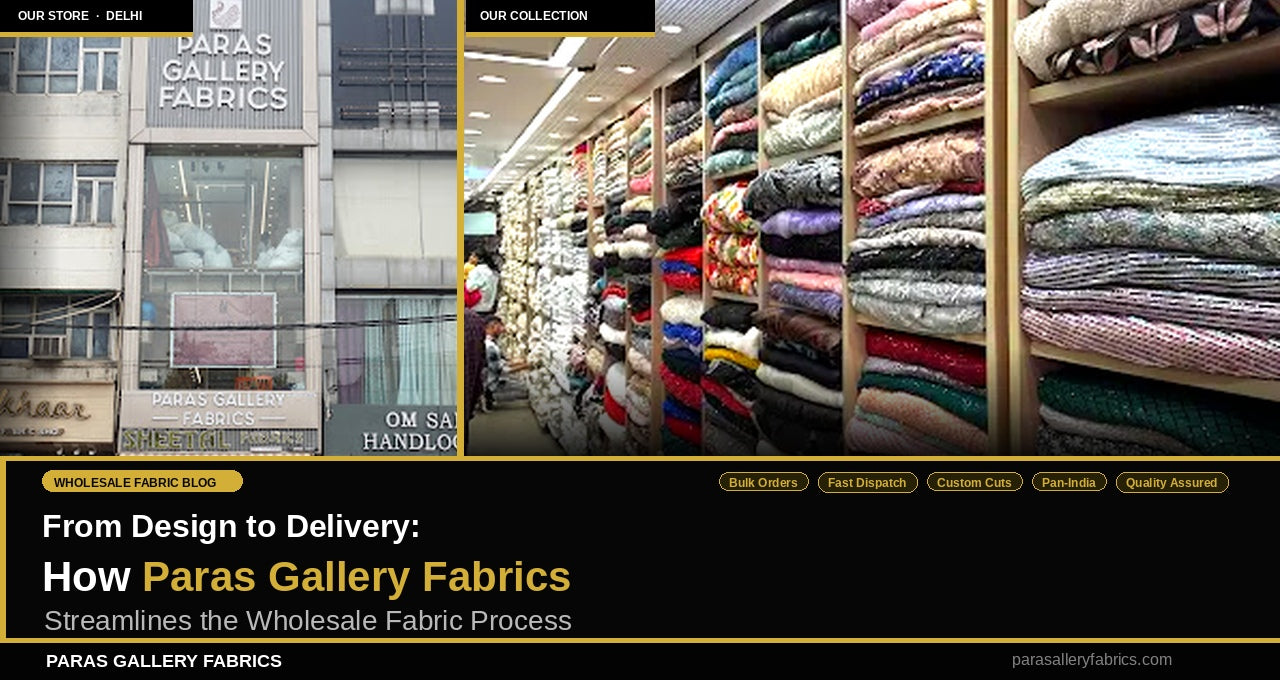
Every roll arriving at our Lajpat Nagar warehouse gets unrolled. Checked for embroidery consistency. Colour matching across the dye lot. Fabric width uniformity. Surface defects. The inspection takes 20 to 30 minutes per roll for embroidered fabrics. Faster for plain bases.
Anything that fails gets pulled out. A thread skip. A colour patch. A width variation beyond 2 inches. Pulled. Either replaced from another roll in the same dye lot. Or refunded to the customer if no replacement is available. This single step is the entire reason boutiques don't get unpleasant surprises when they unbox.
We've rejected ₹4 lakh shipments before because a 200 metre dye lot had inconsistent colour across the run. Mill wasn't happy. Customer would have been much less happy receiving it. Easy decision.
Step 6. Packing. Pre dispatch video verification.
Before sealing the box we shoot a short WhatsApp video of the actual rolls being packed. Customers receive this video the same day. They can see their fabric. The embroidery. The metre count visible on the cut edge. The packaging quality.
Sounds like a small thing. It's actually the single biggest trust builder in wholesale fabric. Boutique owners who've been promised one thing then received something completely different know exactly how much this matters. The video is the receipt no Excel sheet can match.
Rolls get wrapped in protective LDPE sheets. Placed in corrugated boxes with shock absorbing fillers around them. For bulk orders above 100 metres we use double walled crates with insurance documentation included.
Step 7. Tracked dispatch. Post delivery follow up.
Dispatch happens through DTDC. Bluedart. Delhivery. Whichever courier has the best track record for the destination pincode at that time. Mumbai shipments usually go Bluedart. Bengaluru goes Delhivery. Smaller towns sometimes have to be DTDC because the others won't deliver there reliably.
Every shipment gets a tracked AWB number shared on WhatsApp. Live updates till delivery. When the courier hands the package over we know within minutes.
Once the boutique confirms receipt we follow up 72 hours later. Has the fabric been inspected? Any issues. Any feedback for the next order. This isn't a CRM automated "thank you for your purchase" message. It's a human check in from someone on our team who actually knows the order. Roughly 30% of our wholesale customers respond with thoughts that end up shaping our next inventory cycle.
Why this process matters for your boutique
Every step above exists because we have. At some point in the last decade. Been on the receiving end of a wholesale order that went badly wrong.
The catalogue dump that wasted four hours. The swatch that looked nothing like the bulk delivery. The "shipped" status update with no actual tracking number behind it. The wrong colour arriving three weeks late. The roll that turned out to have a 30 metre stretch of defective embroidery hidden in the middle. The supplier who stopped replying after the payment cleared.
We've seen all of it. From the buyer side. That's why we built the process this way.
Streamlining the wholesale fabric process isn't really about being fast. It's about being predictable. A boutique owner planning a 200 piece bridal collection needs to know exactly when the fabric arrives. What condition it'll be in. What happens if something goes wrong. Predictability is the single most underrated thing in Indian wholesale fabric trade. Most suppliers don't build for it because it costs more in operational discipline. We chose to build it in anyway. Long term it pays for itself through repeat orders.